

Executive Summary: A Democratic “blue wave” – control of both the House and Senate after the 3 November 2026 US midterms through the 2028 presidential election – would be a major political setback for President Trump but would not immediately end his policy programme, shifting the final two years from legislative execution toward executive action, litigation and political defense. Prediction markets point to a coinflip chance of this happening. For emerging markets, the theme matters less through US domestic politics than through three dominant external channels that drive EM returns: the US dollar, US real yields and the Treasury curve, and trade/tariff policy. The central thesis remains selective rather than outright negative, but the balance of risks is less supportive than current market pricing may imply. Constrained tariffs, lower front-end and intermediate US yields and a softer medium-term dollar could support EM local-currency debt, hard-currency sovereigns and trade-geared economies, provided US growth slows gently rather than abruptly. However, persistent political uncertainty, episodic risk-off shocks and a structurally elevated term premium are likely to cap upside and create a more volatile backdrop than in earlier easing cycles. The offset is that episodic risk-off from oversight, shutdown or constitutional-crisis headlines still triggers sharp, correlated EM drawdowns and spread widening, making this a high-dispersion credit landscape best expressed with quality and liquidity discipline.
Market Visualizer
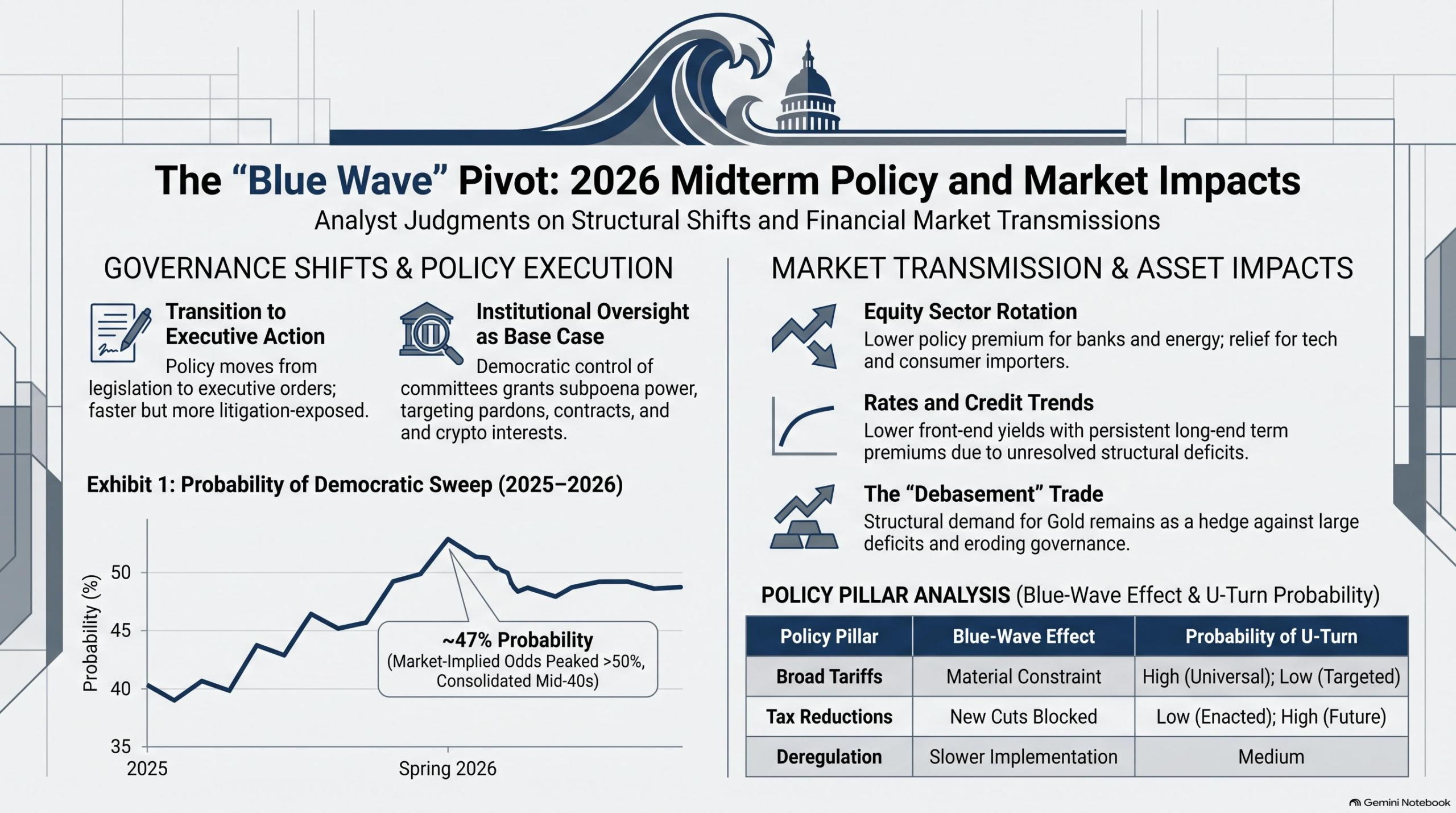
A DEMOCRATIC BLUE WAVE: THE EM CREDIT READ-THROUGH
The Regime Shift: From Policy Execution to Policy Defense
- Loss of the legislative machine: A full sweep hands Democrats committees, subpoenas, the legislative calendar, appropriations, agency oversight, Senate confirmations and the power to initiate impeachment – but not a veto-proof majority or the executive, so Trump remains president until January 2029 absent resignation, removal or incapacity. The mechanism is a pivot from durable legislation to reversible executive action, lowering the capitalised value of policy even when announced forcefully and increasing uncertainty around policy durability, investment decisions and corporate risk-taking.
- Executive action is fast but fragile: Orders and existing statutory authorities can be deployed quickly, but they are litigation-exposed and reversible; the February 2026 Supreme Court ruling that IEEPA does not authorize tariffs already forces reliance on the narrower, more procedural Sections 232 and 301, which require investigations and defined rationales.
- Durability discount: The new equilibrium is divided government with unusually intense institutional conflict – narrower, more legally contested and less durable policymaking – raising execution risk and the probability of selective U-turns, particularly where policies are economically costly, legally vulnerable or funding-dependent.
- Credit implication: A transition away from reflation and deregulation may support parts of investment-grade credit through lower rates, although any benefit could be moderated by slower growth, weaker confidence and elevated policy uncertainty, but more challenging for leveraged borrowers, private credit and policy-sensitive sectors, where lower policy durability and higher litigation risk widen risk premia.
Policy Pillars Under Constraint
- Tariffs – highest U-turn probability: With IEEPA rejected and reliance shifted to Sections 232/301, a Democratic Congress can hold cost-of-tariff hearings, restrict implementation appropriations and probe exemptions, raising the odds of a tactical U-turn from universal to targeted tariffs, quotas or bilateral deals. This lowers the probability of an unconstrained tariff-inflation shock, offering relative relief for retailers, consumer-goods importers, tech-hardware supply chains, import-dependent industrials, selected Asian and LatAm exporters, long-duration equities and intermediate Treasuries, although sector-specific disruption, policy reversals and trade uncertainty remain material risks.
- Tax – momentum freeze, not reversal: New broad-based cuts become highly unlikely and expiring provisions may lapse, but repeal over a veto needs two-thirds majorities (implausible), so the result is a freeze. Markets look to 2028, pricing higher corporate and high-income taxation, stronger minimum taxes, tighter carried-interest treatment and greater digital-asset taxation – a multiple-compression risk for banks, PE managers and domestically tax-sensitive names.
- Deregulation and immigration – slower, funding-constrained: Enforcement discretion continues, but Senate delay of nominees and committee oversight slow rulemaking and lower confidence that deregulation survives beyond 2028 (most exposed: banks/regional lenders, private credit/PE, fossil-fuel producers, tech platforms, contractors, crypto issuers, healthcare/pharma). Immigration authority survives, but appropriations can restrict detention capacity; quiet operational moderation is disinflationary for services and mildly supportive of potential growth.
- Fiscal – less expansion, more confrontation: The starting point is weak – CBO’s February 2026 baseline projected a $1.9tn FY2026 deficit (5.8% of GDP), with public debt rising from 101% of GDP in 2026 to 120% in 2036, and later tracking closer to $2.1tn. A sweep curbs unfunded stimulus but raises shutdown, delayed-appropriations and debt-ceiling risk, keeping a structural bid under the long-end term premium and real-asset hedges while increasing the potential for periodic volatility linked to fiscal confrontation and budget negotiations.
Policy Execution Matrix
| Trump policy pillar | Blue-wave effect | Probability of U-turn | Primary market transmission |
|---|---|---|---|
| Broad tariffs | Material constraint | High for universal tariffs; lower for targeted tariffs | Lower goods inflation; weaker USD; relief for importers |
| Tax reductions | New cuts blocked | Low for enacted measures; high for future proposals | Less earnings upside; modestly lower deficits |
| Deregulation | Slower but not fully reversed | Medium | Pressure on banks, energy and private capital |
| Immigration restrictions | Continues through executive authority, but funding constrained | Medium | Labor supply, wages and services inflation |
| Fiscal expansion | New initiatives constrained; shutdown risk rises | Medium | Lower near-term growth, persistent term premium |
| Energy dominance | Legislative expansion blocked; permits and enforcement continue | Low-to-medium | Higher policy risk for oil and gas |
| Foreign policy and sanctions | Executive retains substantial authority | Low | Continued geopolitical and commodity volatility |
| Crypto liberalization | Greater oversight and legislative resistance | Medium-to-high | Negative for speculative tokens and crypto intermediaries |
Oversight, Impeachment Risk and the Response Function
- Oversight is the base case: A Democratic House gains subpoena, hearing and investigation powers reportedly targeting self-dealing, foreign influence, contracts, pardons and crypto interests – impairing governing capacity even without impeachment by consuming bandwidth, deterring counterparties and prompting resignations. Markets respond to impairment of execution, not merely legal entitlement to office, particularly when prolonged investigations create uncertainty around fiscal negotiations, regulatory implementation and policy continuity.
- The arithmetic of removal: Impeachment needs only a simple House majority (moderate probability), but conviction requires two-thirds of the Senate (low). The probability ladder below ranks extensive investigations “very high,” a Judiciary inquiry “moderate-to-high,” and conviction/removal and resignation “low”/”very low” – so policy paralysis without removal (“high”) is the most market-relevant outcome.
- Trump’s three response paths: Confrontation (resist subpoenas, litigate, weaponise shutdown fights) is most disruptive – higher volatility, demand for cash/USD/Treasuries, wider spreads, stronger gold, mixed Bitcoin. Selective accommodation (negotiate budgets, infrastructure, industrial policy) is most market-friendly. A tactical U-turn recalibrates the costliest, legally weakest policies, presented as success rather than reversal.
- Asymmetry for credit: The higher the congressional and judicial constraint, the greater the odds Trump substitutes symbolic confrontation for economically costly implementation – a channel through which risk assets can rally even as rhetoric hardens, while evidence peeling away Republican senators or forcing senior resignations is the true tail-risk trigger for spread widening.
Probability Ladder
| Event | Qualitative probability after blue wave | Assessment |
|---|---|---|
| Extensive investigations | Very high | Central Democratic strategy |
| Judiciary Committee inquiry | Moderate-to-high | Depends on evidence and leadership strategy |
| House impeachment | Moderate | Simple majority is sufficient |
| Senate trial | High if House impeaches | Follows transmission of articles, subject to procedure |
| Senate conviction and removal | Low | Requires substantial Republican support |
| Trump resignation | Very low | Would require severe legal or political isolation |
| Policy paralysis without removal | High | Most plausible market-relevant outcome |
Rates, the Dollar and the Debasement Regime
- Cyclical inflation trade weakens: As of the July 2026 Monetary Policy Report, headline PCE reached 4.1% y/y in May and core PCE 3.4%, with tariffs and the Middle East energy shock adding pressure and minutes flagging possible further tightening. A sweep that constrains additional tariffs and tax cuts lowers medium-term inflation expectations and creates room for eventual easing if growth weakens, although markets may increasingly interpret future rate cuts as a response to deteriorating growth conditions rather than a clean inflation victory.
- Structural debasement trade persists: With mandatory spending and interest costs driving the deficit regardless of party, there is no decisive end to the US debasement narrative, keeping a structural bid under the long-end term premium; the net is lower 2-10y yields with a re-steepening long end.
- Curve and credit positioning: Favor lower 2y/5y/10y yields and eventual 10s30s steepening – preferring 5-10y duration over an outright 30y long. IG should remain relatively resilient as rates decline, although lower yields alone may not prevent wider risk premia if growth disappoints or fiscal confrontations intensify; HY is mixed, with a preferred order of intermediate IG, strong BB, defensive EM duration, select bank senior, then loans/private credit only with strong coverage.
- FX and real assets: The USD firms briefly on risk aversion then weakens as gridlock slows growth and eases policy; gold remains the cleanest debasement hedge, Bitcoin sees an initial regulatory sell-off then recovery if debasement persists, while altcoins/DeFi are most vulnerable to tighter enforcement.
Emerging Markets: Transmission, Winners and Losers
-
- The dollar is the dominant signal: An initial safe-haven bid could briefly tighten EM financial conditions, but the more durable move – a softer dollar on slower US growth, constrained tariffs and eventual Fed easing – has historically been supportive for EM, easing financial conditions, supporting local FX and lowering hard-currency debt-service burdens, although the benefit could prove smaller than in prior cycles if dollar weakness is driven primarily by slowing US growth rather than improving global risk appetite.
- Real yields and the curve: Lower 2-10y US yields and reduced breakevens compress the risk-free component of EM hard-currency spreads and improve refinancing math for well-run sovereigns and quasi-sovereigns, though tighter financial conditions and weaker growth could still offset part of that benefit; the caveat is a persistent long-end term premium that caps how far EM long duration can rally and leaves EM exposed to any disorderly 30-year Treasury sell-off.
- Trade and tariffs: A shift from universal to targeted, negotiated measures reduces the tariff-inflation shock and creates clearer bilateral frameworks that offer relative support to open, export-geared EMs and manufacturing supply-chain hubs, although softer global demand may limit those gains; commodity exporters remain exposed to a growth setback, while importers benefit only if tariff-driven price pressure fades.
The Three Transmission Channels
| Channel | Blue-wave effect | EM transmission |
|---|---|---|
| US dollar | Brief risk-off strength, then medium-term softening on slower growth and eventual Fed easing | A weaker USD eases EM financial conditions, supports local FX, lowers hard-currency debt-service burdens and typically drives EM inflows |
| US real yields & curve | Lower 2-10y yields and reduced breakevens; long-end term premium persists | Lower front-end/belly yields improve EM carry and duration; a steep long end keeps the tail risk of a disorderly UST sell-off spilling into EM |
| Tariffs & trade | Universal tariffs constrained; shift to targeted, negotiated measures | Reduced tariff-inflation shock and clearer bilateral frameworks benefit open, export-geared EMs and manufacturing supply-chain hubs |
| Commodities | Continued geopolitical/sanctions volatility; energy price risk two-sided | Commodity exporters gain on firm energy/metals; importers benefit if tariff-driven price pressure fades |
| Risk sentiment | Higher US political-headline volatility (oversight, shutdown, crisis tail) | Episodic correlated risk-off, spread widening and outflows – a discipline constraint, not a reason to be structurally short EM |
EM Winners and Losers
| EM segment | Bias | Rationale |
|---|---|---|
| Trade-geared Asian & LatAm exporters | Winner | Tariff de-escalation and clearer bilateral frameworks; supply-chain relocation beneficiaries |
| High-real-yield local-currency markets (credible central banks) | Winner | Softer USD and US disinflation create room to ease; attractive carry with FX tailwind |
| IG & strong-BB EM sovereigns / quasi-sovereigns | Winner | Lower front-end/belly US yields compress spreads and ease refinancing |
| Commodity exporters (energy & metals) | Mixed | Gain from firm commodity prices and geopolitics; exposed if global growth slows sharply |
| Weak-external-balance, high-refinancing-need frontier credits | Loser | Most exposed to risk-off episodes, wider spreads and a disorderly long-end UST sell-off |
| Heavily commodity-import-dependent economies | Loser | Vulnerable if energy/food prices stay high; thinner buffers against external shocks |
Scenario Analysis
| Scenario | Probability bias | Trump execution capacity | Market regime |
|---|---|---|---|
| Democratic House; Republican Senate | Most plausible | Legislation blocked; executive action remains strong; investigations intensify | Gridlock, moderate volatility, duration-positive |
| Full blue wave; no impeachment | Meaningful alternative | Confirmations and legislation constrained; heavy oversight | Lower yields and a softer USD, though accompanied by weaker growth expectations and elevated political uncertainty |
| Blue wave plus House impeachment | Tail but credible | Severe political distraction; executive actions continue | Risk-off initially; gold and Treasuries outperform |
| Impeachment plus credible Senate conviction risk | Low-probability tail | Administration potentially paralyzed | Sharp volatility, credit widening, USD path ambiguous |
| Blue wave prompts Trump moderation | Underpriced upside | More negotiated and targeted policy | Bullish equities and credit; bearish inflation premium |
| Confrontation and constitutional crisis | Low-frequency, high-impact | Execution shifts to courts and emergency authority | Gold up, risk assets down, long-end Treasury volatility |
Credit / Investment Implications
The blue-wave shock works by substituting durable legislation for reversible executive action under intensifying oversight, lowering the policy premium while leaving the structural fiscal-debasement problem unresolved. The impact is asymmetric: cyclical inflation and tariff risk fall (bullish the front end, IG and EM carry), but the long-end term premium is sticky and headline-driven risk-off can widen spreads regardless of fundamentals – so weak frontier and leveraged credit are the most exposed segments, making this a selective rather than outright constructive backdrop for EM. Opportunities remain in higher-quality credits and stronger sovereign balance sheets, but discipline, liquidity management and issuer selection are likely to matter more than broad beta exposure.
www.gembridgecapital.com
DISCLAIMER
This document is strictly confidential and is being provided to you for informational purposes only. It does not constitute an offer to sell or a solicitation of an offer to buy any securities or financial instruments. The information contained herein has been obtained from sources believed to be reliable but is not guaranteed as to accuracy or completeness. Opinions and estimates constitute our judgment as of the date of this material and are subject to change without notice.
AI Generation Notice: Portions of this content may have been generated or assisted by Artificial Intelligence (AI) technologies. Users should independently verify critical data points. Past performance is not indicative of future results.
Executive Summary: NOAA – the National Oceanic and Atmospheric Administration, a U.S. scientific agency that studies and predicts changes in weather, climate, oceans, and coasts while managing marine and coastal resources – has officially declared El Niño with a 63% probability of a Super El Niño, marking one of the fastest regime shifts on record and setting up a highly nonlinear global macro shock into 2H 2026 and early 2027. The event interacts with already tight commodity markets and ongoing geopolitical disruptions, amplifying transmission through food inflation, energy systems, logistics bottlenecks, and commodity supply shocks. Emerging markets face asymmetric exposure via inflation, fiscal stress, and external balances, while select sectors benefit from price spikes and benign insurance loss dynamics. The resulting environment creates a high-dispersion credit landscape with pronounced winners and losers across sovereign and corporate risk.
Market Visualizer
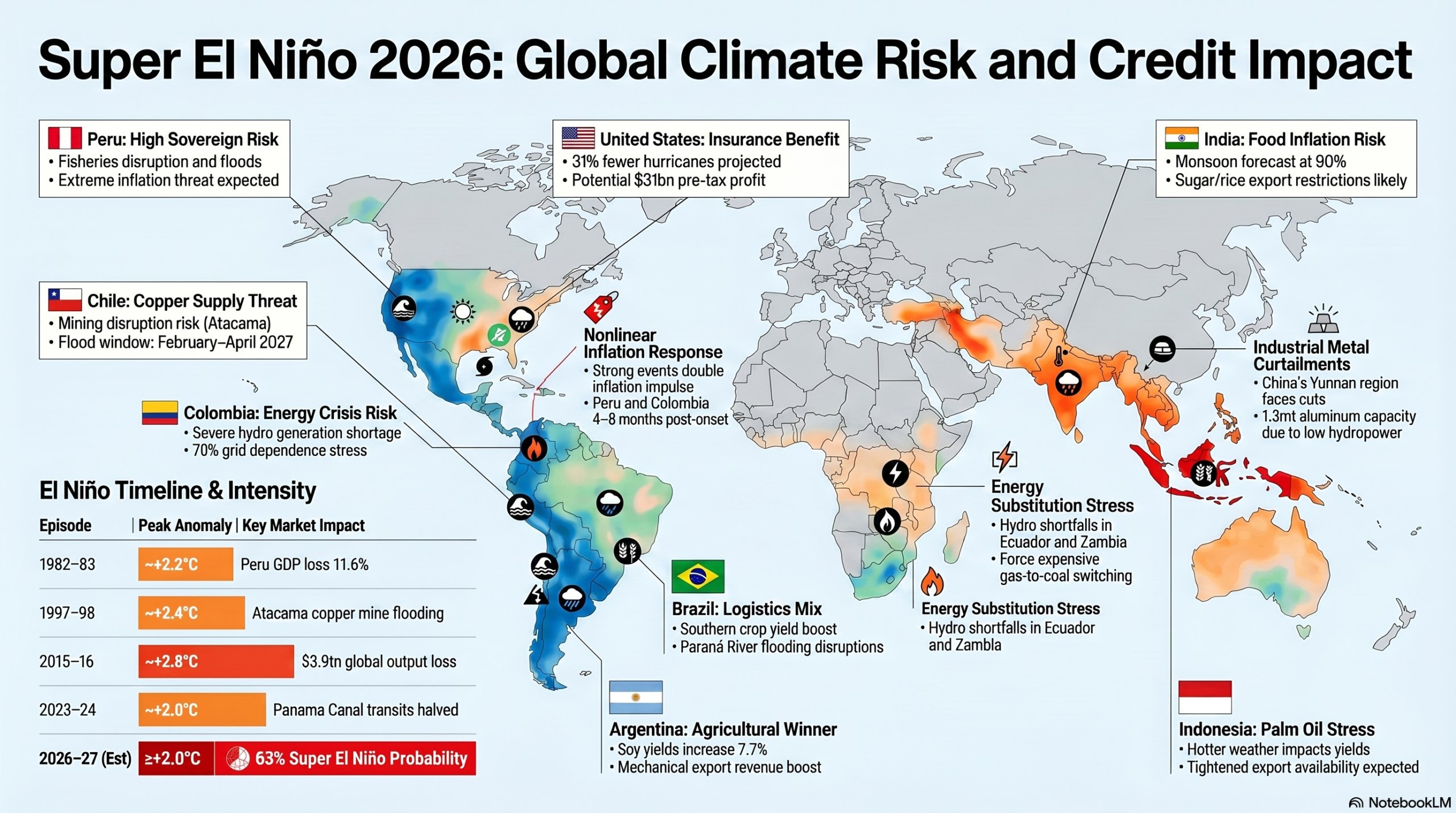
SUPER EL NIÑO: THE CLIMATE RISK TRADE
Theme Setup and Probability Skew
- Rapid regime shift: Sea surface temperatures flipped from La Niña conditions in March 2026 to El Niño by June 11, setting a record pace and signaling an aggressive thermal buildup that historically correlates with stronger downstream climate shocks.
- Super El Niño probability: NOAA assigns a 63% probability of ≥+2.0°C by NDJ 2026–27, while some sell side research forecasts a 60% probability of strong-plus events, implying elevated tail risk for severe macro and credit dislocations.
- Subsurface heat reservoir: Temperature anomalies exceeding +6°C below surface levels provide a structural driver of sustained warming, increasing persistence into 1Q 2027 and deepening economic transmission.
- Upper-tail scenario risk: Some models exceed historical intensities seen in the past 80 years, suggesting potential nonlinear impacts that surpass prior episodes such as 2015–16.
- Compounding macro backdrop: Elevated energy prices linked to Iran/Strait of Hormuz tensions increase cost-push inflation risks, reinforcing El Niño’s supply-side shock across EM economies.
Historical Precedent and Structural Differences
- Growth destruction magnitude: The 2015–16 El Niño reduced global output by an estimated $3.9tn over five years, highlighting the medium-term persistence of climate shocks beyond initial weather effects.
- Country-level losses: Peru experienced GDP losses of 6.2–11.6% during past strong events, underscoring sovereign vulnerability in directly exposed coastal economies.
- Commodity disruption track record: The 2015–16 event disrupted ~90kt of copper supply and forced ~300kt aluminium curtailments, demonstrating sensitivity in industrial metals supply chains.
- Food shock evidence: India’s monsoon decline of −13.8% in 2015–16 drove food inflation to 6.2%, illustrating transmission from weather to CPI and policy tightening risks.
- Current cycle tighter starting point: Unlike prior cycles, the 2026 copper market already faces a 300–400kt deficit, amplifying price sensitivity and credit implications from supply disruptions.
Macro Transmission Channels to Credit
- Nonlinear inflation response: Sell side models show inflation more than doubles moving from mild to strong El Niño, with peak effects lagging 4–8 months into H2 2026, creating delayed policy pressure.
- Food CPI transmission: With food comprising 10–35% of EM CPI baskets, any supply shock feeds directly into headline inflation, tightening financial conditions and pressuring sovereign credit.
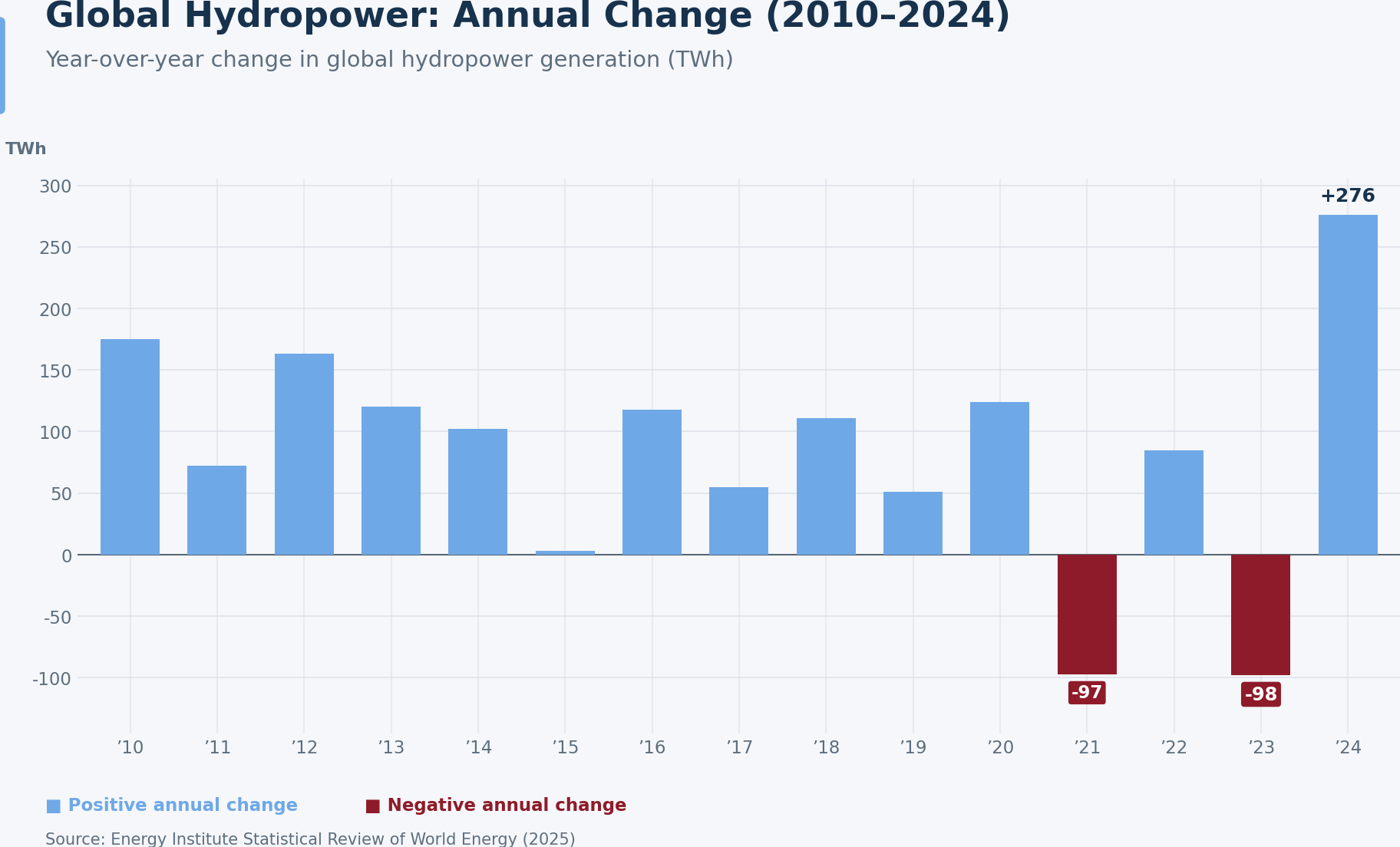
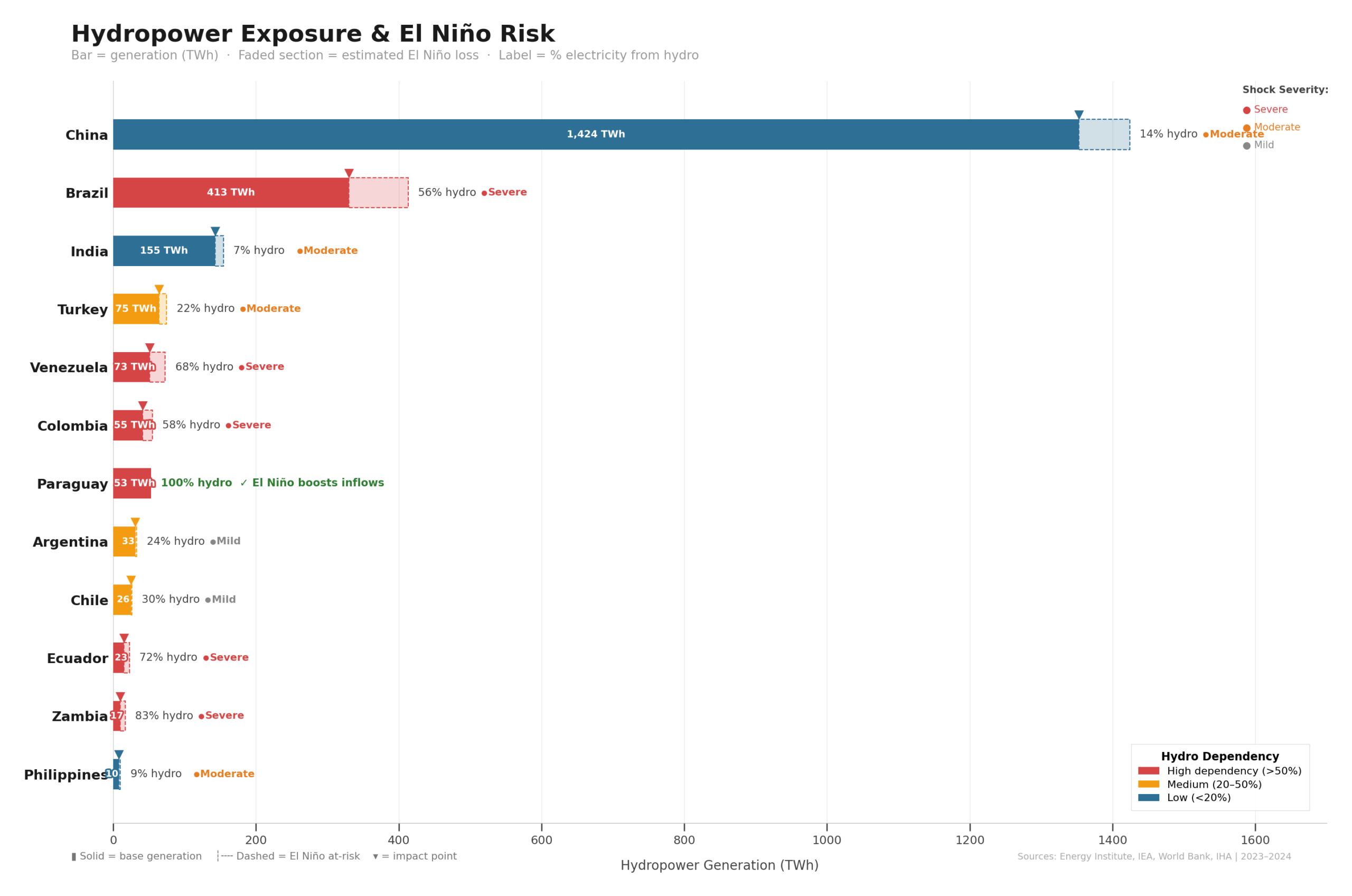
- Hydro-to-thermal switching: Drought reduces hydro output (e.g., Colombia 60–70% hydro dependence), forcing coal and LNG substitution at higher costs, weakening utility balance sheets and fiscal positions.
- Commodity price amplification: Chile’s 4.2mt copper production (17% global share) faces flood risk, where even a one-week outage (~80kt) materially tightens markets and boosts price-driven earnings volatility.
- Logistics disruption: Panama Canal throughput fell ~29% in 2024 during prior El Niño, indicating global shipping constraints that raise freight costs and delay supply chains, impacting corporate cash flows.
Sovereign Credit Differentiation
- Peru stress case: Direct ocean exposure, fisheries disruption, and historical GDP losses up to 11.6% position Peru as the highest-risk EM sovereign under a super El Niño scenario.
- India inflation risk: With an 84% probability of sub-normal monsoon, food inflation could breach the RBI’s 6% ceiling, driving fiscal slippage via INR500bn+ fertilizer subsidies.
- Colombia hydro vulnerability: Heavy reliance on hydropower combined with drought risks increases electricity prices and adds ~465bps to inflation during strong events, complicating monetary policy.
- Argentina upside skew: Soy yields improve ~+7.7% per degree of warming and maize output can rise ~6mt, supporting GDP (+0.31pp) and fiscal revenues via export taxes.
- Panama risk timing: While 2026 conditions remain strong with $5.7bn revenues, the 2027 dry season presents a key inflection point for canal revenue and sovereign balance implications.
Sectoral and Corporate Credit Impacts
- Agriculture input inflation: Cocoa prices previously exceeded $10,000/t and remain volatile, pressuring margins for processors and driving working capital expansion.
- Hydro utilities stress: EBITDA compression emerges as hydro shortfalls force thermal imports at higher marginal costs, particularly in Colombia, Ecuador, and Zambia.
- Metals upside asymmetry: Aluminium curtailments up to 1.3mt in Yunnan and 2.5mt already offline from Iran disruptions support price upside.
- Insurance earnings boost: Reduced hurricanes (−31%) and storms result in 14–20% lower global insured losses, implying $21–31bn pre-tax benefits for insurers.
- Aquaculture margin pressure: Fishmeal price spikes (~$2,500/mt) increase feed costs (40–45% of production), compressing margins for salmon producers unless offset via pricing.
Credit / Investment Implications
The Super El Niño shock is inherently nonlinear, with simultaneous supply disruptions across food, energy, and commodities amplifying inflation and compressing real incomes in EM. The asymmetric nature of exposure creates divergence, with import-dependent and hydro-reliant economies facing stress while commodity exporters and select corporates benefit. The interaction with tight commodity markets and geopolitical energy shocks increases the probability of outsized spread moves.
- Overweight commodity beneficiaries (thermal coal, aluminium, copper) where supply disruptions translate directly into EBITDA uplift of 3–17% per 10% price move.
- Underweight hydro-dependent sovereigns and utilities where drought-driven generation costs materially weaken fiscal and credit metrics.
- Position for insurance earnings upside but anticipate reinsurance pricing softening due to reduced loss environment and excess capital supply.
www.gembridgecapital.com
DISCLAIMER
This document is strictly confidential and is being provided to you for informational purposes only. It does not constitute an offer to sell or a solicitation of an offer to buy any securities or financial instruments. The information contained herein has been obtained from sources believed to be reliable but is not guaranteed as to accuracy or completeness. Opinions and estimates constitute our judgment as of the date of this material and are subject to change without notice.
AI Generation Notice: Portions of this content may have been generated or assisted by Artificial Intelligence (AI) technologies. Users should independently verify critical data points. Past performance is not indicative of future results.
Executive Summary: This week’s special focus examines the seven-decade trajectory of US-Iran relations, culminating in current tensions following Trump’s naval deployment amid Iran’s domestic protests and ongoing nuclear disputes. Understanding this historical context is critical for assessing sovereign credit risks and regional market volatility.
Market Visualizer
⚠️ Special Topic: US-Iran Tensions Timeline
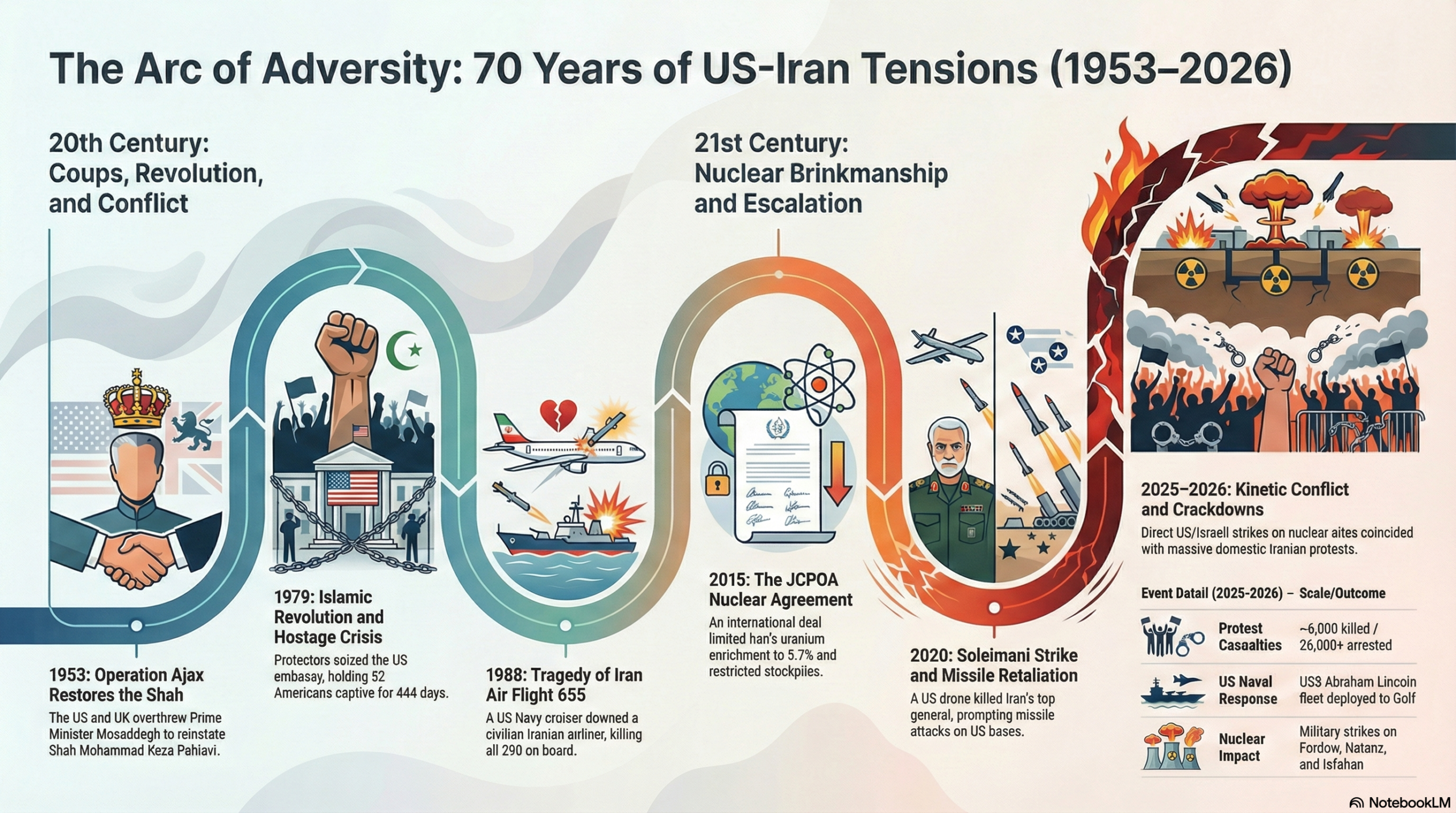
US-Iran tensions trace back over 70 years, with granular milestones from the 1953 coup to Trump’s 2026 naval deployment amid Iran’s protests and nuclear disputes.
1950s: Coup and Early Ties
- 1951: Iran’s parliament nationalizes oil from British control, led by PM Mohammad Mosaddegh.
- 1953: US/UK Operation Ajax overthrows Mosaddegh, reinstating Shah Mohammad Reza Pahlavi.
- 1957: US signs nuclear cooperation deal under “Atoms for Peace.”
1960s-1970s: Arms and Revolution Buildup
- 1968: Both nations sign Nuclear Non-Proliferation Treaty.
- 1972: Nixon pledges unlimited conventional arms to Shah.
- 1979 Jan: Shah flees amid Islamic Revolution protests.
- 1979 Feb-Apr: Ayatollah Khomeini returns; Iran becomes Islamic Republic.
- 1979 Nov: Students seize US embassy, taking 52 hostages.
1980s: Hostage Crisis and War
- 1980 Apr: Failed US Operation Eagle Claw kills 8 servicemen; ties severed.
- 1980 Sep: Iraq invades Iran; US backs Iraq despite chemical weapons.
- 1981 Jan: Hostages released after 444 days via Algiers Accords.
- 1984: US labels Iran state terrorism sponsor.
- 1986: Iran-Contra scandal exposed.
- 1988 Jul: USS Vincennes downs Iran Air 655, killing 290.
1990s-2000s: Sanctions and Nuclear Revelations
- 1995-96: Clinton imposes oil/trade bans, Iran-Libya Sanctions Act.
- 2002 Jan: Bush’s “axis of evil” speech.
- 2002 Aug: Natanz, Arak sites revealed.
- 2003: Iran suspends enrichment, allows IAEA inspections.
- 2007: US intel says Iran halted weapons program in 2003.
- 2009: Fordow enrichment site exposed by US/UK/France.
2010s: JCPOA and Withdrawal
- 2013: Obama-Rouhani call; interim Joint Plan of Action signed.
- 2015 Jul: JCPOA limits Iran to 3.7% enrichment, 300kg stockpile.
- 2018 May: Trump withdraws, restores sanctions.
2020s: Strikes, Talks, Protests
- 2019: IRGC designated terrorist group.
- 2020 Jan: US drone kills Qasem Soleimani; Iran missiles US bases.
- 2021: Biden Vienna talks fail.
- 2023: Prisoner swap releases $6B Iranian funds.
- 2025 Feb-Jun: Trump demands new deal; US/Israel strike Fordow/Natanz/Isfahan; Iran hits Qatar base.
- 2025 Dec: Protests erupt over currency collapse, demanding Khamenei ouster.
- 2026 Jan: Crackdown kills ~6,000, arrests 26,000+; Trump deploys USS Abraham Lincoln fleet to Gulf, threatens action.
Credit Market Implications
The current US-Iran escalation introduces notable risks to regional sovereign and corporate credits in emerging markets. Investors should closely track:
- Oil price volatility and its effects on Gulf sovereign spreads.
- Prospective sanctions expansions impacting regional banks and trade finance.
- Safe-haven flows into higher-quality EM credit.
- Contagion to other USD-denominated Middle East sovereign credits if conflict broadens.
Binary Event Risk
Potentially a binary event in the coming weeks: US military action against Iran (risking selloff) or Iran agreeing to a new nuclear treaty (risking rally).
www.gembridgecapital.com
DISCLAIMER
This document is strictly confidential and is being provided to you for informational purposes only. It does not constitute an offer to sell or a solicitation of an offer to buy any securities or financial instruments. The information contained herein has been obtained from sources believed to be reliable but is not guaranteed as to accuracy or completeness. Opinions and estimates constitute our judgment as of the date of this material and are subject to change without notice.
AI Generation Notice: Portions of this content may have been generated or assisted by Artificial Intelligence (AI) technologies. Users should independently verify critical data points. Past performance is not indicative of future results.
2026 Strategy
AI-led insights into emerging market credit
The global investment landscape for 2026 is defined by a transition into a regime of high dispersion, characterized by structural technological disruption and geopolitical fragmentation. While inflationary shocks have receded, the divergence between proactive emerging markets (EM) and those in systemic debt distress creates a fertile environment for alpha generation. This AI-generated analysis integrates corrections to election cycles, commodity valuations, and the renewed U.S. emphasis on tariffs and bilateral bargaining.
Watch: AI-Generated Market Analysis
1. Illustrative 2026 Political Risk Calendar
Note: Election dates reflect official commissions as of January 11, 2026.
Key Insight: Sovereign Spread Volatility
Brazil and Colombia exhibit the highest beta to political headlines. Brazilian USD spreads have historically widened by 100-200 bps during contested cycles where fiscal rules are debated.
2. Sovereign Liability Management and the Restructuring Cycle
The “Sweet Spot” for tactical opportunity lies in B and CCC-rated sovereigns that completed restructurings between 2023-2025.
🇺🇦 Ukraine
Concluded a major restructuring of $20.5bn in bonds (Sept 2024) with a ~37% principal haircut. Prices reached post-restructuring highs of 70+ in late 2025 on peace optimism.
🇱🇰 Sri Lanka
Completed restructuring in Dec 2024 with a 35-40% NPV reduction and 98% participation.
🇦🇷 Argentina
Under Milei, the U.S. Treasury established a support facility reported up to $20B, with discussions of expansion toward $40B as policy shifts accelerate.
SDG Pressure Point
Per OECD projections, approximately 92 countries spent more on external debt service in 2024 than on non-climate Sustainable Development Goal (SDG) investments.
3. The Structural Shift: EV Transition and Tech Debt
EV Market Adoption
Global plug-in sales reached nearly 22 million units in 2025 (~25% market share). China notably exceeded a 50% EV sales share in late 2025.
The Oracle Proxy: Tech Debt Risk
Tech sector bond supply remains high. Oracle (ORCL) is the primary risk proxy for AI-driven leverage:
Total Debt
Ballooned to $131.7 billion as of the Nov 30, 2025, quarter due to massive AI CapEx.
Credit Risk
Barclays has flagged a potential downgrade to BBB- and cash exhaustion risk by Nov 2026 if revenue does not scale to match current infrastructure spending.
4. Revised Commodity Bull Cycle (2025-2026)
Projections reflect 2025 realized peaks and updated January 2026 house forecasts.
5. Geopolitical Spheres: The “Trumpian” Influence
🇻🇪 Venezuela
Following Operation Absolute Resolve (January 3, 2026) and the removal of Maduro, sovereign and PDVSA bonds surged from distressed single digits to the 35-45 cent range as markets priced in a restructuring path.
🇨🇴 Colombia: BRI Alignment
Formally joined the Belt and Road Initiative (BRI) in May 2025, deepening ties with China amidst a diplomatic crisis with the U.S.
🇧🇷 Brazil: Tariff Complexity
Faces a 50% total tariff (stacking a 40% reciprocal duty) imposed by the U.S. in mid-2025. However, Annex I carve-outs (modified Nov 2025) exempt roughly 44% of export volume, including iron ore, crude oil, and civil aviation.
6. Regional Real Estate and Corporate Resilience
Hong Kong Property
Shifting to a “volume-led” recovery. Developers face 27,000 unsold units, but rental yields for small units (Class A) have stabilized near 3.7%.
Brazil Corporates
Despite sovereign fiscal rigidity, JBS, Vale, and Itaú show robust fundamentals. Approximately 60% of Brazilian corporate debt remains Selic-linked, making 2026 rate cuts a primary catalyst for credit rotation.
Investment Thesis
The high dispersion environment of 2026 favors active managers with deep regional expertise. Focus areas include:
- Post-restructuring sovereigns with improving fundamentals (Ukraine, Sri Lanka, Argentina)
- Corporate credit in EM countries with high policy rates entering easing cycles (Brazil, Colombia)
- Commodity-linked exposures benefiting from structural deficits and geopolitical premiums
- Technology sector credit with careful attention to refinancing risk and AI capex sustainability
References & Data Sources
- Thailand Election: https://en.wikipedia.org/wiki/2026_Thai_general_election
- Bangladesh Election: https://ddnews.gov.in/en/bangladesh-to-hold-national-election-on-feb-12-first-since-sheikh-hasinas-ouster/
- Ethiopia Election: https://en.wikipedia.org/wiki/2026_Ethiopian_general_election
- Ukraine Restructuring: https://www.whitecase.com/insight-alert/ukraine-concludes-historic-restructuring-us205-billion-international-bonds
- OECD SDG Report: https://www.oecd.org/en/publications/2025/02/global-outlook-on-financing-for-sustainable-development-2025_6748f647.html
- Oracle Debt (SEC): https://www.sec.gov/Archives/edgar/data/1341439/000119312525200095/orcl-20250831.htm
- Venezuela Bond Rally: https://www.bnnbloomberg.ca/business/2026/01/06/venezuela-debt-rally-belies-complex-creditor-web-political-quagmire/
- Brazil Tariff Annex I: https://www.ey.com/en_gl/technical/tax-alerts/us-imposes-additional-tariffs-on-brazilian-origin-goods
- HSBC Gold Forecast: https://www.kitco.com/news/article/2026-01-08/gold-price-could-reach-5050oz-h1-2026-h2-correction-could-be-deeper-hsbc
- Hong Kong Property: https://news.gov.hk/eng/2025/07/20250725/20250725_142505_825.html
Gembridge Capital
Singapore-based emerging markets credit hedge fund specializing in sovereign and corporate debt strategies.
Research
Periodic AI-powered report of special topic on emerging market credit
Disclaimer: This report is generated primarily by artificial intelligence and may contain errors, inaccuracies, or outdated information. Users should exercise extreme caution and independently verify all data and analysis before making any decisions. This content is for informational purposes only and does not constitute investment advice. The information contained herein is based on sources believed to be reliable, but Gembridge Capital makes no representation or warranty as to its accuracy or completeness. Past performance is not indicative of future results. Investing in emerging market securities involves substantial risk, including the risk of loss of principal. Investors should conduct their own due diligence and consult with qualified financial advisors before making any investment decisions.