


- EM credit sentiment improved into week-end as sovereign spreads tightened across parts of Latin America and CEEMEA, while Asia credit remained broadly defensive amid continued de-risking.
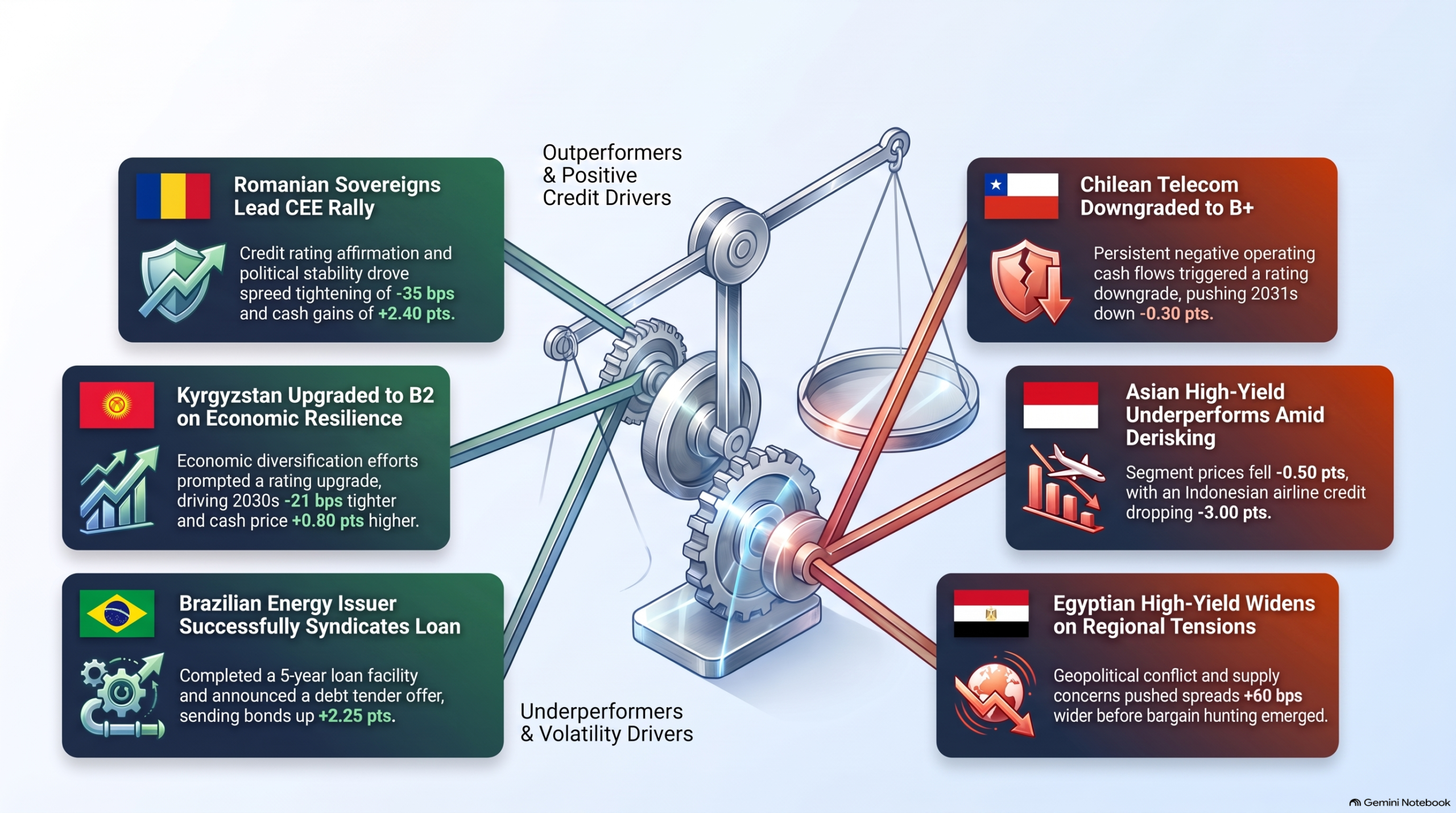
- Romania, Turkey, Ukraine and Kyrgyzstan outperformed following supportive political, macroeconomic and rating developments, driving meaningful spread compression and cash price gains.
- Asia high-yield corporates underperformed with continued pressure across transportation, gaming and property credits, although selected China industrial names diverged sharply.
- Primary market activity remained constructive as Laos successfully placed a US$500 million sovereign issue with strong demand and secondary market performance.
- Flows stabilized across EM credit after recent volatility, with investors selectively adding exposure to higher-yielding sovereign opportunities.
Market Visualizer
Global EM Themes
- EM credit flows improved toward week-end as outflows largely subsided despite developed market volatility, supporting selective risk-taking across higher-yielding sovereign credits.
- Investment-grade Gulf credits remained resilient due to persistent institutional demand and limited primary market supply.
- Asia credit traded defensively, with investment-grade corporates generally 2-3bp wider and high-yield corporates declining 0.25-0.5pts on continued de-risking.
- Geopolitical risks remained a key market driver, particularly around the Middle East and Black Sea region, though risk assets generally stabilized during the week.
- Turkey’s September inflation data surprised positively at 29.7% YoY versus expectations of 30.3%, reinforcing confidence in the ongoing disinflation trend.
- Both Sri Lanka and Pakistan reached IMF staff-level agreements, supporting sentiment toward frontier sovereign credits.
Regional Developments
- Egypt remained actively traded as investors balanced widening risk premiums driven by Middle East tensions against emerging value opportunities.
- Senegal drew significant investor focus amid discussions with creditors and the IMF regarding its restructuring framework and debt treatment.
- Cameroon successfully reopened its 2033 Eurobond with a US$300 million tap at a 10.8% yield, while Côte d’Ivoire and Kenya reported supportive fiscal developments.
- Romanian sovereign bonds outperformed regional peers, tightening 15-35bp and gaining 1.8-2.4pts after rating affirmation and constructive political developments surrounding government formation.
- Ukraine sovereign bonds rebounded strongly, rising 1.8-2.9pts following additional European military and energy-sector support commitments.
- Kyrgyzstan benefited from a sovereign rating upgrade and saw its 2030 bonds tighten 21bp WoW while gaining 0.8pts in price.
- Turkey’s sovereign curve tightened 10-15bp WoW following the stronger-than-expected inflation print.
- Brazil was among the strongest performers, with sovereign spreads tightening 15-22bp and 5-year CDS improving 22bp following the first round of presidential elections.
- Argentina continued to attract investor inflows, with sovereign CDS tightening significantly as broader regional demand remained supportive.
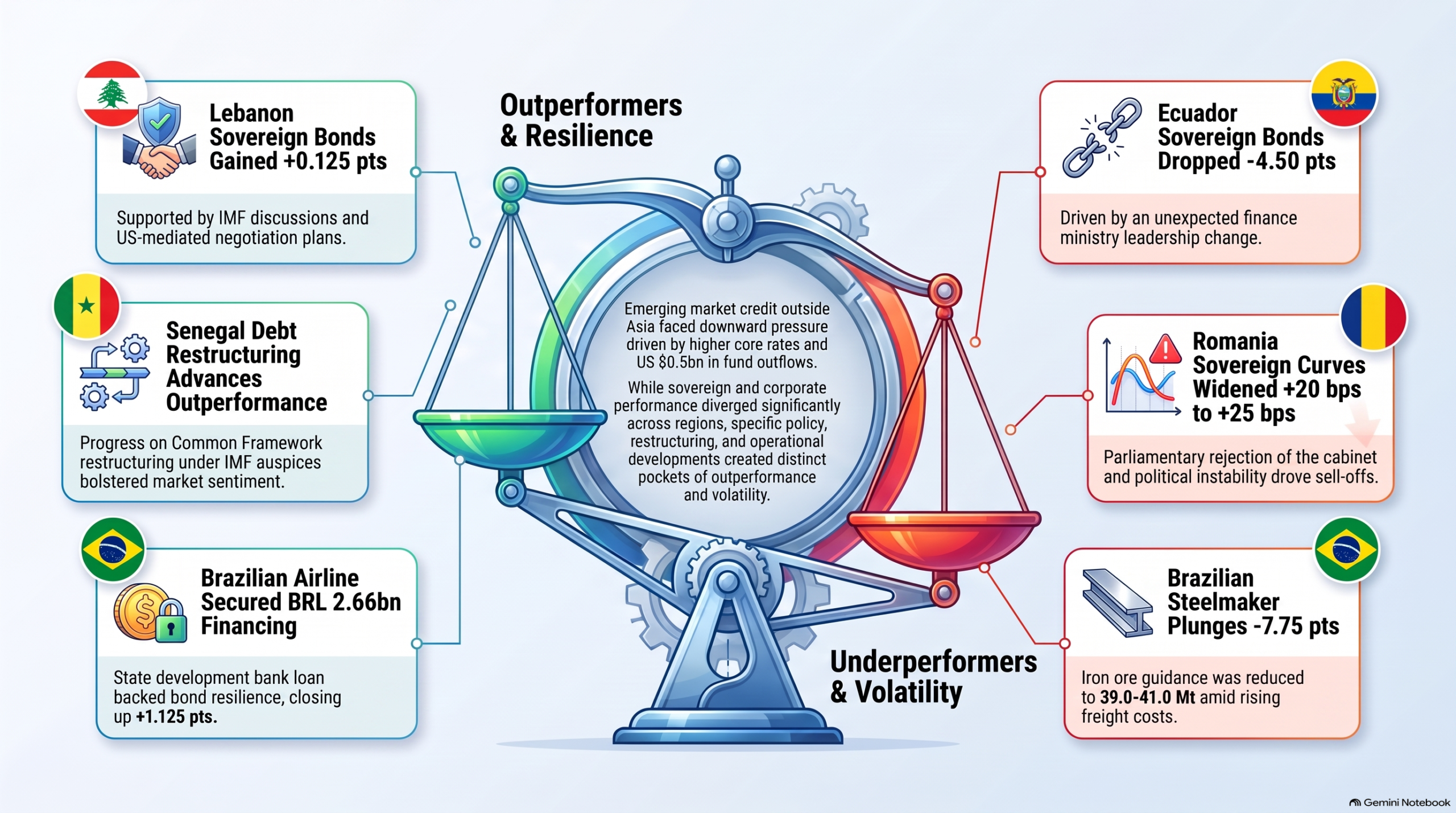
- Ecuador rebounded after authorities ruled out electricity blackouts during the peak drought period, supporting a recovery of 0.25-1.13pts across the curve.
- Transportation and industrial credits were mixed, with several aviation issuers outperforming while selected telecom and airline credits lagged despite corporate developments.
- Asia investment-grade corporates widened 2-3bp, with China technology and telecom names pressured by expectations of sizeable upcoming issuance.
- Regional investment-grade sovereigns outperformed corporates, with Indonesia and the Philippines tightening 1-3bp during the week.
- Pakistan underperformed Sri Lanka despite both receiving IMF support, while Laos delivered strong secondary-market performance after its new sovereign issuance.
- High-yield corporate sentiment remained weak, with transportation, gaming and property names declining amid risk reduction, although selected industrial issuers posted notable gains.
- A major Hong Kong property liability management exercise supported long-dated bonds, while perpetual securities lagged the broader capital structure.
Primary Markets
- Laos issued US$500 million of 5.5-year sovereign notes at a 9.625% yield, attracting a final orderbook of approximately US$1.45 billion with participation from EMEA, US and Asian investors.
- The new Laos issuance traded as high as 102.25 before settling around 101.5, representing a gain of roughly 1.5pts from reoffer levels.
- Several corporate refinancing, tender and liability management exercises across Asia and Latin America remained important drivers of secondary-market performance during the week.
www.gembridgecapital.com
DISCLAIMER
This document is strictly confidential and is being provided to you for informational purposes only. It does not constitute an offer to sell or a solicitation of an offer to buy any securities or financial instruments. The information contained herein has been obtained from sources believed to be reliable but is not guaranteed as to accuracy or completeness. Opinions and estimates constitute our judgment as of the date of this material and are subject to change without notice.
AI Generation Notice: Portions of this content may have been generated or assisted by Artificial Intelligence (AI) technologies. Users should independently verify critical data points. Past performance is not indicative of future results.
- EM fixed income weakened across the principal asset classes, with hard-currency sovereigns returning -1.59%, local-currency debt -1.11% and EM corporates -0.83% at the 2 October mid-day cut-off.
- Long-duration and lower-quality sovereign credit underperformed as 10-year-plus bonds returned -2.66% and HY sovereigns returned -1.86%, versus -0.45% for the 1–3-year segment and -1.29% for IG.
- Dedicated hard-currency EM debt funds recorded US$789m of net outflows, while China-focused and regional local-currency vehicles continued to attract inflows.
- Credit risk widened unevenly, with CDX EM moving 14.9bp wider to 166bp while iTraxx Asia ex-Japan IG widened only 0.6bp to 70bp.
- Primary issuance slowed to US$8.5bn under the broader reported universe, while higher Treasury yields contributed to a postponed benchmark transaction.
Market Visualizer
Global EM Themes
- Global-mandated EM debt funds recorded US$909m of outflows, including US$878m from hard-currency mandates and US$117m from local-currency mandates.
- Regional and country local-currency funds attracted US$3.0bn, including US$3.5bn of ETF inflows, although both figures slowed from US$4.9bn and US$5.9bn previously.
- Hard-currency sovereign returns were -2.27% in Africa, -1.72% in Europe and -0.98% in Asia, while corporate returns ranged from -1.48% in Latin America to -0.28% in Asia.
- Brent hovered around elevated levels of US$100/bbl.
- DM front-end yields rallied 10–30bp while curves steepened approximately 10–20bp, leaving long-duration EM bonds particularly exposed despite the front-end rally.
- September US payroll growth was 29k, prior months were revised down by 60k and unemployment stood at 4.2%, reducing the market-implied probability of an October Fed hike from about 70% to 20%.
- Macro readings were mixed across Asia, with India’s manufacturing PMI rising to 55.1, South Korean CPI easing to 2.9% y/y and Indonesian CPI increasing to 3.28%.
Regional Developments
- MENA high-grade credit widened 22bp over five sessions, while high-beta sovereigns widened 38bp, HY corporates 47bp and AT1/perpetuals 29bp.
- Long-duration Bahrain, Egypt and Jordan sovereign bonds lost 2.5 pts, 4.5 pts and 4.3 pts, respectively, while a short-dated Oman bond gained 0.75 pt.
- Senegal scheduled an IMF-chaired creditor meeting for 6 October covering its economic programme, debt-treatment strategy and engagement timetable, while reiterating that domestic debt remained outside the intended treatment perimeter.
- Angola’s sovereign outlook was revised to positive with its B3 rating affirmed, while projected government debt and interest costs stood at approximately 46% of GDP and 23% of revenue by end-2026.
- South Africa’s first-five-month FY26 deficit narrowed to R188.8bn from R215.2bn as revenue rose 9.5% and expenditure increased 4.6%, although local-market debt returned -2.41% during the week.
- Zambia cut its policy rate by 250bp to 10.75% after inflation eased to 6.1% and opened discussions with the IMF on a successor ECF programme.
- Romania’s 2026 gross financing needs were estimated at RON278.5bn, including a 6.2%-of-GDP deficit and RON150.7bn of maturities, with issuance through end-September covering approximately 52.2% of the requirement before other funding sources.
- Romania’s government-formation uncertainty remained a credit focus after Parliament rejected the proposed government, while local-currency debt returned -2.17%, predominantly through FX.
- Polish headline inflation rose to 4.0% y/y, above the 3.5% upper tolerance limit, although estimated core inflation eased to 3.2% from 3.3%.
- Ukraine recorded a -5.26% weekly hard-currency sovereign return, the second-weakest country performance in the reported sovereign universe.
- Brazil entered the 4 October first-round presidential vote with a statistically tight race, while five-year CDS widened 7bp to 130bp and August unemployment remained at 5.3%.
- Colombia raised its overnight lending rate by 25bp to 12.25% following higher inflation, while five-year CDS widened 14bp to 177bp.
- Chile’s August activity contracted 1.0% y/y and 0.7% m/m as mining fell 10.7% m/m, while five-year CDS widened 8bp to 59bp.
- Mexico maintained its policy rate at 6.50%, with the central bank citing domestic slack and the inflation outlook, while five-year CDS widened 12bp to 101bp.
- Stress intensified in a major Brazilian industrial credit CSN as its 2030 bond fell 8pts to $71, yielding 22.7%, after lower-grade production and cost guidance deteriorated.
- China, Indonesia and Philippines five-year CDS widened 2bp, 4bp and 4bp, respectively, even as the broader regional IG index widened only 0.6bp to 70bp.
- Long-dated Indonesia and Philippines sovereign bonds fell 0.25–0.50 pt early in the week, while Sri Lanka lost 0.5 pt and Pakistan declined a further 0.25–0.50 pt amid selling and thinner bid-side liquidity.
- Corporate performance remained highly dispersed, with several Kazakhstan and Türkiye credits losing 4–5 pts while selected China and Japan-related bonds gained 1 pt.
Primary Markets
- EM credit issuance totaled US$8.5bn, down from US$14.0bn previously, including US$5.5bn of sovereign supply and US$3.5bn of ESG-labelled issuance.
- A narrower external hard-currency universe recorded approximately US$7.1bn across six issuers and nine tranches; differing universes and cut-offs prevent direct reconciliation with the US$8.5bn broader tally.
- A planned benchmark, Marfrig 7/10-year corporate transaction was postponed after higher Treasury yields increased expected borrowing costs, with proceeds originally intended partly to refinance US$467m of 2029 notes.
- Liability-management activity included the announced redemption at par of US$235m of Adecoagro’s 2027 notes and a BRL2.6bn five-year development-bank facility, of which BRL1.3bn had been drawn.
- Ghana’s B-/B sovereign ratings were affirmed with a stable outlook alongside a planned GHS78bn central-bank recapitalisation, while Angola’s B3 rating was affirmed with a positive outlook.
www.gembridgecapital.com
DISCLAIMER
This document is strictly confidential and is being provided to you for informational purposes only. It does not constitute an offer to sell or a solicitation of an offer to buy any securities or financial instruments. The information contained herein has been obtained from sources believed to be reliable but is not guaranteed as to accuracy or completeness. Opinions and estimates constitute our judgment as of the date of this material and are subject to change without notice.
AI Generation Notice: Portions of this content may have been generated or assisted by Artificial Intelligence (AI) technologies. Users should independently verify critical data points. Past performance is not indicative of future results.
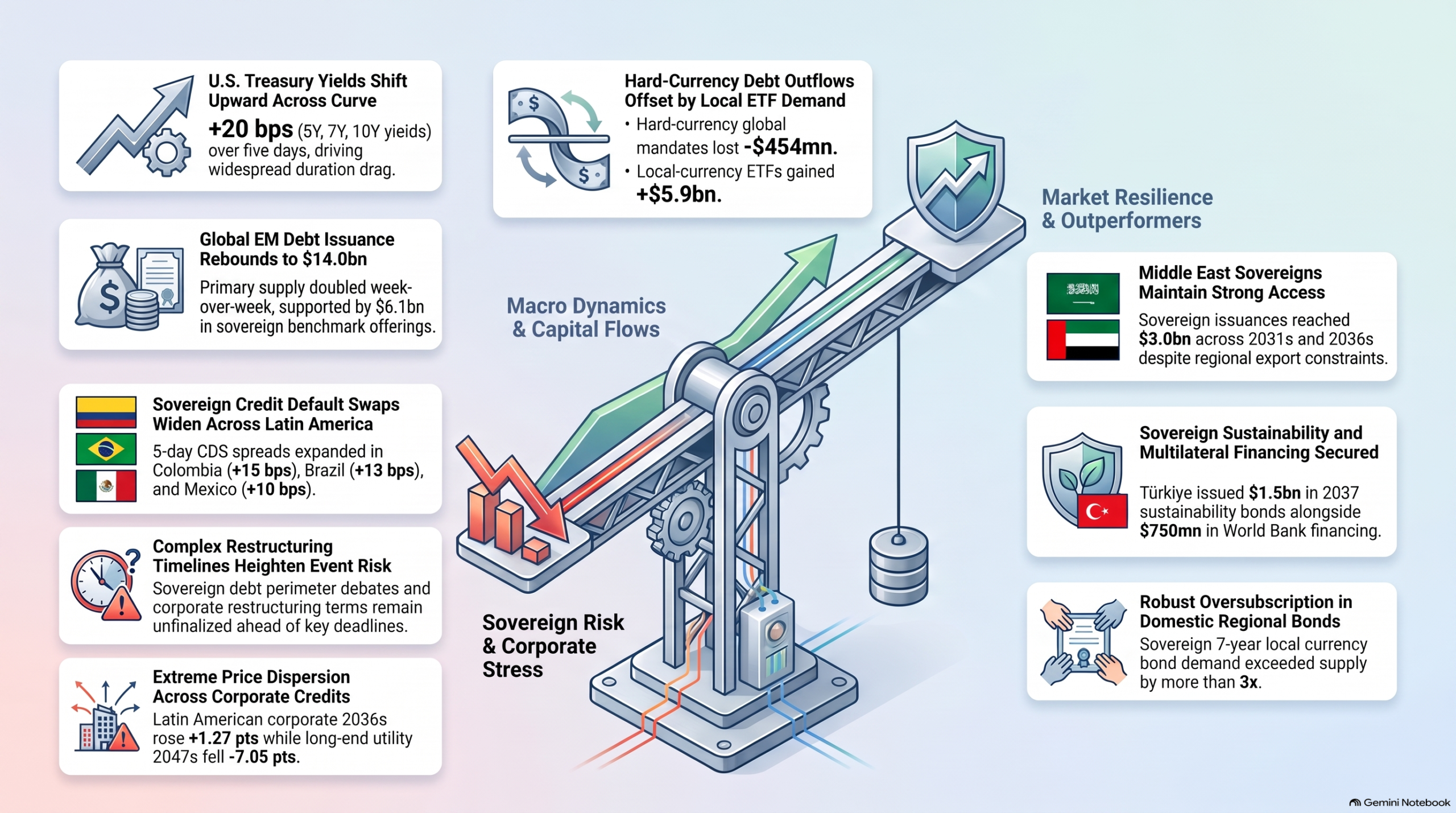
- Higher U.S. rates were the dominant weekly return driver, with 5Y, 7Y and 10Y Treasury yields each rising about 20bp over five days and the 30Y rising 15bp.
- EM bond outflows moderated to -US$104mn from -US$320mn, but hard-currency demand remained weak and sovereign HY underperformed.
- EM corporates proved more resilient than sovereign duration, while thin liquidity and defensive demand favoured front-end instruments and shorter spread duration.
- EM credit issuance increased to US$14.0bn, including US$6.1bn of sovereign supply, showing that primary-market access remained open despite weaker secondary performance.
- Brent ended near US$105.9/bbl, but physical export, insurance and logistics constraints prevented higher prices from translating uniformly into stronger credit conditions.
Market Visualizer
Global EM Themes
- EM bond flows improved to -US$104mn from -US$320mn, indicating a slower outflow pace without a return to sustained inflows.
- Global-mandated EM debt recorded -US$201mn of flows, including -US$454mn from hard-currency global mandates and +US$183mn into local-currency global mandates.
- Local regional and country funds attracted US$4.9bn, while local-currency ETFs received US$5.9bn, accounting for much of the reported local-flow strength.
- External weekly index readings showed returns of approximately -0.94% for hard-currency sovereigns, -0.94% for local sovereigns and -0.48% for EM corporates.
- Weekly trading remained defensive, with lighter liquidity, demand concentrated in front-end instruments and sovereign HY underperforming IG.
- U.S. Treasury yields rose 18bp in the 2Y, 20bp in the 5Y, 7Y and 10Y, and 15bp in the 30Y over five days, creating the principal drag on weekly credit returns.
- Brent increased 2.0% over five days to US$105.9/bbl, sustaining inflation and geopolitical risk even as prices declined late in the week.
- High implied rate volatility, robust U.S. activity, energy-linked inflation risk and weak auction dynamics increased pressure on long-duration credit.
- Oil remained a two-sided credit variable because high prices were offset in several markets by physical export, insurance, refining and logistics constraints.
Regional Developments
- GCC credit remained relatively resilient, although MENA IG and longer-dated energy-linked bonds weakened as U.S. rates rose.
- Qatar’s crude and product exports operated at 50–60% of pre-war levels, LNG utilisation remained near 20%, and full recovery was estimated to require two to three months.
- Qatar retained primary-market access by raising US$3.0bn across 2031 and 2036 sovereign bonds despite continuing physical-supply disruption.
- Senegal maintained that domestic debt should remain outside the restructuring perimeter, while uncertainty over comparable treatment continued to affect recovery assumptions.
- South Africa raised its policy rate 25bp to 7.25%, Nigeria cut 350bp to 23%, and Egypt held at 19%, highlighting significant regional policy divergence.
- Selected Kenyan T-bills and Zambian bonds cleared at yields of approximately 14.48–16.27%, underscoring elevated domestic funding costs.
- Hungary paused monetary easing at 5.50%, while tighter global rates and defensive EM FX positioning placed pressure on CEE valuations.
- Türkiye issued US$1.5bn of 2037 sustainability bonds and secured US$750mn of World Bank agri-food financing, taking reported 2026 World Bank funding above US$9bn.
- Turkish corporate and financial bonds weakened by approximately 0.15–0.65 pts during the broader rates sell-off despite continued sovereign market access.
- Ukrainian corporate bonds fell about 0.75 pts as reported threats to winter power, heating, water and interconnector infrastructure reinforced event risk.
- Five-day CDS changes reached Brazil +13bp, Mexico +10bp, Peru +5bp, Colombia +15bp and Chile +8bp, while COP depreciated 5.9%.
- Brazil’s September IPCA-15 increased 0.70% m/m, while polling remained within the margin of error ahead of the 4 October first-round election.
- Mexico’s central bank held its policy rate at 6.50% and indicated that future decisions would depend on inflation and FX pass-through.
- BRASKM, a Brazilian petrochemical restructuring story remained unresolved amid contested shareholder support, court intervention and an October 9 deadline for agreement on principal terms.
- Chile’s sovereign rating was affirmed at A with a stable outlook on 25 September.
- The regional policy cycle became more hawkish as higher energy prices and USD strength increased inflation risk across major oil-importing economies.
- Japan and Korea holidays reduced liquidity, while trading demand concentrated in front-end bullet bonds and Tier 2 instruments.
- Asian IG cash bonds lost approximately 0.5–1.375 pts and corporate spreads generally widened 1–2bp as Treasury yields rose.
- Pakistan sovereign bonds declined 0.5–1.0 pts during the week as sovereign HY remained the principal pressure point. Sri Lankan sovereign bonds got an upgrade to B- from CCC+, traded up 0.5 pts.
- Several large regional financial and energy transactions underperformed after issuance, while an active pipeline encouraged defensive secondary positioning.
- China’s faster fiscal execution and nearly CNY2tn of September government-bond issuance supported expectations for manufacturing PMI to improve to 50.1, although housing and consumption remained weak.
Primary Markets
- Total EM credit issuance reached US$14.0bn, more than doubling from US$5.9bn, with sovereign issuance accounting for US$6.1bn.
- ESG-labelled issuance totalled US$1.8bn as sovereign and corporate borrowers continued to access primary markets despite weaker secondary duration.
- Qatar issued US$3.0bn, the Dominican Republic raised US$1.6bn and Türkiye issued US$1.5bn, accounting for the principal sovereign transactions.
- San Juan Province raised US$600mn at 9.875%, while another Latin American issuer placed US$875mn of 10Y bonds at 7.1%.
- Softbank Group completed the well-expected $11b new bond offering on Wednesday, where three tranches of USD bonds and two tranches of EUR bonds were priced.
- Asia’s visible pipeline remained active across state-owned enterprises, banks and Australian issuers, although recent new issues were absorbed unevenly.
www.gembridgecapital.com
DISCLAIMER
This document is strictly confidential and is being provided to you for informational purposes only. It does not constitute an offer to sell or a solicitation of an offer to buy any securities or financial instruments. The information contained herein has been obtained from sources believed to be reliable but is not guaranteed as to accuracy or completeness. Opinions and estimates constitute our judgment as of the date of this material and are subject to change without notice.
AI Generation Notice: Portions of this content may have been generated or assisted by Artificial Intelligence (AI) technologies. Users should independently verify critical data points. Past performance is not indicative of future results.
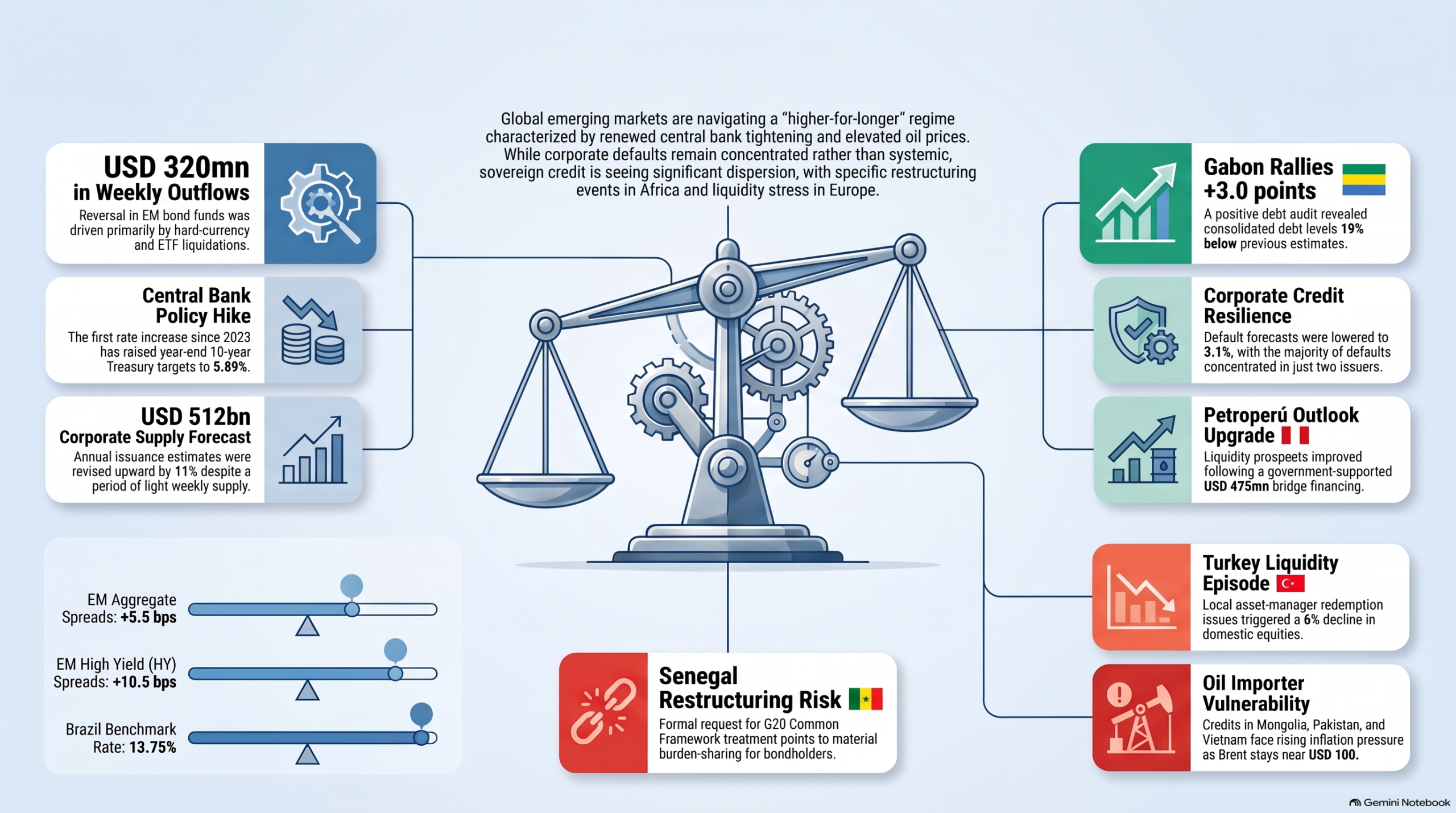
- The Federal Reserve delivered its first rate increase since 2023, with median projections pointing to one further hike by year-end, unchanged policy through 2027 and 25bp cuts in both 2028 and 2029, raising the duration hurdle for EM credit.
- EM bond funds returned to outflows of -US$320mn, driven by US$542mn of hard-currency redemptions and US$304mn from ETFs, while local-currency funds still took in US$221mn.
- EM credit weakened modestly over 14-18 September with high yield underperforming, as aggregate spreads widened 5.5bp WoW and high-yield spreads widened 10.5bp.
- Senegal formally requested debt treatment under the G20 Common Framework and continued IMF discussions, shifting bondholder focus to the treatment perimeter and burden sharing.
- Weekly EM credit issuance fell to US$5.9bn from US$19.3bn with no sovereign supply, though the forward pipeline remains considerable.
Market Visualizer
Regional Credit Developments
Global EM Themes
- EM bond funds swung to -US$320mn of weekly outflows, with hard-currency funds losing US$542mn after US$228mn of inflows the prior week; broad EM funds shed US$375mn and Asia ex-Japan funds US$166mn.
- Local-currency funds attracted US$221mn including US$204mn into EM ex-China, though non-resident local-bond flows were negative and led by -US$735mn from Indonesia, the largest country outflow in the week.
- ETF outflows accelerated to US$304mn from US$16mn and EM equity funds lost US$2.0bn, weakening the technical cushion for tight-spread and less-liquid credits.
- EM aggregate spreads widened 5.5bp WoW and high-yield spreads widened 10.5bp, with Türkiye and Argentina among the weakest sovereigns and Gabon and Mozambique the strongest.
- The Federal Reserve raised rates 25bp, its first increase since 2023, and paired it with hawkish guidance; 10y UST touched 5% into the meeting before rallying with a flatter curve the following day.
- Year-end 2026 Treasury yield targets were lifted to 4.70% on 2s and 5.05% on 10s, with a further hike expected in December and a risk of another in early 2027 if growth holds and inflation stays sticky.
- EM disinflation is assessed as largely behind us on higher crude and refined-product prices, rising global food prices and diminishing fiscal buffers, with Asia showing the strongest inflation acceleration among EM Edge regions.
- Ukraine raised its policy rate 50bp to 16% and Armenia hiked 25bp, while South Africa is forecast to move 25bp higher to 7.25% and Hungary, Egypt and Nigeria to stay on hold.
- Brent traded at US$100-110/bbl, with sustained prices above US$100 viewed as unlikely as surplus inventory, additional supply and demand destruction rebalance the market.
Regional Developments
- The temporary shutdown of Saudi Arabia’s East-West pipeline, Iran-Houthi tensions and continued Gulf and Red Sea shipping disruption drove early-week weakness, though GCC credits proved resilient and recovered as escalation fears eased.
- Israel’s August inflation printed at 1.5% year over year, modestly below expectations.
- Senegal formally requested debt treatment under the G20 Common Framework while continuing IMF discussions, with bondholders focused on burden sharing and the eventual restructuring perimeter.
- A Gabonese state debt audit put the consolidated stock at CFA9.52tn (about US$16.7bn) at end-2025 versus an initial estimate of nearly CFA11.7tn, 19% lower, and bonds rallied +1.50/+3.0pts WoW.
- Mozambique was downgraded to Caa3 with a stable outlook on heightened restructuring risk, yet bonds still gained around 2.5pts on expectations of a new IMF arrangement.
- South African headline inflation is expected to rise on higher food and transport prices, supporting a forecast 25bp policy-rate increase to 7.25%.
- Türkiye was the week’s focal point after redemption problems at local asset managers triggered liquidity concerns and a 6% equity-market decline; sovereign bonds and CDS widened before stabilising once regulators and the central bank introduced support measures.
- Romania outperformed midweek after treasury officials indicated no further bond issuance, but reversed on negative political commentary, leaving the dollar and euro curves +3/+8bp wider.
- Ukraine’s central bank raised the policy rate 50bp to 16%, with fuel and regulated-price increases expected to push inflation higher into year-end.
- A Latvian airline filed for Chapter 11 protection in the Southern District of New York a day before a scheduled bondholder meeting, with its bonds down about 1pt WoW.
- A Turkish power producer appointed financial advisers to assess potential financing opportunities and its bonds fell roughly 15pts WoW, the week’s most significant corporate underperformance.
- Brazil’s central bank cut the benchmark rate to 13.75% as expected, though the sovereign curve still widened +4/+6bp WoW, erasing part of its recent outperformance, with presidential polls effectively tied.
- Regional performance was mixed but broadly constructive, with investor focus on Colombia’s economic team engagement, the Dominican Republic’s debt tender and funding plans, and selective demand for high-quality duration.
- A Peruvian state oil company was moved to a positive outlook at Caa1 after a US$475mn government-supported bridge loan expected to improve liquidity and support working-capital normalisation, but its bonds still closed -0.30/-0.20pts WoW.
- Argentine sovereign bonds underperformed alongside broader high-beta risk assets, with no exact weekly move reported.
- In Venezuela, a major oil company was reported to have held talks on re-entering the country, while the government and opposition were said to be near a deal to move about US$4bn of gold reserves from the Bank of England to the Federal Reserve Bank of New York, potentially for use as borrowing collateral.
- Asian investment-grade sovereigns closed 5-15bp tighter and high-yield sovereigns rallied post-FOMC, with Pakistan 0.25-0.375pts lower across the curve and Sri Lanka’s longer-dated bonds 0.5-1pt higher; Vietnam’s finance ministry is reportedly in talks on a sovereign dollar bond of up to US$1bn, its first since 2014.
- Indonesia saw -US$735mn of non-resident local-bond outflows and a change of finance minister that markets largely looked through.
- Asian IG corporates tightened 3-5bp, led by a strong week in China TMT where spreads rallied 4-7bp tighter post-FOMC on short-covering and end-client demand, while Asian HY corporates closed 0.25-0.5pts lower.
- Real-time secondary property transactions across nine mainland cities rose 15% year over year and tier-one volumes 17%, with official primary and secondary registrations up 4% and 2%, though listing prices remained under pressure.
- China’s securities regulator reportedly declined to accept mandatory convertible bond registrations from distressed developers, which could complicate restructurings by limiting debt-to-equity conversion and creditor exit options.
- Hong Kong property was under significant pressure, with one developer’s perpetuals 3-5pts lower and associated instruments down 7.5-9.5pts amid rights-issue delays and higher mortgage-rate concerns; the city’s first Five-Year Plan (2026-30) was neutral for the sector, prioritising the Northern Metropolis and public housing supply without new measures.
- In Asian gaming, Malaysian perpetuals ended unchanged (3-5bp tighter) while a related curve firmed 0.75-1pt (30-45bp tighter); Macau front-end bonds slipped 0.125-0.375pts and higher-beta intermediate tenors fell 0.5-1pt.
- Mongolia, Pakistan, Sri Lanka and Vietnam face greater fuel or food-price pressure, with a possible December rate increase flagged for Mongolia if fuel and fiscal pressures persist.
Primary Markets
- Total EM credit issuance fell to US$5.9bn from US$19.3bn the prior week, with no EM sovereign supply printed.
- Year-to-date sovereign issuance stood at US$213.7bn, US$16.7bn above the comparable 2025 level and equivalent to 73.2% of full-year expectations.
- Prospective sovereign issuers include Argentina, Colombia, Dominican Republic, Egypt, Guatemala and Nigeria in high yield, and Chile, Latvia, Panama and Romania in investment grade.
- The 2026 EM corporate supply forecast was raised 11% to approximately US$512bn, with issuance reaching US$396.8bn through 15 September, comprising US$288.1bn of IG and US$108.8bn of HY.
- The 2026 EM high-yield corporate default forecast was reduced to 3.1% from 4.3%, with two issuers accounting for 75% of year-to-date default volume.
www.gembridgecapital.com
DISCLAIMER
This document is strictly confidential and is being provided to you for informational purposes only. It does not constitute an offer to sell or a solicitation of an offer to buy any securities or financial instruments. The information contained herein has been obtained from sources believed to be reliable but is not guaranteed as to accuracy or completeness. Opinions and estimates constitute our judgment as of the date of this material and are subject to change without notice.
AI Generation Notice: Portions of this content may have been generated or assisted by Artificial Intelligence (AI) technologies. Users should independently verify critical data points. Past performance is not indicative of future results.
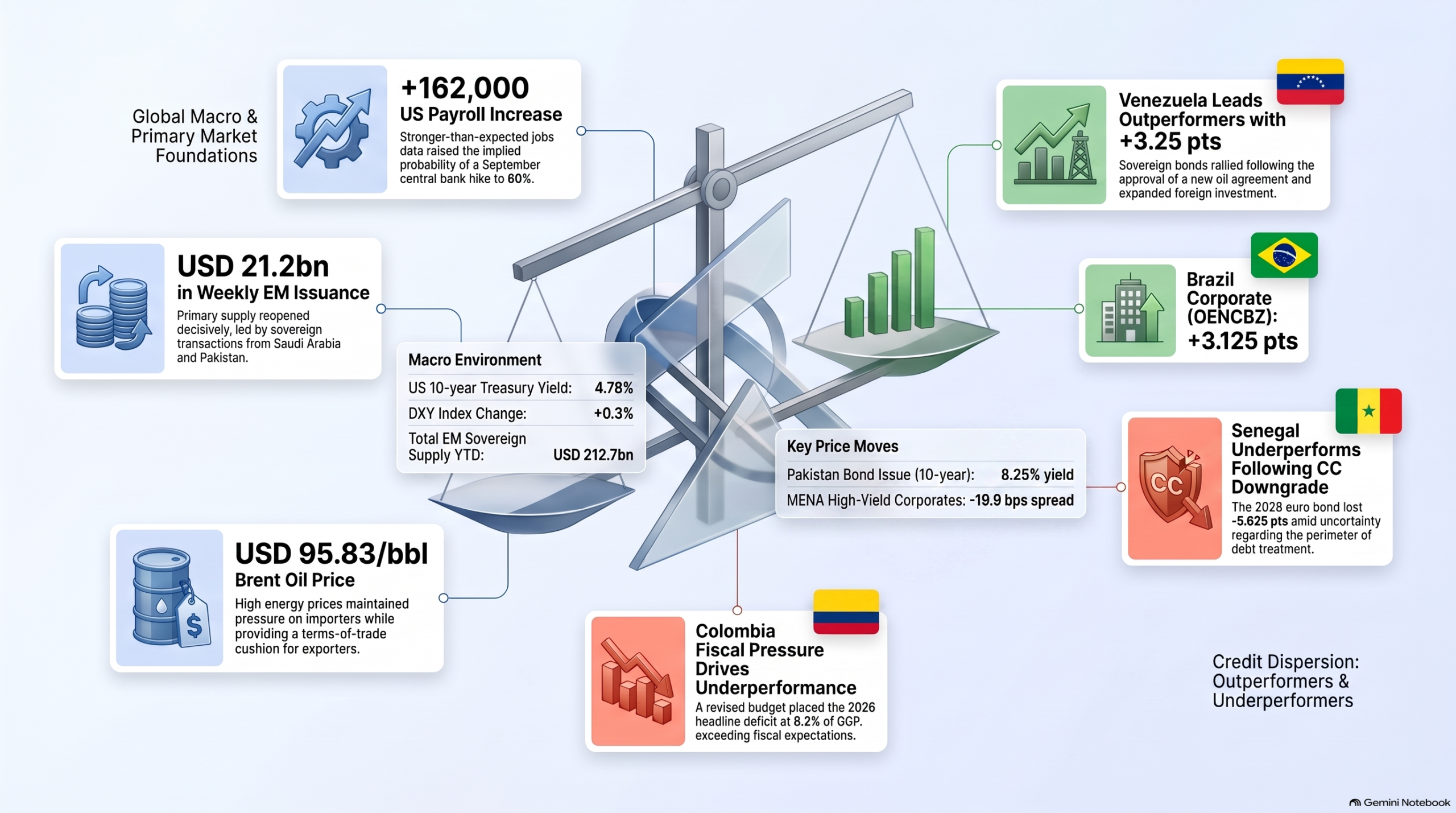
- EM credit remained broadly stable despite rising geopolitical risks and higher US Treasury yields, with performance driven primarily by country-specific catalysts rather than broad beta moves.
- Fund flows slowed materially during the week, although August data continued to point to a constructive medium-term allocation backdrop for hard-currency and local-currency EM debt.
- Energy prices remained elevated, supporting oil exporters while increasing pressure on importers through inflation, external balances and tighter monetary-policy constraints.
- Primary market activity accelerated with US$21.2bn of weekly EM issuance and robust demand for sovereign transactions from Saudi Arabia and Pakistan.
- Credit dispersion remained high, with Venezuela outperforming on oil-related developments while Senegal, Colombia and parts of Asia faced fiscal, restructuring or supply-related pressures.
Market Visualizer
Regional Credit Developments
Global EM Themes
- Hard-currency fund inflows slowed sharply to near flat during the week, while local-currency strategies continued to attract positive demand.
- August positioning remained supportive overall, with year-to-date hard-currency inflows exceeding prior-year totals despite a recent loss of momentum.
- Primary issuance surged to US$21.2bn, reinforcing continued market access across sovereign and corporate EM borrowers.
- Stronger US payrolls increased expectations of additional Fed tightening, pushing Treasury yields higher and reducing support from global duration.
- Brent crude ended near US$95.83/bbl, preserving a favorable backdrop for exporters while raising challenges for energy importers.
- Global activity indicators remained resilient despite elevated energy costs and growing inflation concerns.
Regional Developments
- Gulf credit remained resilient despite renewed regional geopolitical tensions, with broad spread tightening across sovereign, corporate and AT1 segments.
- Saudi Arabia attracted strong demand for a dual-tranche sukuk transaction, with the final order book reported near US$16.5bn.
- Senegal remained the region’s main event risk after announcing debt-treatment measures alongside an IMF staff-level agreement, generating significant volatility across the curve.
- Broader African macro developments were mixed, with fiscal, growth and inflation dynamics remaining highly country specific.
- Ukraine recovered from early weakness as political and negotiation headlines offset concerns around IMF-related legislative developments.
- Inflation surprises in Poland increased hawkish policy risks, while Czech and Hungarian monetary expectations remained comparatively stable.
- Venezuela rallied strongly after an oil-sector agreement and announcements of expanded energy investment, making it one of the week’s top sovereign performers.
- Colombia underperformed as concerns increased around the medium-term fiscal outlook and financing requirements.
- Brazilian growth slowed in the second quarter, although market sentiment remained comparatively constructive and selected credits outperformed.
- El Salvador advanced modestly following progress under its IMF program, while Ecuador saw limited credit benefit from new multilateral financing.
- Pakistan’s fiscal and reserve positions continued to improve, although external funding vulnerabilities remain an important medium-term consideration.
- China’s housing-market reforms support long-term stability but may tighten financing conditions for developers and pressure property-sector credit fundamentals.
- Asian corporate credit softened around heavy new issuance, with Japan particularly weak while selected Chinese technology credits outperformed.
Primary Markets
- Saudi Arabia completed a heavily oversubscribed dual-tranche sukuk transaction, reopening sovereign GCC issuance after the summer period.
- Pakistan issued new 5½-year and 10-year bonds totaling US$3bn, marking one of the most significant EM sovereign deals of the week.
- Strong demand extended into regional bank-capital markets, with multiple subordinated and senior transactions drawing substantial investor interest.
- The September pipeline remains active, with investors closely monitoring additional potential sovereign issuance from several frontier and emerging-market borrowers.
www.gembridgecapital.com
DISCLAIMER
This document is strictly confidential and is being provided to you for informational purposes only. It does not constitute an offer to sell or a solicitation of an offer to buy any securities or financial instruments. The information contained herein has been obtained from sources believed to be reliable but is not guaranteed as to accuracy or completeness. Opinions and estimates constitute our judgment as of the date of this material and are subject to change without notice.
AI Generation Notice: Portions of this content may have been generated or assisted by Artificial Intelligence (AI) technologies. Users should independently verify critical data points. Past performance is not indicative of future results.