


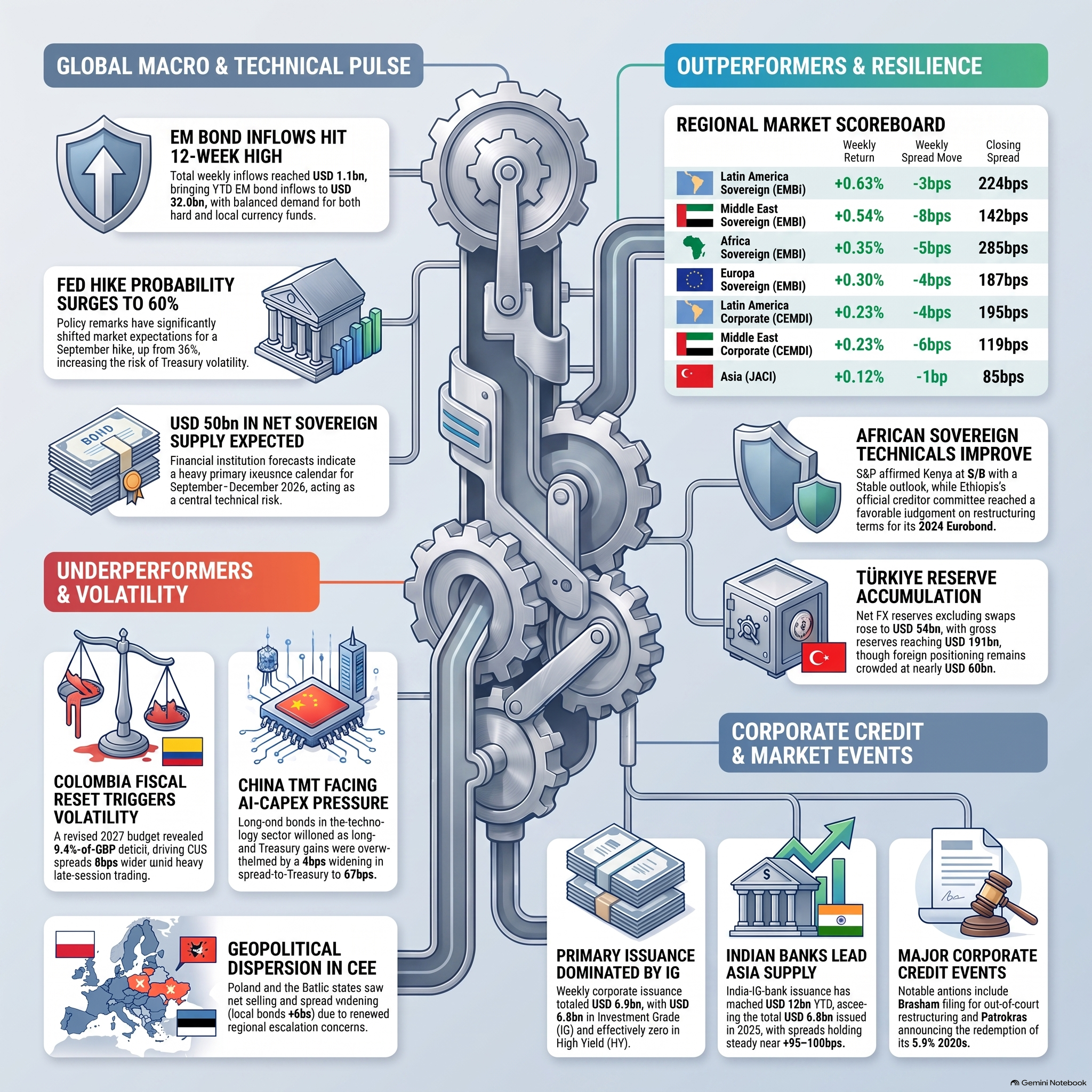
- EM bond funds absorbed US$1.1 billion, the strongest weekly intake in 12 weeks, with both hard-currency and local-currency funds attracting money and YTD inflows reaching US$33.9 billion.
- Hawkish central-bank commentary at Jackson Hole lifted the perceived probability of a September Fed hike from 36% to 60%, raising the risk that Treasury volatility offsets otherwise-supportive EM technicals.
- Sovereign credit outperformed corporates across every reported ex-Asia region, led by Latin America at +0.63%, while corporate returns compressed into a 0.17–0.23% band.
- Colombia was the week’s clearest volatility event as a revised 2027 budget revealed a 9.4%-of-GDP deficit, leaving CDS 8bp wider even as cash bonds retraced to roughly unchanged.
- September supply is the central technical risk, with roughly US$90 billion of further EM sovereign issuance forecast for the remainder of 2026 competing against heavy global IG demand.
Market Visualizer
Regional Credit Developments
Global EM Themes
- EM bond inflows rose to US$1.1 billion, split US$584 million into hard currency and US$516 million into local currency; ETFs contributed US$519 million and non-ETFs US$581 million, taking YTD EM bond inflows to US$33.9 billion.
- Broad hard-currency EM funds attracted US$598 million, while Asia ex-Japan hard-currency funds lost US$14 million.
- Local-bond inflows were geographically concentrated, with Hungary leading available non-resident inflows at US$92 million; in Asia dollar corporates a modest buying bias and rotation toward bonds longer than ten years saw China reverse to a 14% net inflow while Hong Kong, India and Singapore recorded net outflows.
- Sovereigns outperformed corporates across every reported ex-Asia region, with Latin America sovereign +0.63% (-3bp to 224bp), Middle East +0.54% (-8bp to 142bp), Africa +0.35% (-5bp to 285bp) and Europe +0.30% (-4bp to 187bp) against compressed corporate returns of 0.17–0.23%.
- Hawkish Jackson Hole remarks lifted the perceived probability of a September Fed hike from 36% to 60%, increasing the risk that Treasury volatility overwhelms supportive EM technicals.
- Mexico’s 2026 growth forecast was raised to 1.5% on firm external demand and industrial-policy traction, while Brazil is expected to slow from 4.5% annualized in 1Q to 2% in 2Q and toward 1% in early 3Q on high debt-service costs and a fading fiscal impulse.
- Policy divergence widened, with five of seven EMEA EM central banks expected to cut — Türkiye effectively lowered interbank funding rates by 300bp and is forecast to cut 100bp in both October and December, and Hungary is seen cutting 25bp in September — while Asia turned more hawkish as Korea and the Philippines raised rates and Thailand held on weak, uneven growth.
Regional Developments
- MENA stayed range-bound despite renewed US-Iran tension; GCC IG was slightly softer in cash with no broad spread pressure, while higher oil supported exporters and wider bid-offer spreads reflected a geopolitical premium amid an empty near-term pipeline.
- Bahrain’s 2033 sukuk tightened about 10bp in z-spread and its 2028 and 2038 conventional bonds tightened roughly 20–25bp, while Oman’s January 2028 bond outperformed the October 2027 point by around 25bp on thin liquidity.
- Over five sessions the high-grade, high-beta, HY and AT1 baskets tightened 1.6bp, 8.1bp, 2.2bp and 5.6bp respectively, with MENA HY range-bound and AT1s broadly unchanged to slightly lower.
- African sovereign technicals improved, with duration extension in Angola, better belly buying in Kenya, two-way flow in Nigeria and a South African curve 1–3bp tighter alongside CDS 0.5bp tighter.
- Kenya was affirmed at B/B with a Stable outlook on stronger reserves and exchange-rate stability, while Ethiopia’s official creditor committee judged the restructuring terms for its US$1 billion 2024 Eurobond compliant with comparability-of-treatment requirements.
- Cameroon’s 2033 bond gained 0.32 cents to 98.51 as its yield fell to 9.18% after the president returned from a prolonged absence, and Ghana’s banking-system capital ratio rose to 20.4% in June from 10.6% a year earlier, with all 23 banks fully capitalized.
- Ukraine traded down 0.25 points before finishing 0.125 points higher amid balanced activity.
- Poland was the principal weak point on renewed Russian-escalation concerns, with hard-currency bonds widening roughly 1–2bp and local bonds about 6bp, while Latvia and Lithuania also saw net selling.
- Türkiye’s foreign carry exposure fell US$1.2 billion over two weeks to US$48.7 billion, still well above the roughly US$40 billion pre-conflict level, with short-term foreign positioning near US$60 billion including money-market funds; net FX reserves excluding swaps rose to about US$54 billion and gross reserves reached US$191 billion.
- Colombia’s revised 2027 budget revealed a 9.4%-of-GDP deficit and a planned 2.2 percentage-point primary adjustment; cash traded 4–6bp wider and CDS as much as 6bp wider before cash retraced to roughly unchanged, though CDS closed 8bp wider with more than US$200 million traded in the final hour.
- Argentina stabilized after meaningful underperformance as passage of central-bank charter reform and the Fiscal Innocence bill through the Lower House triggered a 25–50 cent opening rally and a curve close about 20 cents higher, leaving bonds still down roughly 4 points and 100bp wider month-to-date.
- Braskem filed for an out-of-court restructuring; Fitch upgraded Brava Energia to BB from BB- following Ecopetrol’s acquisition of control; Fitch removed Rumo from Rating Watch Negative but assigned a negative outlook; and Petrobras announced redemption of its 5.9% 2028 notes.
- JACI gained 0.12%, with sovereigns returning 0.29%, quasis 0.13% and corporates 0.06%, and Pakistan led country returns at 0.58%.
- China IG lost 0.03% as a 4bp widening in spread-to-Treasury to 67bp overwhelmed seven-year Treasury gains, with technology long-end bonds widening on concerns over the size and duration of AI capex and reported hedge-fund shorting on prospective supply and sanctions risk.
- China financial spreads widened 5bp versus only 1bp for Asia financials overall, while Asia gaming returned 0.17% with spreads tightening 4bp to SOT+188 across both IG and HY.
- SoftBank hybrid bonds fell as much as 2.5 points after potential US$10–20 billion refinancing headlines.
Primary Markets
- Through August 27, EM corporate issuance totaled US$6.9 billion WTD, of which US$6.8 billion was IG and effectively zero was HY; Asia supplied US$4.9 billion, Emerging Europe US$1.1 billion, Middle East and Africa US$0.9 billion and Latin America none, taking YTD corporate issuance to US$357.1 billion.
- Approximately US$12 billion of India IG-bank supply already exceeded the roughly US$6.5 billion issued in all of 2025, yet most deals performed and high-quality five-year bank spreads held near +95–100bp, while the broader Asia primary market raised US$2.4 billion entirely in IG.
- September supply is the central technical risk, with roughly US$90 billion of further EM sovereign USD/EUR issuance forecast for 2026 and US$50 billion of net issuance during September–December, historically led by EEMEA and competing with heavy US hyperscaler financing for global IG demand.
www.gembridgecapital.com
DISCLAIMER
This document is strictly confidential and is being provided to you for informational purposes only. It does not constitute an offer to sell or a solicitation of an offer to buy any securities or financial instruments. The information contained herein has been obtained from sources believed to be reliable but is not guaranteed as to accuracy or completeness. Opinions and estimates constitute our judgment as of the date of this material and are subject to change without notice.
AI Generation Notice: Portions of this content may have been generated or assisted by Artificial Intelligence (AI) technologies. Users should independently verify critical data points. Past performance is not indicative of future results.
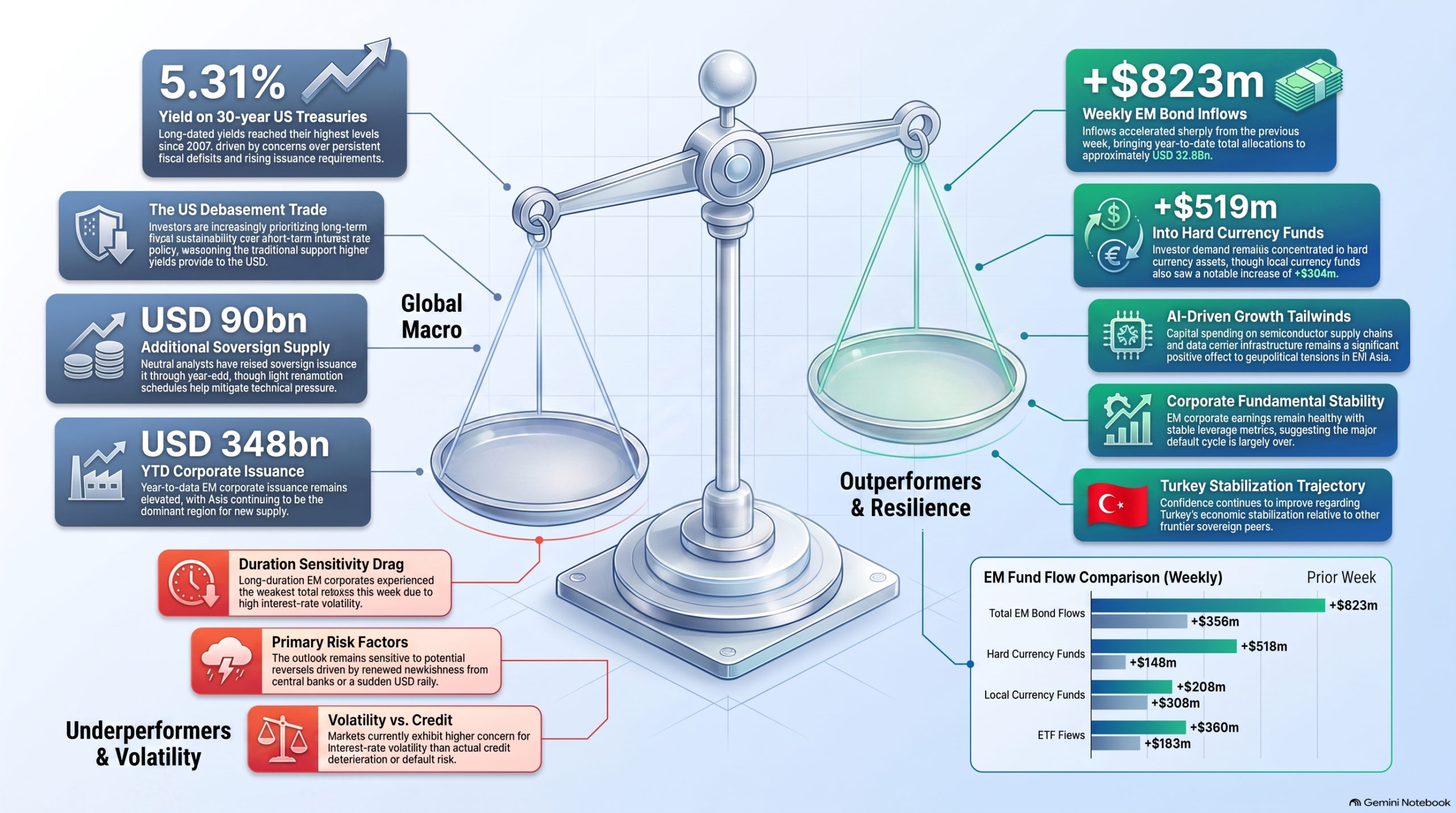
- EM bond inflows accelerated to US$823mn as investors continued allocating toward higher-yielding non-dollar assets despite rising U.S. Treasury yields.
- Long-dated Treasury yields reached their highest levels since 2007, but EM credit spreads remained resilient as carry and fundamentals outweighed duration concerns.
- Growing focus on U.S. fiscal sustainability helped support gold, Bitcoin, EM credit and other assets linked to the broader debasement narrative.
- Corporate fundamentals remained healthy with stable leverage, contained default risk and continued demand for new issuance across major EM regions.
- AI-related investment spending continued to support parts of EM Asia through semiconductor, infrastructure and power-sector demand.
Market Visualizer
Regional Credit Developments
Global EM Themes
- Aggregate EM bond fund inflows accelerated to US$823mn from US$356mn the prior week, with both hard-currency and local-currency strategies attracting fresh capital.
- ETF participation remained constructive with US$360mn of inflows, reinforcing demand for carry-oriented exposure despite elevated rate volatility.
- Spread performance remained considerably more stable than duration performance as investors focused on income generation rather than directional rate positioning.
- The dominant macro theme was growing investor concern around persistent U.S. fiscal deficits, rising debt burdens and long-term financing requirements.
- Treasury yields continued rising with the 30-year yield briefly reaching 5.31%, its highest level since 2007.
- Gold, Bitcoin and EM assets advanced together, highlighting continued demand for diversification away from traditional dollar exposures.
- A weaker U.S. dollar backdrop remained supportive for EM local currencies, carry trades and commodity-linked economies.
Regional Developments
- Sovereign financing conditions remained generally supportive as strong market technicals continued offsetting the impact of higher global rates.
- Frontier sovereigns continued benefiting from improving risk appetite and sustained investor demand for higher-yielding credit exposure.
- Market participants increasingly focused on relative-value opportunities as policy normalization and stabilization trends continued across selected sovereign credits.
- Investor attention remained centered on macro stability, external financing dynamics and sensitivity to shifts in global rate expectations.
- Commodity-linked sovereign and corporate credits continued drawing support from the broader weakness in the U.S. dollar and resilient global liquidity conditions.
- Carry-oriented strategies remained attractive as investors sought spread income while avoiding excessive duration exposure.
- AI-driven capital expenditure continued supporting semiconductor supply chains, technology exporters and digital infrastructure providers.
- Technology-oriented issuers remained key beneficiaries of continued investment into data centers, computing infrastructure and power networks.
- Although growth concerns persisted in parts of the region, AI-related demand provided an important offset for medium-term credit fundamentals.
Primary Markets
- EM corporate issuance reached approximately US$348bn year-to-date, with full-year volumes projected near US$460bn.
- Additional EM sovereign issuance of roughly US$90bn is expected through year-end, although relatively light redemption schedules continue supporting market absorption.
- Asia remained the dominant source of corporate issuance as borrowers continued taking advantage of constructive demand conditions.
- New issuance continued to be well absorbed across both sovereign and corporate markets despite elevated benchmark rate volatility.
GEMBRIDGE CAPITAL
DISCLAIMER
This document is strictly confidential and is being provided to you for informational purposes only. It does not constitute an offer to sell or a solicitation of an offer to buy any securities or financial instruments. The information contained herein has been obtained from sources believed to be reliable but is not guaranteed as to accuracy or completeness. Opinions and estimates constitute our judgment as of the date of this material and are subject to change without notice.
AI Generation Notice: Portions of this content may have been generated or assisted by Artificial Intelligence (AI) technologies. Users should independently verify critical data points. Past performance is not indicative of future results.
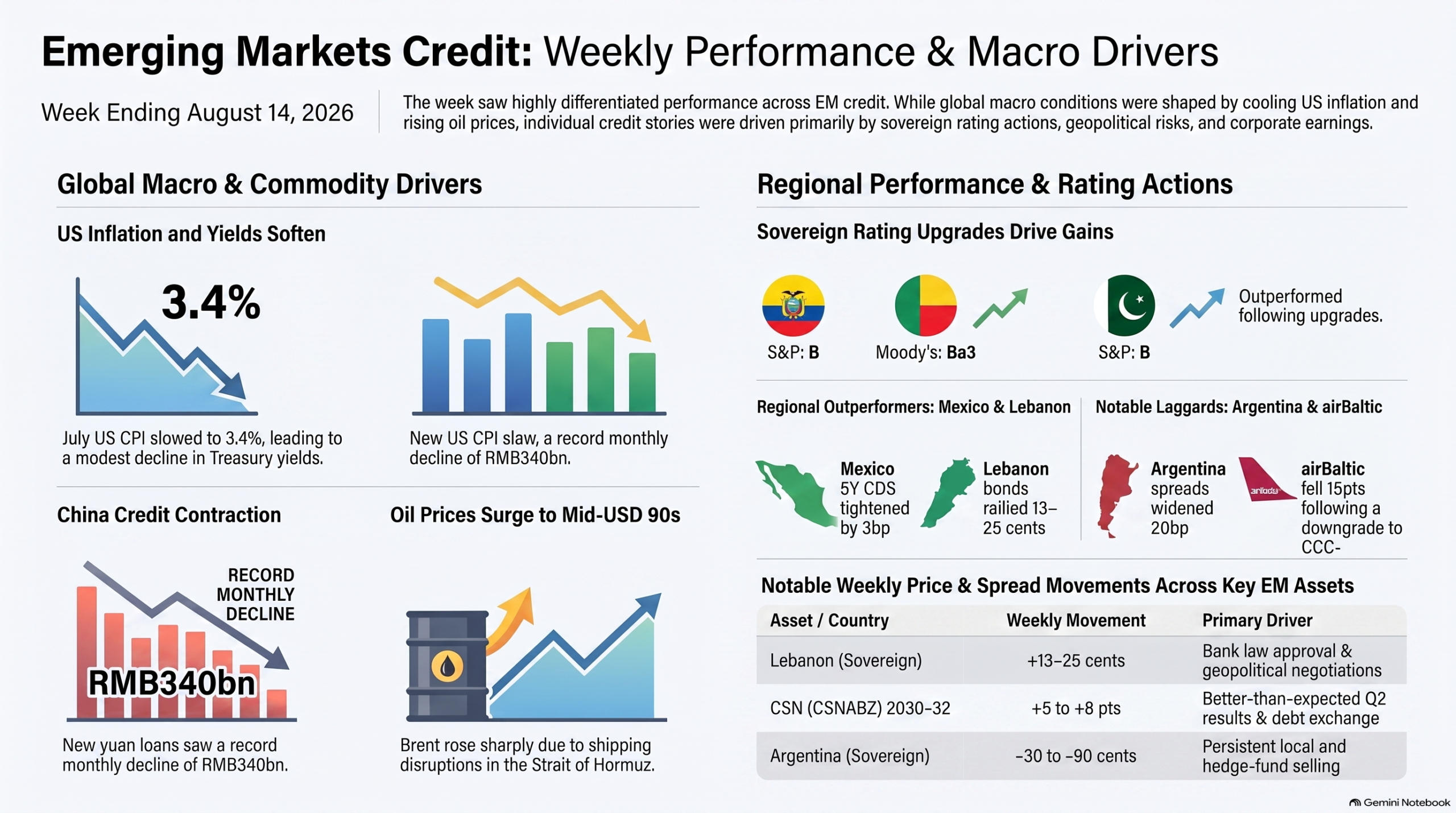
Executive Summary: For the week ended 14 August 2026, EM credit markets traded broadly rangebound with EM investment-grade spreads essentially unchanged and EM high-yield modestly wider. Local-currency EM funds recorded continued inflows while hard-currency flows remained flat. July US CPI slowed to 3.4% year-on-year with core CPI at 2.5%, while China’s July credit contracted by RMB340bn, the largest monthly decline on record. Brent crude rose into the mid-USD 90s amid Strait of Hormuz disruptions.
Market Visualizer
Regional Credit Developments
🌍 EM Ex-Asia Credit
- Mexico (Sovereign): 5Y CDS tightened approximately 3bp over the week of 10-14 August; cash sovereign bonds closed 2-5bp tighter as local selling was absorbed by real-money and hedge-fund demand.
- Panama (Sovereign): Sovereign bonds outperformed after several sluggish weeks, supported by renewed buying interest particularly in the long end of the curve.
- Peru (Sovereign): Sovereign bonds tightened modestly over the week as investors monitored the possibility of upcoming sovereign issuance.
- Brazil (Sovereign): Underperformed regional peers with fast-money selling pushing spreads 4-5bp wider intraweek before hedge-fund buying emerged; 5Y CDS finished approximately 5bp wider on the week.
- Argentina (Sovereign): Remained the main regional underperformer with sovereign bonds declining 30-90 cents and spreads widening around 20bp amid persistent local and hedge-fund selling; some real-money demand observed from midweek.
- Ecuador (Sovereign): S&P upgraded sovereign rating to B from B- on Thursday, citing continued fiscal adjustment, access to official and market financing, and improved external position. Ecuador bonds outperformed with some issues gaining up to 40 cents; ECUA curve was broadly flat to +0.50pts week-on-week.
- Aegea (AEGEBZ): Moody’s changed outlook to negative from rating under review on Thursday, citing weak liquidity despite completion of BRL2.1bn capital raise. AEGEBZ bonds down approximately 0.75-0.50pts week-on-week.
- Braskem (BRASKM): Reported strong 2Q 2026 results supported by strong chemical spreads. CFO stated company in regular conversations with creditors about capital structure. BRASKM complex closed week in range of -0.25 to +0.50pts versus prior week.
- Raízen (RAIZBZ): Reported strong 2Q 2026 results with weaker sugar and ethanol business offset by strong energy distribution in Brazil. RAIZBZ curve closed approximately +2.0pts week-on-week.
- CSN (CSNABZ): Reported better-than-expected 2Q 2026 results although free cash flow remained negative. Exchange and consent solicitation for 2028 bonds settled with 77% participation. CSNABZ 2030/2031/2032 bonds rallied +5 to +8pts on week; 2028 holdouts up +2.5pts. New 2030 bond closed at cash price 81.5 (YTM 18%).
- Nexa (NEXA): Reported strong 2Q 2026 with zinc output rising 8% year-on-year to 79kt and Peru operations normalized. Zinc, copper, silver and gold prices increased 31%, 40%, 117% and 37% year-on-year respectively. NEXA curve ended week unchanged.
- Arauco / Empresas Copec (CELARA): Arauco announced Empresas Copec will provide Equity Support Agreement of up to USD 450mn available between 1 January 2027 and 31 December 2028, in addition to previously committed USD 1.2bn capital injection with USD 400mn remaining to disburse in 2H 2026. CELARA curve traded -0.625pts to unchanged week-on-week.
- Romania (Sovereign): Moody’s affirmed Baa3 rating early in the week, supporting sovereign bonds which outperformed regional peers before later profit-taking.
- Turkey (Sovereign): Sovereign CDS tightened approximately 7bp during week of 10-14 August, supported by local and real-money demand.
- Benin (Sovereign): Moody’s upgraded rating to Ba3 from B1. Eurobonds gained as much as 2 points over the week.
- Nigeria (Sovereign): Sovereign bonds traded actively and finished firmer on week amid strong relative-value demand and healthy activity in cash bonds and swaps.
- Zambia (Sovereign): Election dominated local news flow with reports of ballot disruptions and temporary suspensions of vote counting coinciding with modest weakness in sovereign bonds.
- Lebanon (Sovereign): Remained one of most actively traded Middle East credits. U.S. security-assistance proposals, progress in Israel negotiations, and parliamentary approval of amended bank resolution law reported. Bonds rallied 13-25 cents as new buyers replaced earlier sellers.
- Pegasus (PGSUST): Reported weak 2Q 2026 with EBITDA declining sharply and margins compressing due to materially higher fuel costs and Middle East operations disruptions. PGSUST 2031 bonds broadly flat week-on-week.
- airBaltic (AIRBAL): S&P downgraded to CCC- from CCC+ on concerns over potential debt operation and maintained negative outlook. Airline released new business plan including debt restructuring component. AIRBAL 2029 bonds fell approximately 15pts to low-20s price area week-on-week.
- DP World (DPWDU): Reported resilient 2Q 2026 results despite ongoing Strait of Hormuz closure disrupting Middle East trade flows. DPWDU bonds unchanged on week.
🇨🇳 Asia Credit: China Property & HY
- Far East Consortium / Faecao (Perpetuals): Perpetuals traded up approximately 3pts, supported by increased market focus on potential liability-management exercise.
- Las Vegas Sands-linked / Lasude (8% 2029): Newly exchanged 2029 bond opened around USD 89 and finished week at approximately USD 94, yielding about 10%.
- New World Development / Nwdevl (Perpetuals & Senior): Perpetual bonds rose approximately 1pt and senior bonds gained approximately 0.5pts over week as market monitored prospect of repeat deal.
🌏 Asia Credit: Frontier & Sovereign
- Malaysia (Sovereign Sukuk): Priced two US dollar sukuk tranches: USD 850mn 5.75-year at T+15bp and USD 650mn 10-year at T+25bp. In secondary trading, both tranches widened approximately 1-2bp versus reoffer amid weak macro backdrop.
- Indonesia / Danatara (Sovereign Wealth Fund): Indonesia Investment Authority vehicle Danatara returned to market sounding investors for potential 20-year and 30-year issues to complement existing 5-year and 10-year bonds issued in June 2026.
- Pakistan (Sovereign): S&P raised long-term sovereign rating to B from B- during week. Curve closed -25 cents to +12.5 cents on Wednesday; activity showed hedge-fund selling against two-way real-money flows. Full week Pakistan curve closed approximately -50 cents to -1.63pts lower.
- Laos / EDF-Generation Public Company (SOE Debut): State-owned utility held investor meetings for debut US dollar Reg S/144A 5NC3 bond transaction. Expected issue ratings: CCC+ from S&P and CCC+ from Fitch.
www.gembridgecapital.com
DISCLAIMER
This document is strictly confidential and is being provided to you for informational purposes only. It does not constitute an offer to sell or a solicitation of an offer to buy any securities or financial instruments. The information contained herein has been obtained from sources believed to be reliable but is not guaranteed as to accuracy or completeness. Opinions and estimates constitute our judgment as of the date of this material and are subject to change without notice.
AI Generation Notice: Portions of this content may have been generated or assisted by Artificial Intelligence (AI) technologies. Users should independently verify critical data points. Past performance is not indicative of future results.
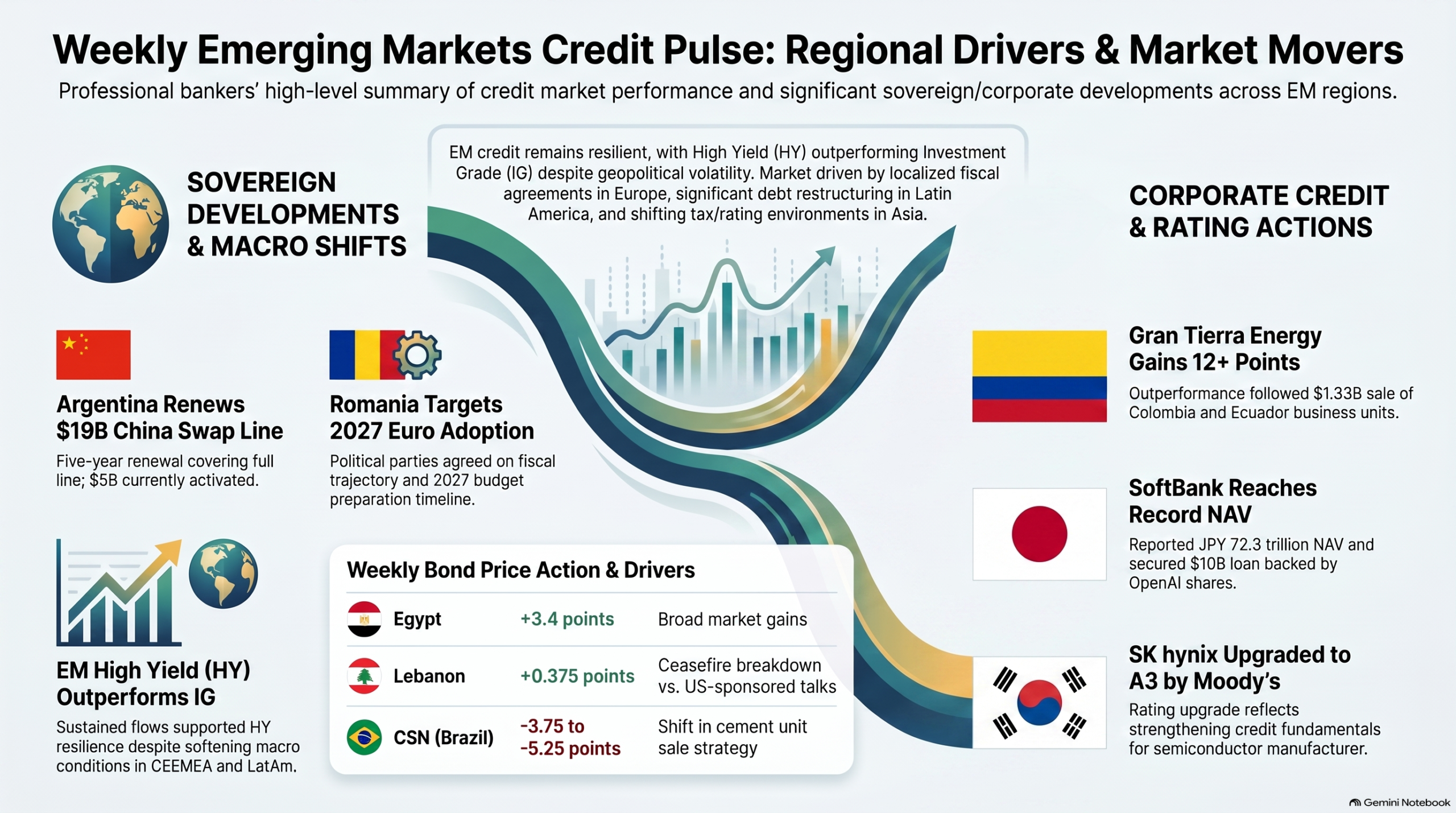
Executive Summary: EM credit markets remained resilient despite late-week risk reduction, with EM HY outperforming IG. CEEMEA and LatAm rallied early on easing Middle East tensions before consolidating. Key developments included Romania’s political agreement on euro adoption, Argentina’s renewal of its China swap line, and a ceasefire breakdown in southern Lebanon following Israeli airstrikes. Corporate earnings were mixed across emerging markets.
Market Visualizer
Regional Credit Developments
🌍 Europe Credit
- Romania: Political parties reached agreement on euro adoption, including maintaining fiscal trajectory and preparing 2027 budget before year-end. Fitch affirmed sovereign at BBB-. US dollar curve 5 bps tighter, euro curve flat on the week.
- Latvia / AirBaltic: Bondholder meeting on Monday lacked quorum and was rescheduled to August 17. Bonds down 2.50 points on the week.
🌍 Middle East & Africa Credit
- Lebanon: Ceasefire in southern Lebanon broken on Wednesday after Israel launched air strikes in response to claimed Hezbollah violations. Curve rallied 0.375 points on the week, supported by IMF engagement and Israel-Lebanon discussions in Rome.
- Ghana / Kosmos Energy: Reported better-than-expected 2Q26 results on Monday. Bonds flat to up 0.375 points on the week.
- Ghana / Tullow Oil: Revised 2026 free cash flow guidance upward on Wednesday. Bonds unchanged on the week.
- Egypt: Bonds gained as much as 3.4 points on the week.
- Kenya: Bonds outperformed following lower oil prices.
- Senegal: Bonds supported by news that World Bank will provide CFA340 billion of financing over the next decade.
- Gabon: Bonds underperformed after a strong prior run.
- Democratic Republic of Congo: Bonds pressured by reports that government banned exports of copper and cobalt concentrates.
🌎 Latin America Credit
- Venezuela: Government and opposition members started political dialogue, planning to remain in continuous sessions until August 12. Sovereign curve up 1.375 points and PDVSA curve up 0.50-0.75 points on the week.
- Argentina: Government renewed US$19 billion China swap line for five years on Wednesday, covering entire swap line with activated portion remaining at approximately US$5 billion. Separately, Bloomberg reported Thursday that Milei government likely to pass BCRA charter reform by early September. Bonds closed 40-65 cents lower over week and CDS widened materially.
- Peru: Remained one of most actively traded sovereigns in region, with real-money buyers supporting curve.
- Chile: Continued to attract demand and was described as one of cheapest IG sovereigns in region.
- Mexico / Aeromexico: Reported July passenger traffic of 2.16 million, down 6.1% year on year, with load factor at 88.0% versus 88.5% a year earlier. Bonds up 0.75 points on the week.
- Brazil / Latam Airlines: Reported 2Q26 net income of US$125 million, down 48% year on year, versus Bloomberg consensus of US$17.5 million. Bonds up 0.75 points on the week.
- Brazil / Azul: Brazil’s antitrust watchdog CADE approved without restriction American Airlines’ acquisition of approximately 8% minority stake. Bonds up 2.0 points on the week.
- Brazil / Aegea: Reported mixed 2Q26 results with continued recovery in underlying operating performance following accounting restatements and persistently high cash burn. Executed recently approved BRL2.1 billion capital raise. CFO stated company evaluating possibility of debt repurchase using proceeds. Bonds up 0.875 to 1.125 points on the week.
- Brazil / CSN: Bloomberg reported Monday that Steinbruch considering keeping minority stake in cement unit. Front-end bonds fell 3-4 points post-news, then recovered after Wednesday headline that CSN abandoned plan to retain minority stake and seeking at least BRL15 billion from whole cement business sale. Bonds down 5.25 to 3.75 points on the week with front-end underperforming.
🌏 Asia Credit
- West China Cement: Issued profit warning on Friday after close, expecting 1H26 profit attributable to owners to fall 45-50% year on year to RMB374.2-411.6 million from RMB748.3 million a year earlier, citing lower ASPs and volumes. Bonds rose 5 points on the week.
- Zhongsheng Group: Repurchased US$117.91 million of bonds in open market, leaving US$482.09 million outstanding. Bonds traded up 2 points to 93/94.
- Hong Kong insurance and bank sectors: Bonds fell after reports that China expanded personal income tax to include returns from insurance policies in Hong Kong at 20% tax rate on returns.
- Japan / Nissan Motor: Reported 1QFYE27/3 operating income of JPY78 billion versus Bloomberg consensus of JPY6 billion. Management left FY27/3 forecast unchanged. US$ bonds up 0.25 to 0.50 points on the week.
- Japan / SoftBank Group: Reported 1QFYE27/3 NAV of JPY72.3 trillion, a record high, and LTV of 13% versus 17% in prior quarter. Secured US$10 billion loan backed by OpenAI shares. Senior unsecured and subordinated bonds unchanged on the week.
- South Korea / SK hynix: Moody’s upgraded to A3.
- India / SAIL: Fitch downgraded to BB from BB+.
- Laos / utility: Printed US$300 million 5-year deal at 11.125% yield. Bonds up 3 points.
- Mongolia / Mongolian Mining: Issued positive profit alert expecting consolidated net profit of approximately US$100-110 million for 1H26 versus consolidated net loss of US$19.9 million for six months ended June 30, 2025, driven by increased washed coking coal sales volume, improved ASP, and gold mine production commencement.
www.gembridgecapital.com
DISCLAIMER
This document is strictly confidential and is being provided to you for informational purposes only. It does not constitute an offer to sell or a solicitation of an offer to buy any securities or financial instruments. The information contained herein has been obtained from sources believed to be reliable but is not guaranteed as to accuracy or completeness. Opinions and estimates constitute our judgment as of the date of this material and are subject to change without notice.
AI Generation Notice: Portions of this content may have been generated or assisted by Artificial Intelligence (AI) technologies. Users should independently verify critical data points. Past performance is not indicative of future results.
Executive Summary: EM credit markets ended the week firmer despite midweek volatility from US-Iran tensions, FOMC uncertainty and Middle East geopolitical risks. Most EM central banks remain on hold through end-2026, with key developments including Bolivia’s US$1.9bn IMF Extended Fund Facility agreement, Egypt’s US$1.8bn IMF disbursement, Gabon’s US$920m bond issuance with debt audit findings showing lower levels than previously reported, and divergent monetary policies in Eastern Europe with Ukraine raising rates 50bp and Kazakhstan cutting 25bp. Asia credit traded cautiously with IG spreads widening 4bps and HY prices down 0.25-0.5pts, while Hong Kong property names outperformed on liability-management exercise expectations.
Market Visualizer

Regional Credit Developments
🌍 EM Ex-Asia Credit
- Egypt: IMF approved a review and disbursed about US$1.8bn. Egypt continues progress toward a more credible inflation-targeting framework with greater exchange-rate flexibility relative to prior years.
- Lebanon: Finance and Budget Committee approved key articles of the draft banking reform law on 29 July. LEBAN bonds rallied about 1.625pts week-on-week as investors boosted hopes for eventual IMF support.
- Nigeria: notes monetary transmission issues with liquidity conditions influenced more by the Standing Deposit Facility than the policy rate. Nigeria attracted demand as a higher-yielding oil exporter and is viewed as relatively insulated from short-term Fed rate moves.
- Angola: Remains among frontier credits benefiting from elevated commodity prices and relatively high real interest rates.
- Ghana: Benefited from renewed financing plans linked to cocoa-sector funding, supporting demand for its sovereign risk.
- Gabon: Issued a new US$920m 7-year 2033 bond via private placement at yield-to-put of 12.65%, rallying 2pts on the day. Preliminary audit findings indicate recorded outstanding debt levels are expected to decrease significantly. IMF staff visit scheduled for September 2026 with view to reaching staff-level agreement for program start in early 2027.
- Bahrain: Underperformed within GCC as investors focused on large financing needs and fiscal vulnerabilities, though GCC credits overall remained relatively resilient amid heightened US-Iran tensions.
- Ukraine: Central bank raised policy rate by 50bp during the month in response to domestic inflation pressures. Market remained under pressure from continued Russian attacks on port infrastructure.
- Kazakhstan: Cut policy rate by 25bp, bringing cumulative easing in 2026 to 125bp. Country remains exposed to commodity-market disruptions and global oil-price volatility.
- Georgia: Adopted a more hawkish monetary-policy stance and implemented institutional reforms aimed at strengthening central-bank credibility.
- Romania: Parliament approved several bills that help unlock around 3 billion euros in EU recovery funds crucial for meeting 2026 budget-deficit goal. ROMANI USD/EUR bonds tightened 10bps with cash prices flat to +0.75pts over the week.
- Armenia: Moody’s changed sovereign outlook from Stable to Positive, citing reduced political risks, lower probability of large-scale hostilities with Azerbaijan, more diversified external relations and contained domestic political risks. ARMEN bonds were down 0.375pts week-on-week.
- Bolivia: Reached staff-level agreement with the IMF for a US$1.9bn Extended Fund Facility over 36 months. IMF expects the program could catalyze more than US$5bn in additional multilateral financing over the life of the program. Key reform pillars include fiscal consolidation, increased exchange-rate flexibility, zero central-bank deficit financing and enhanced monetary-policy credibility.
- Argentina: Recovered strongly during the week with sovereign CDS tightening into Friday as investors re-engaged in LatAm risk.
- Brazil: Recovered strongly during the week with sovereign CDS tightening into Friday as investors re-engaged in LatAm risk.
- Mexico: Recovered strongly during the week with sovereign CDS tightening into Friday as investors re-engaged in LatAm risk.
- Dominican Republic: Recovered strongly during the week with sovereign CDS tightening into Friday as investors re-engaged in LatAm risk.
- Colombia: Benefited from real-money demand, supporting sovereign performance during the week.
- Ecuador: Negotiating up to US$1.3bn in additional IMF financing via the Fund’s climate-lending facility, following earlier discussions in 2024 during a severe drought that affected electricity generation. ECUA bonds were down about 1.0pt week-on-week.
- Uruguay: Pursuing targeted pension-system reforms. Current proposals maintain the existing pension architecture while allowing earlier retirement, which authorities and analysts are assessing for long-term sustainability implications.
- Aegea: Shareholders approved a BRL2.1bn capital increase at extraordinary general meeting. AEGEBZ bonds were flat to +0.50pts week-on-week.
- CSN: Launched a debt-exchange and consent-solicitation offer for its 2028 bonds. CSNABZ bonds traded 0.625pts to 4.0pts higher over the week.
- GOL Linhas Aéreas: Fitch upgraded from CCC+ to B- with Stable outlook. GOLLBZ bonds were up around 1.50pts week-on-week.
- Raízen: The 3rd Bankruptcy and Judicial Reorganization Court of São Paulo approved Raízen’s extrajudicial restructuring plan on 30 July 2026, making the reprofiling of about R$61.4bn of unsecured financial debt effective and binding on covered creditors. RAIZBZ bonds were up about 0.50pts week-on-week.
🇨🇳 Asia Credit: China Property & HY
- Faecao: Perpetuals traded up about 3pts on the week, supported by market focus on a potential liability-management exercise.
- Lasude: New 8% 2029 bond issued via exchange post-LME, opened around US$89 and closed the week at about US$94 at 10% yield.
- Nwdevl: Perpetuals were up around 1pt and senior bonds gained about 0.5pt as the market awaited a potential repackaging deal.
- Binghatti: Reported 2Q26 results showing declines in non-escrow cash levels and undrawn credit facilities. BINHLD bonds fell by about 8 to 9pts over the week.
🌏 Asia Credit: Frontier & Sovereign
- Pakistan: S&P upgraded long-term rating from B- to B. Pakistan is seeking about US$10bn in funding from the US to boost reserves. Sovereign curve closed around -25cts to +12.5cts on Wednesday but ended the week around -50cts to -1.63pts lower overall due to hedge-fund selling versus real-money two-way activity. Pakistan previously implemented 100bp policy-rate increase in response to inflation pressures and continues to highlight the country’s fiscal discipline compared with other frontier markets.
- Sri Lanka: Frontier sovereign long-end underperformed during the week. Sri Lanka previously implemented 100bp policy-rate increase in response to inflation pressures and highlights the country’s fiscal discipline compared with other frontier markets.
- Vietnam: Policymakers are balancing currency stability, domestic liquidity conditions and strong credit growth.
- Bangladesh: Cut policy rate by 50bp despite inflation remaining above target.
- EDF-Generation Public Co (Laos): Laos SOE utility is meeting investors for a debut US dollar RegS/144A 5NC3 transaction with expected issue ratings of CCC+ from S&P and CCC+ from Fitch.
- Malaysia: Priced two-tranches sukuk: US$850m 5.75-year at T+15 and US$650m 10-year at T+25. Secondary market widened 1-2bps versus reoffer due to weak macro.
- Danatara (Indonesia SWF): Back in the market for potential 20-year and 30-year issuance, adding to existing 5-year and 10-year issued in June 2026.
www.gembridgecapital.com
DISCLAIMER
This document is strictly confidential and is being provided to you for informational purposes only. It does not constitute an offer to sell or a solicitation of an offer to buy any securities or financial instruments. The information contained herein has been obtained from sources believed to be reliable but is not guaranteed as to accuracy or completeness. Opinions and estimates constitute our judgment as of the date of this material and are subject to change without notice.
AI Generation Notice: Portions of this content may have been generated or assisted by Artificial Intelligence (AI) technologies. Users should independently verify critical data points. Past performance is not indicative of future results.