


GEMBRIDGE CAPITAL
Global Emerging Markets Credit Strategy
Week Ending: 26 September 2026
Key Takeaways
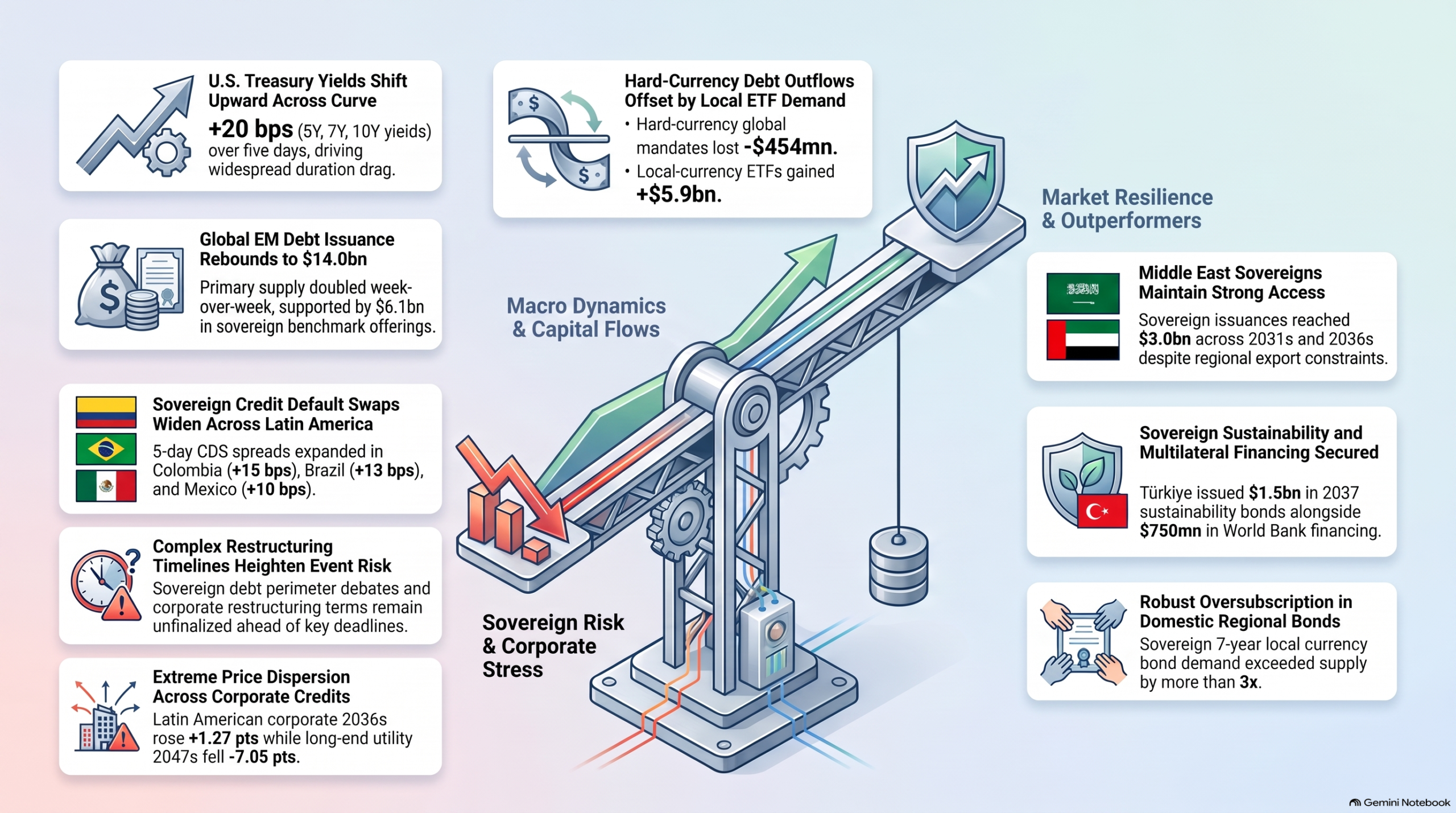
- Higher U.S. rates were the dominant weekly return driver, with 5Y, 7Y and 10Y Treasury yields each rising about 20bp over five days and the 30Y rising 15bp.
- EM bond outflows moderated to -US$104mn from -US$320mn, but hard-currency demand remained weak and sovereign HY underperformed.
- EM corporates proved more resilient than sovereign duration, while thin liquidity and defensive demand favoured front-end instruments and shorter spread duration.
- EM credit issuance increased to US$14.0bn, including US$6.1bn of sovereign supply, showing that primary-market access remained open despite weaker secondary performance.
- Brent ended near US$105.9/bbl, but physical export, insurance and logistics constraints prevented higher prices from translating uniformly into stronger credit conditions.
Market Visualizer
Weekly Snapshot: Key Drivers & Regional Flows
Global EM Themes
Flows & Technicals
- EM bond flows improved to -US$104mn from -US$320mn, indicating a slower outflow pace without a return to sustained inflows.
- Global-mandated EM debt recorded -US$201mn of flows, including -US$454mn from hard-currency global mandates and +US$183mn into local-currency global mandates.
- Local regional and country funds attracted US$4.9bn, while local-currency ETFs received US$5.9bn, accounting for much of the reported local-flow strength.
- External weekly index readings showed returns of approximately -0.94% for hard-currency sovereigns, -0.94% for local sovereigns and -0.48% for EM corporates.
- Weekly trading remained defensive, with lighter liquidity, demand concentrated in front-end instruments and sovereign HY underperforming IG.
Macro & Economics
- U.S. Treasury yields rose 18bp in the 2Y, 20bp in the 5Y, 7Y and 10Y, and 15bp in the 30Y over five days, creating the principal drag on weekly credit returns.
- Brent increased 2.0% over five days to US$105.9/bbl, sustaining inflation and geopolitical risk even as prices declined late in the week.
- High implied rate volatility, robust U.S. activity, energy-linked inflation risk and weak auction dynamics increased pressure on long-duration credit.
- Oil remained a two-sided credit variable because high prices were offset in several markets by physical export, insurance, refining and logistics constraints.
Regional Developments
Middle East & Africa
- GCC credit remained relatively resilient, although MENA IG and longer-dated energy-linked bonds weakened as U.S. rates rose.
- Qatar’s crude and product exports operated at 50–60% of pre-war levels, LNG utilisation remained near 20%, and full recovery was estimated to require two to three months.
- Qatar retained primary-market access by raising US$3.0bn across 2031 and 2036 sovereign bonds despite continuing physical-supply disruption.
- Senegal maintained that domestic debt should remain outside the restructuring perimeter, while uncertainty over comparable treatment continued to affect recovery assumptions.
- South Africa raised its policy rate 25bp to 7.25%, Nigeria cut 350bp to 23%, and Egypt held at 19%, highlighting significant regional policy divergence.
- Selected Kenyan T-bills and Zambian bonds cleared at yields of approximately 14.48–16.27%, underscoring elevated domestic funding costs.
Eastern Europe (CEE)
- Hungary paused monetary easing at 5.50%, while tighter global rates and defensive EM FX positioning placed pressure on CEE valuations.
- Türkiye issued US$1.5bn of 2037 sustainability bonds and secured US$750mn of World Bank agri-food financing, taking reported 2026 World Bank funding above US$9bn.
- Turkish corporate and financial bonds weakened by approximately 0.15–0.65 pts during the broader rates sell-off despite continued sovereign market access.
- Ukrainian corporate bonds fell about 0.75 pts as reported threats to winter power, heating, water and interconnector infrastructure reinforced event risk.
Latin America
- Five-day CDS changes reached Brazil +13bp, Mexico +10bp, Peru +5bp, Colombia +15bp and Chile +8bp, while COP depreciated 5.9%.
- Brazil’s September IPCA-15 increased 0.70% m/m, while polling remained within the margin of error ahead of the 4 October first-round election.
- Mexico’s central bank held its policy rate at 6.50% and indicated that future decisions would depend on inflation and FX pass-through.
- BRASKM, a Brazilian petrochemical restructuring story remained unresolved amid contested shareholder support, court intervention and an October 9 deadline for agreement on principal terms.
- Chile’s sovereign rating was affirmed at A with a stable outlook on 25 September.
Asia
- The regional policy cycle became more hawkish as higher energy prices and USD strength increased inflation risk across major oil-importing economies.
- Japan and Korea holidays reduced liquidity, while trading demand concentrated in front-end bullet bonds and Tier 2 instruments.
- Asian IG cash bonds lost approximately 0.5–1.375 pts and corporate spreads generally widened 1–2bp as Treasury yields rose.
- Pakistan sovereign bonds declined 0.5–1.0 pts during the week as sovereign HY remained the principal pressure point. Sri Lankan sovereign bonds got an upgrade to B- from CCC+, traded up 0.5 pts.
- Several large regional financial and energy transactions underperformed after issuance, while an active pipeline encouraged defensive secondary positioning.
- China’s faster fiscal execution and nearly CNY2tn of September government-bond issuance supported expectations for manufacturing PMI to improve to 50.1, although housing and consumption remained weak.
Primary Markets
- Total EM credit issuance reached US$14.0bn, more than doubling from US$5.9bn, with sovereign issuance accounting for US$6.1bn.
- ESG-labelled issuance totalled US$1.8bn as sovereign and corporate borrowers continued to access primary markets despite weaker secondary duration.
- Qatar issued US$3.0bn, the Dominican Republic raised US$1.6bn and Türkiye issued US$1.5bn, accounting for the principal sovereign transactions.
- San Juan Province raised US$600mn at 9.875%, while another Latin American issuer placed US$875mn of 10Y bonds at 7.1%.
- Softbank Group completed the well-expected $11b new bond offering on Wednesday, where three tranches of USD bonds and two tranches of EUR bonds were priced.
- Asia’s visible pipeline remained active across state-owned enterprises, banks and Australian issuers, although recent new issues were absorbed unevenly.
GEMBRIDGE CAPITAL
www.gembridgecapital.com
www.gembridgecapital.com
DISCLAIMER
This document is strictly confidential and is being provided to you for informational purposes only. It does not constitute an offer to sell or a solicitation of an offer to buy any securities or financial instruments. The information contained herein has been obtained from sources believed to be reliable but is not guaranteed as to accuracy or completeness. Opinions and estimates constitute our judgment as of the date of this material and are subject to change without notice.
AI Generation Notice: Portions of this content may have been generated or assisted by Artificial Intelligence (AI) technologies. Users should independently verify critical data points. Past performance is not indicative of future results.
© 2026 Gembridge Capital. All rights reserved.