


GEMBRIDGE CAPITAL
Global Emerging Markets Credit Strategy
Week Ending: September 5, 2026
Key Takeaways
- EM credit remained broadly stable despite rising geopolitical risks and higher US Treasury yields, with performance driven primarily by country-specific catalysts rather than broad beta moves.
- Fund flows slowed materially during the week, although August data continued to point to a constructive medium-term allocation backdrop for hard-currency and local-currency EM debt.
- Energy prices remained elevated, supporting oil exporters while increasing pressure on importers through inflation, external balances and tighter monetary-policy constraints.
- Primary market activity accelerated with US$21.2bn of weekly EM issuance and robust demand for sovereign transactions from Saudi Arabia and Pakistan.
- Credit dispersion remained high, with Venezuela outperforming on oil-related developments while Senegal, Colombia and parts of Asia faced fiscal, restructuring or supply-related pressures.
Market Visualizer
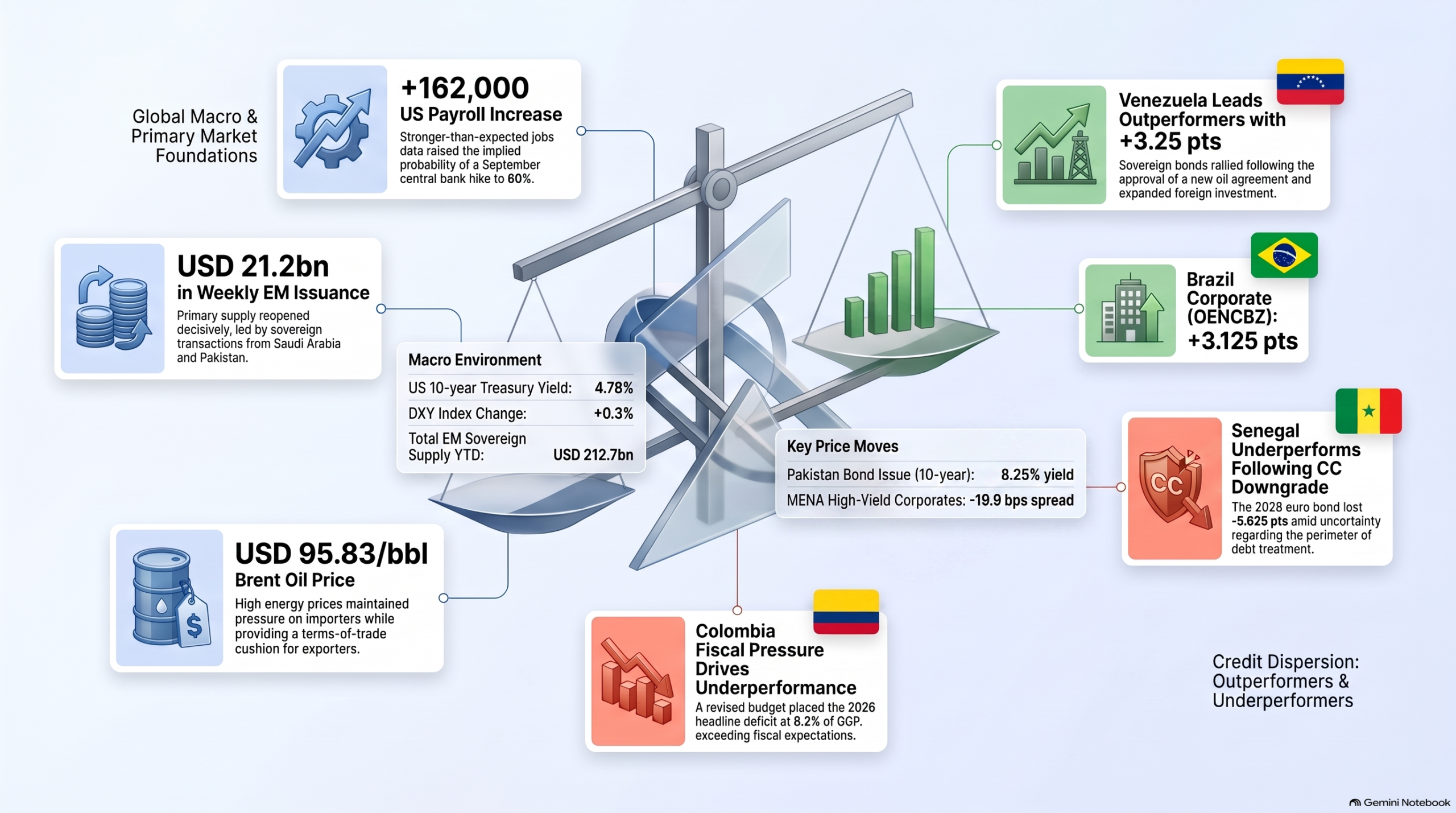
Weekly Snapshot: Key Drivers & Regional Flows
Regional Credit Developments
Global EM Themes
Flows & Technicals
- Hard-currency fund inflows slowed sharply to near flat during the week, while local-currency strategies continued to attract positive demand.
- August positioning remained supportive overall, with year-to-date hard-currency inflows exceeding prior-year totals despite a recent loss of momentum.
- Primary issuance surged to US$21.2bn, reinforcing continued market access across sovereign and corporate EM borrowers.
Macro & Economics
- Stronger US payrolls increased expectations of additional Fed tightening, pushing Treasury yields higher and reducing support from global duration.
- Brent crude ended near US$95.83/bbl, preserving a favorable backdrop for exporters while raising challenges for energy importers.
- Global activity indicators remained resilient despite elevated energy costs and growing inflation concerns.
Regional Developments
Middle East & Africa
- Gulf credit remained resilient despite renewed regional geopolitical tensions, with broad spread tightening across sovereign, corporate and AT1 segments.
- Saudi Arabia attracted strong demand for a dual-tranche sukuk transaction, with the final order book reported near US$16.5bn.
- Senegal remained the region’s main event risk after announcing debt-treatment measures alongside an IMF staff-level agreement, generating significant volatility across the curve.
- Broader African macro developments were mixed, with fiscal, growth and inflation dynamics remaining highly country specific.
Eastern Europe (CEE)
- Ukraine recovered from early weakness as political and negotiation headlines offset concerns around IMF-related legislative developments.
- Inflation surprises in Poland increased hawkish policy risks, while Czech and Hungarian monetary expectations remained comparatively stable.
Latin America
- Venezuela rallied strongly after an oil-sector agreement and announcements of expanded energy investment, making it one of the week’s top sovereign performers.
- Colombia underperformed as concerns increased around the medium-term fiscal outlook and financing requirements.
- Brazilian growth slowed in the second quarter, although market sentiment remained comparatively constructive and selected credits outperformed.
- El Salvador advanced modestly following progress under its IMF program, while Ecuador saw limited credit benefit from new multilateral financing.
Asia
- Pakistan’s fiscal and reserve positions continued to improve, although external funding vulnerabilities remain an important medium-term consideration.
- China’s housing-market reforms support long-term stability but may tighten financing conditions for developers and pressure property-sector credit fundamentals.
- Asian corporate credit softened around heavy new issuance, with Japan particularly weak while selected Chinese technology credits outperformed.
Primary Markets
- Saudi Arabia completed a heavily oversubscribed dual-tranche sukuk transaction, reopening sovereign GCC issuance after the summer period.
- Pakistan issued new 5½-year and 10-year bonds totaling US$3bn, marking one of the most significant EM sovereign deals of the week.
- Strong demand extended into regional bank-capital markets, with multiple subordinated and senior transactions drawing substantial investor interest.
- The September pipeline remains active, with investors closely monitoring additional potential sovereign issuance from several frontier and emerging-market borrowers.
GEMBRIDGE CAPITAL
www.gembridgecapital.com
www.gembridgecapital.com
DISCLAIMER
This document is strictly confidential and is being provided to you for informational purposes only. It does not constitute an offer to sell or a solicitation of an offer to buy any securities or financial instruments. The information contained herein has been obtained from sources believed to be reliable but is not guaranteed as to accuracy or completeness. Opinions and estimates constitute our judgment as of the date of this material and are subject to change without notice.
AI Generation Notice: Portions of this content may have been generated or assisted by Artificial Intelligence (AI) technologies. Users should independently verify critical data points. Past performance is not indicative of future results.
© 2026 Gembridge Capital. All rights reserved.