


GEMBRIDGE CAPITAL
Global Emerging Markets Credit Strategy
Week Ending: 18 September 2026
Key Takeaways
- The Federal Reserve delivered its first rate increase since 2023, with median projections pointing to one further hike by year-end, unchanged policy through 2027 and 25bp cuts in both 2028 and 2029, raising the duration hurdle for EM credit.
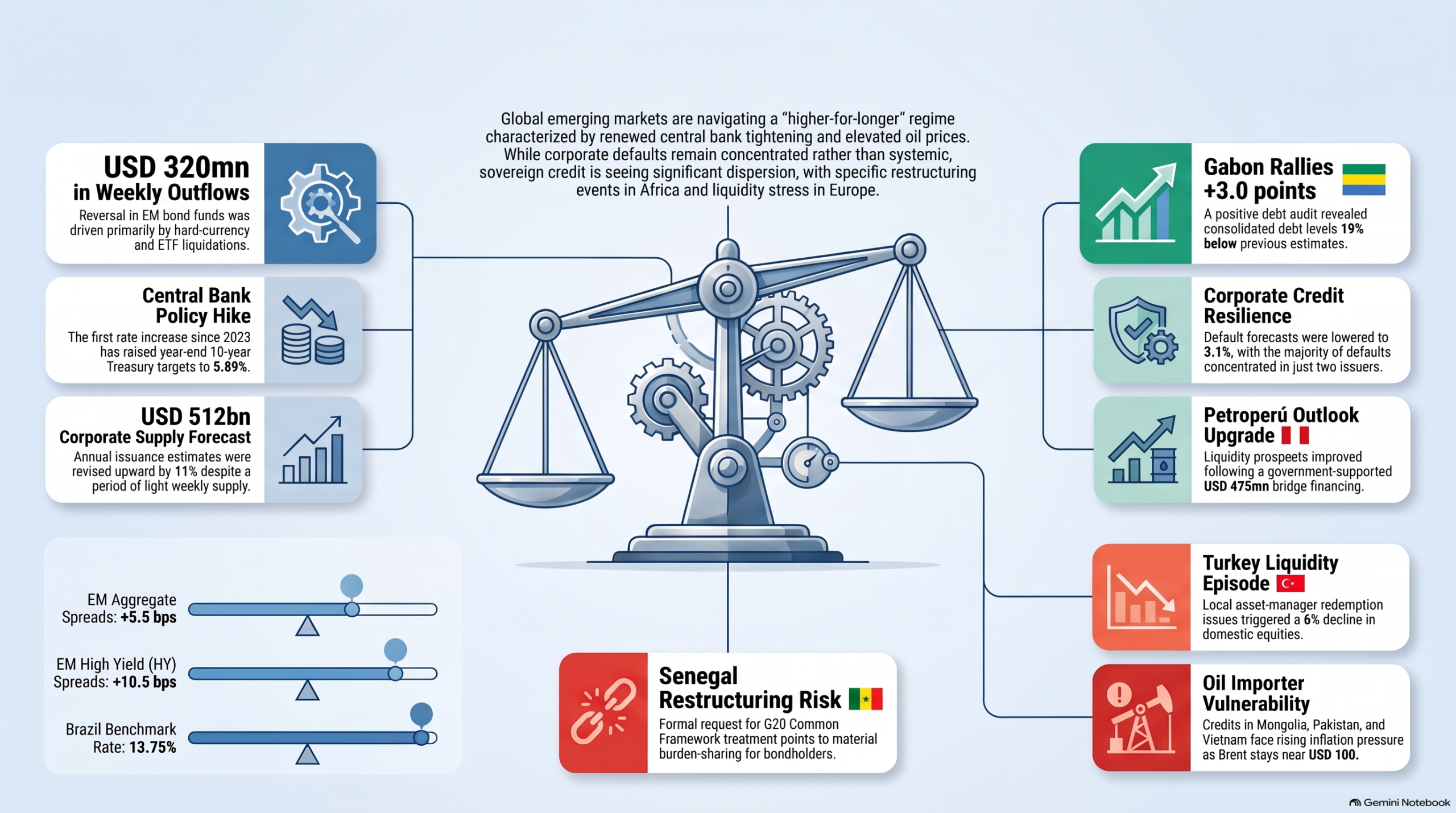
- EM bond funds returned to outflows of -US$320mn, driven by US$542mn of hard-currency redemptions and US$304mn from ETFs, while local-currency funds still took in US$221mn.
- EM credit weakened modestly over 14-18 September with high yield underperforming, as aggregate spreads widened 5.5bp WoW and high-yield spreads widened 10.5bp.
- Senegal formally requested debt treatment under the G20 Common Framework and continued IMF discussions, shifting bondholder focus to the treatment perimeter and burden sharing.
- Weekly EM credit issuance fell to US$5.9bn from US$19.3bn with no sovereign supply, though the forward pipeline remains considerable.
Market Visualizer
Weekly Snapshot: Key Drivers & Regional Flows
Regional Credit Developments
Global EM Themes
Flows & Technicals
- EM bond funds swung to -US$320mn of weekly outflows, with hard-currency funds losing US$542mn after US$228mn of inflows the prior week; broad EM funds shed US$375mn and Asia ex-Japan funds US$166mn.
- Local-currency funds attracted US$221mn including US$204mn into EM ex-China, though non-resident local-bond flows were negative and led by -US$735mn from Indonesia, the largest country outflow in the week.
- ETF outflows accelerated to US$304mn from US$16mn and EM equity funds lost US$2.0bn, weakening the technical cushion for tight-spread and less-liquid credits.
- EM aggregate spreads widened 5.5bp WoW and high-yield spreads widened 10.5bp, with Türkiye and Argentina among the weakest sovereigns and Gabon and Mozambique the strongest.
Macro & Economics
- The Federal Reserve raised rates 25bp, its first increase since 2023, and paired it with hawkish guidance; 10y UST touched 5% into the meeting before rallying with a flatter curve the following day.
- Year-end 2026 Treasury yield targets were lifted to 4.70% on 2s and 5.05% on 10s, with a further hike expected in December and a risk of another in early 2027 if growth holds and inflation stays sticky.
- EM disinflation is assessed as largely behind us on higher crude and refined-product prices, rising global food prices and diminishing fiscal buffers, with Asia showing the strongest inflation acceleration among EM Edge regions.
- Ukraine raised its policy rate 50bp to 16% and Armenia hiked 25bp, while South Africa is forecast to move 25bp higher to 7.25% and Hungary, Egypt and Nigeria to stay on hold.
- Brent traded at US$100-110/bbl, with sustained prices above US$100 viewed as unlikely as surplus inventory, additional supply and demand destruction rebalance the market.
Regional Developments
Middle East & Africa
- The temporary shutdown of Saudi Arabia’s East-West pipeline, Iran-Houthi tensions and continued Gulf and Red Sea shipping disruption drove early-week weakness, though GCC credits proved resilient and recovered as escalation fears eased.
- Israel’s August inflation printed at 1.5% year over year, modestly below expectations.
- Senegal formally requested debt treatment under the G20 Common Framework while continuing IMF discussions, with bondholders focused on burden sharing and the eventual restructuring perimeter.
- A Gabonese state debt audit put the consolidated stock at CFA9.52tn (about US$16.7bn) at end-2025 versus an initial estimate of nearly CFA11.7tn, 19% lower, and bonds rallied +1.50/+3.0pts WoW.
- Mozambique was downgraded to Caa3 with a stable outlook on heightened restructuring risk, yet bonds still gained around 2.5pts on expectations of a new IMF arrangement.
- South African headline inflation is expected to rise on higher food and transport prices, supporting a forecast 25bp policy-rate increase to 7.25%.
Eastern Europe (CEE)
- Türkiye was the week’s focal point after redemption problems at local asset managers triggered liquidity concerns and a 6% equity-market decline; sovereign bonds and CDS widened before stabilising once regulators and the central bank introduced support measures.
- Romania outperformed midweek after treasury officials indicated no further bond issuance, but reversed on negative political commentary, leaving the dollar and euro curves +3/+8bp wider.
- Ukraine’s central bank raised the policy rate 50bp to 16%, with fuel and regulated-price increases expected to push inflation higher into year-end.
- A Latvian airline filed for Chapter 11 protection in the Southern District of New York a day before a scheduled bondholder meeting, with its bonds down about 1pt WoW.
- A Turkish power producer appointed financial advisers to assess potential financing opportunities and its bonds fell roughly 15pts WoW, the week’s most significant corporate underperformance.
Latin America
- Brazil’s central bank cut the benchmark rate to 13.75% as expected, though the sovereign curve still widened +4/+6bp WoW, erasing part of its recent outperformance, with presidential polls effectively tied.
- Regional performance was mixed but broadly constructive, with investor focus on Colombia’s economic team engagement, the Dominican Republic’s debt tender and funding plans, and selective demand for high-quality duration.
- A Peruvian state oil company was moved to a positive outlook at Caa1 after a US$475mn government-supported bridge loan expected to improve liquidity and support working-capital normalisation, but its bonds still closed -0.30/-0.20pts WoW.
- Argentine sovereign bonds underperformed alongside broader high-beta risk assets, with no exact weekly move reported.
- In Venezuela, a major oil company was reported to have held talks on re-entering the country, while the government and opposition were said to be near a deal to move about US$4bn of gold reserves from the Bank of England to the Federal Reserve Bank of New York, potentially for use as borrowing collateral.
Asia
- Asian investment-grade sovereigns closed 5-15bp tighter and high-yield sovereigns rallied post-FOMC, with Pakistan 0.25-0.375pts lower across the curve and Sri Lanka’s longer-dated bonds 0.5-1pt higher; Vietnam’s finance ministry is reportedly in talks on a sovereign dollar bond of up to US$1bn, its first since 2014.
- Indonesia saw -US$735mn of non-resident local-bond outflows and a change of finance minister that markets largely looked through.
- Asian IG corporates tightened 3-5bp, led by a strong week in China TMT where spreads rallied 4-7bp tighter post-FOMC on short-covering and end-client demand, while Asian HY corporates closed 0.25-0.5pts lower.
- Real-time secondary property transactions across nine mainland cities rose 15% year over year and tier-one volumes 17%, with official primary and secondary registrations up 4% and 2%, though listing prices remained under pressure.
- China’s securities regulator reportedly declined to accept mandatory convertible bond registrations from distressed developers, which could complicate restructurings by limiting debt-to-equity conversion and creditor exit options.
- Hong Kong property was under significant pressure, with one developer’s perpetuals 3-5pts lower and associated instruments down 7.5-9.5pts amid rights-issue delays and higher mortgage-rate concerns; the city’s first Five-Year Plan (2026-30) was neutral for the sector, prioritising the Northern Metropolis and public housing supply without new measures.
- In Asian gaming, Malaysian perpetuals ended unchanged (3-5bp tighter) while a related curve firmed 0.75-1pt (30-45bp tighter); Macau front-end bonds slipped 0.125-0.375pts and higher-beta intermediate tenors fell 0.5-1pt.
- Mongolia, Pakistan, Sri Lanka and Vietnam face greater fuel or food-price pressure, with a possible December rate increase flagged for Mongolia if fuel and fiscal pressures persist.
Primary Markets
- Total EM credit issuance fell to US$5.9bn from US$19.3bn the prior week, with no EM sovereign supply printed.
- Year-to-date sovereign issuance stood at US$213.7bn, US$16.7bn above the comparable 2025 level and equivalent to 73.2% of full-year expectations.
- Prospective sovereign issuers include Argentina, Colombia, Dominican Republic, Egypt, Guatemala and Nigeria in high yield, and Chile, Latvia, Panama and Romania in investment grade.
- The 2026 EM corporate supply forecast was raised 11% to approximately US$512bn, with issuance reaching US$396.8bn through 15 September, comprising US$288.1bn of IG and US$108.8bn of HY.
- The 2026 EM high-yield corporate default forecast was reduced to 3.1% from 4.3%, with two issuers accounting for 75% of year-to-date default volume.
GEMBRIDGE CAPITAL
www.gembridgecapital.com
www.gembridgecapital.com
DISCLAIMER
This document is strictly confidential and is being provided to you for informational purposes only. It does not constitute an offer to sell or a solicitation of an offer to buy any securities or financial instruments. The information contained herein has been obtained from sources believed to be reliable but is not guaranteed as to accuracy or completeness. Opinions and estimates constitute our judgment as of the date of this material and are subject to change without notice.
AI Generation Notice: Portions of this content may have been generated or assisted by Artificial Intelligence (AI) technologies. Users should independently verify critical data points. Past performance is not indicative of future results.
© 2026 Gembridge Capital. All rights reserved.