


GEMBRIDGE CAPITAL
Global Emerging Markets Credit Strategy
Week Ending: 7 November 2026
Key Takeaways
- The top-down signal remained conflicted as post-election hopes for lower fiscal and Middle-East risk initially pushed oil, yields and the dollar lower, before the AI-equity sell-off and a 165k US payroll print restored Fed-tightening risk and pushed front-end US yields back into focus.
- EM sovereign credit returned +0.3% despite spreads widening 13bp to 211bp, with IG returning +0.6% versus HY at -0.1%; Asia and CEEMEA returned +0.7%, while LatAm returned -0.3% as spreads widened 27bp.
- Corporate credit was softer, with CEMBI Broad widening 4bp to 208bp; HY widened 10bp versus only 1bp for IG, while Transport tightened 12bp and Oil & Gas widened 10bp.
- EM bond flows were more balanced beneath the headline number, with only $27mn of net outflows as $562mn of hard-currency redemptions were largely offset by $535mn of local-currency inflows.
- Regional dispersion remained high, with Argentina and Paraguay leading LatAm weakness, Senegal facing renewed restructuring pressure, Indonesia absorbing a sizeable sovereign supply concession, and China property remaining differentiated between stressed local-SOE and more resilient higher-quality credits.
Market Visualizer
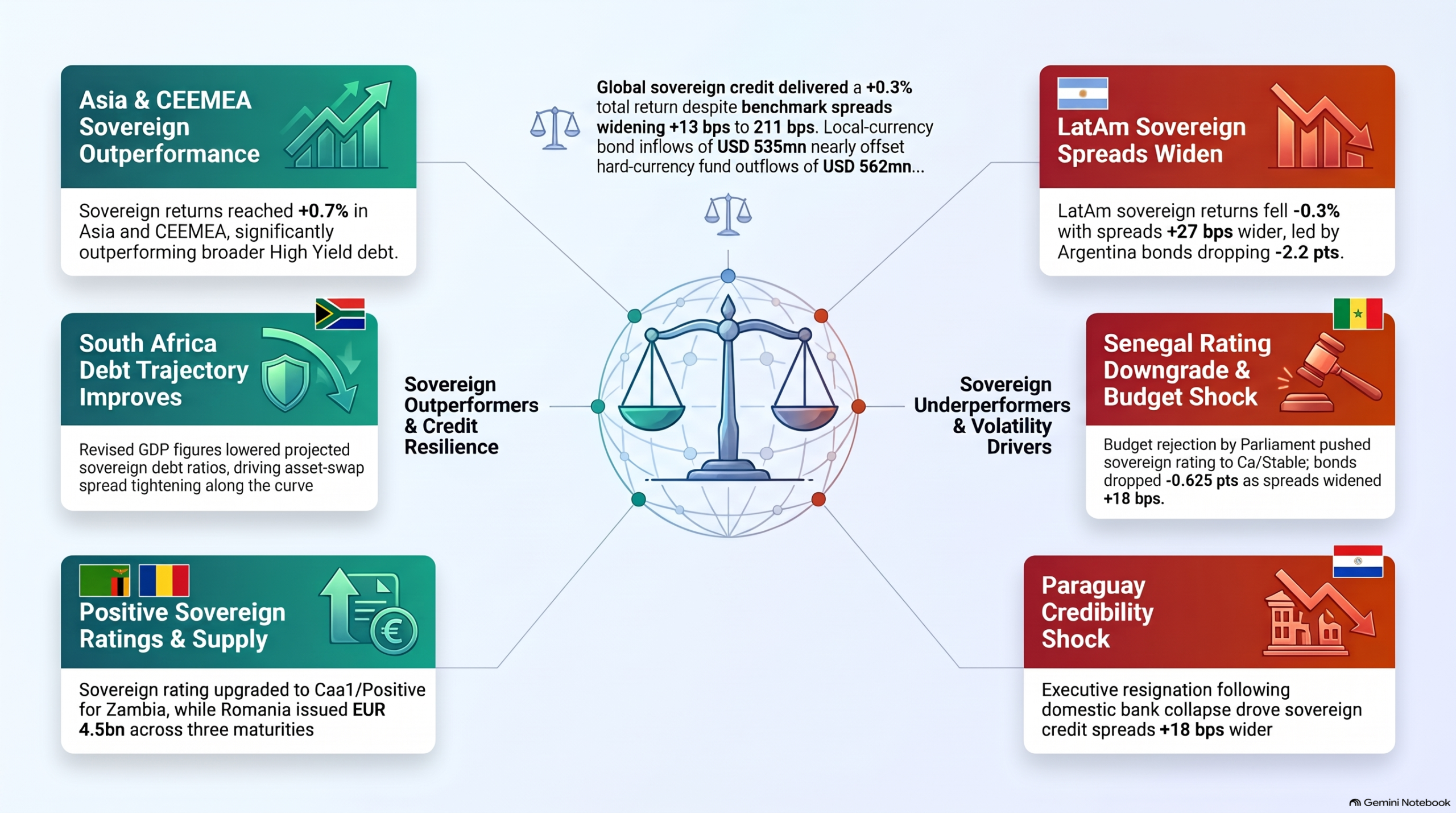
Weekly Snapshot: Key Drivers & Regional Flows
Regional Credit Developments
Global EM Themes
Flows & Technicals
- EM bond funds recorded only $27mn of net outflows, comprising $562mn of hard-currency outflows offset by $535mn of local-currency inflows, highlighting materially different demand patterns across the two asset classes.
- ETFs attracted $221mn while non-ETF funds lost $248mn; broad hard-currency funds recorded $520mn of outflows, while EM ex-China local-currency funds attracted $564mn.
Macro & Economics
- Post-election hopes for lower fiscal and Middle-East risk initially drove oil, US Treasury yields and the dollar lower, before the AI-equity sell-off and a 165k US payroll print restored Fed-tightening risk and pushed yields and the dollar higher.
- The sovereign index returned +0.3% even as spreads widened 13bp to 211bp, with IG returning +0.6% against HY at -0.1%; Asia and CEEMEA both returned +0.7%, while LatAm returned -0.3% as spreads widened 27bp.
- CEMBI Broad widened 4bp to 208bp, with HY widening 10bp compared with only 1bp for IG; sector performance was also differentiated as Transport tightened 12bp while Oil & Gas widened 10bp.
Regional Developments
Middle East & Africa
- Senegal remained under significant pressure after parliament rejected the revised budget, increasing uncertainty around IMF timing and state liquidity; the sovereign was downgraded to Ca/Stable, while bonds fell about 0.6 pt and widened 13-18bp.
- South Africa benefited from revised GDP data that lowered the projected government debt burden, supporting further improvement in local sovereign credit metrics after a strong technical performance.
- Ghana reached staff-level agreement on the first review of its Policy Coordination Instrument, while Zambia was upgraded to Caa1/Positive; Kenya, by contrast, continued to explore sizeable Eurobond, sukuk and liability-management funding that could increase prospective sovereign supply.
- Middle-East markets remained dominated by geopolitical optionality as Qatar-mediated proposals contemplated reopening the Strait of Hormuz and resuming nuclear talks, although Iran maintained that neither step would occur until its conditions were met and Qatar LNG tanker exits remained well below pre-war levels.
- Saudi Aramco cut December Arab Light pricing to Asia by $2 to a $7 discount, while GCC credit reversed an earlier rally and moved around 2-4bp wider as selling in Saudi Arabia and Qatar duration combined with prospective Saudi Electricity Company supply.
Eastern Europe (CEE)
- CEE central banks continued to differentiate, with Poland holding its policy rate at 3.8% while signalling readiness to hike, the Czech National Bank raising rates 25bp to 4.0%, and Romania expected to remain at 6.5% alongside a higher inflation forecast.
- Poland’s late-week risk backdrop deteriorated as hawkish policymakers halted the rates rally and the sovereign outlook was revised to negative on elevated fiscal deficits and rising government debt.
- Romania successfully raised €4.5bn across new 2030, 2034 and 2038 euro-denominated maturities.
- Turkey remained technically fragile beneath relatively stable sovereign spreads, with ETFs selling sovereign duration while corporate weakness broadened; WESODA closed 2.0-2.4 pts lower and SISETI fell about 1.9 pts.
Latin America
- Argentina and Paraguay drove regional underperformance, with Argentina bonds falling roughly 1.6-2.2 pts despite hedge-fund buying, while Paraguay initially widened 18bp before finishing around 7-8bp wider following President Peña’s resignation after the Ueno Bank collapse.
- Paraguay’s shock remained concentrated in credibility and risk premia rather than broader financial stability, with no clear evidence of systemic deposit flight from the Ueno Bank collapse, although FX-linked inflation pressure and weaker investment sentiment remained key risks.
- Brazil’s central bank held Selic at 13.8%, while 2027 inflation expectations rose 42bp to 4.8% and the expected end-2027 Selic rate increased 75bp to 12.5%, keeping rates and fiscal credibility central to the domestic credit backdrop.
- PEMEX reported a $4.0bn q/q decline in net debt to $67.7bn and a fall in net leverage to 2.8x, while increasing differentiation between its intermediate and long-dated bonds reflected expectations that government support and potential liability-management activity would be concentrated in nearer maturities.
- Petroperu reported $200mn of 3Q EBITDA and completed the full October disbursement of its bridge loan, while Nutresa’s leverage increased to 5.1x following another debt-funded share buyback.
Asia
- Indonesian sovereign bonds widened 4-10bp as new supply displaced demand.
- Ex-Indonesia Asian credit was comparatively resilient through the equity shock, with China IG opening just 1-2bp wider, Southeast Asia and Korea 1-3bp wider and HY around 0.3-0.4 pt lower.
- China property remained differentiated between stressed local-SOE and more resilient higher-quality credits; prior-period data showed China HY property down 4.4% in the week ended 30 October as Huafa stress spilled into Longfor and Greentown, while Vanke’s cash-to-short-term-debt coverage fell to 0.3x.
- Macau gaming fundamentals weakened as SJM’s EBITDA fell 20% y/y and leverage reached 9.0x, with HK$19bn of bank loans maturing in 2Q28, while Wynn Macau’s EBITDA declined 15% y/y.
Primary Markets
- EM credit issuance totaled approximately $9.7bn, including $8.0bn of sovereign supply concentrated largely in Indonesia and Romania, while corporate primary issuance remained below $2bn week-to-date.
- Indonesia accounted for $3bn of primary sovereign supply through its triple-tranche sukuk deal, with the new bonds carrying roughly a 30bp concession and contributing to 4-10bp of widening in secondary Indonesian sovereign credit.
- Romania raised €4.5bn across new 2030, 2034 and 2038 maturities, adding another significant sovereign transaction to a week in which new issuance was heavily concentrated in sovereign rather than corporate borrowers.
GEMBRIDGE CAPITAL
www.gembridgecapital.com
www.gembridgecapital.com
DISCLAIMER
This document is strictly confidential and is being provided to you for informational purposes only. It does not constitute an offer to sell or a solicitation of an offer to buy any securities or financial instruments. The information contained herein has been obtained from sources believed to be reliable but is not guaranteed as to accuracy or completeness. Opinions and estimates constitute our judgment as of the date of this material and are subject to change without notice.
AI Generation Notice: Portions of this content may have been generated or assisted by Artificial Intelligence (AI) technologies. Users should independently verify critical data points. Past performance is not indicative of future results.
© 2026 Gembridge Capital. All rights reserved.