


GEMBRIDGE CAPITAL
Global Emerging Markets Credit Strategy
Week Ending: 26 June 2026
Key Takeaways
- EM credit markets were broadly range‑bound with mild spread widening, as investors reduced risk amid heavy supply and geopolitical uncertainty.
- Flows returned to positive territory, with renewed inflows into EM bond funds after a period of flat activity, supporting technicals.
- Oil price declines (~>10%) driven by US‑Iran progress shifted macro dynamics, supporting oil importers but weighing on exporters.
- Valuations remain tight across regions, consistent with a late‑cycle setup characterized by stable fundamentals but limited upside.
Market Visualizer
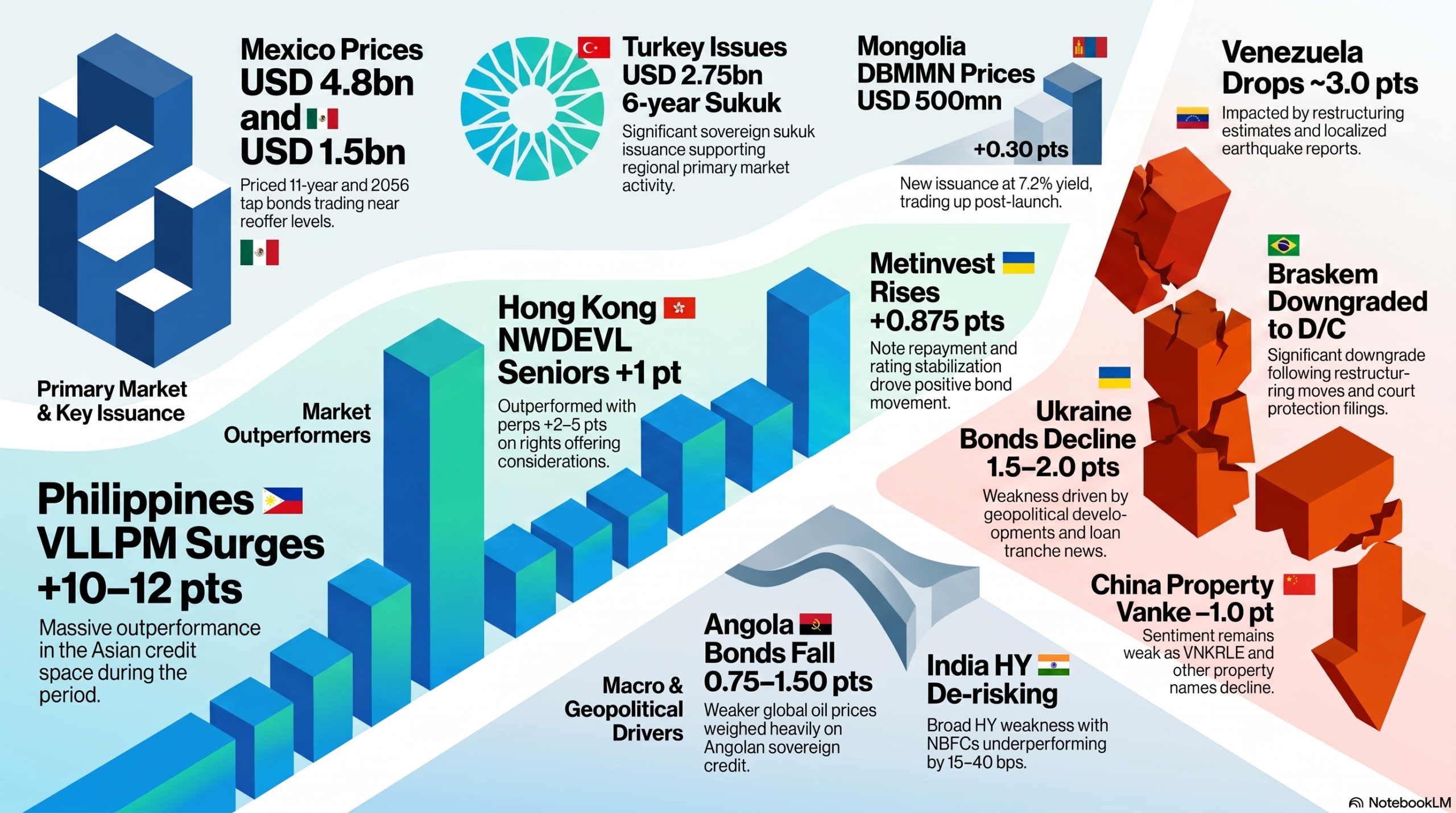
Weekly Snapshot: Key Drivers & Regional Flows
Regional Credit Developments
Global / Cross‑EM Themes
Flows & Technicals
- EM bond funds saw renewed inflows in the week to 24 June, reversing prior flat flows and supporting overall technical conditions.
- Flow recovery was broad but uneven, with local‑currency global funds lagging due to FX weakness, while EM credit funds and Asia‑focused funds saw inflows.
- High‑frequency data indicates +US$614mn EM bond inflows, driven by strong hard‑currency demand (+$651mn) and ETF participation.
- Equity flows remain volatile, though turned positive WoW (+US$1.1bn), highlighting improving but still fragile risk sentiment.
Macro & Economics
- Oil prices have declined sharply following easing tensions in the Strait of Hormuz, with Brent falling from >$110/bbl to below ~$73/bbl.
- The oil decline is expected to reduce inflation and improve current accounts across EM, especially for importers, though not fully reversing earlier shocks.
- Global macro remains mixed, with a more hawkish Fed outlook and inflation still elevated despite easing energy pressures.
- Overall EM economies are described as “remarkably resilient” despite volatility in energy and geopolitics.
Regional Developments
Middle East & Africa
- Africa credit performance diverged by oil exposure:
- Oil exporters (Nigeria, Angola) underperformed as oil prices declined (‑0.75 to ‑1.50pts WoW)
- Importers (Kenya, Egypt) outperformed relatively, though absolute price moves remained muted
- Gabon sold off after a negative outlook revision, while Senegal outperformed despite restructuring headlines and fiscal uncertainty.
- Lower oil prices are expected to improve external balances for importers but weaken fiscal positions for exporters.
Eastern Europe (CEEMEA)
- CEE markets were volatile but resilient, with Romania trading around political headlines (confidence vote) before stabilizing.
- Ukraine bonds weakened (~‑1 to ‑1.75pts WoW) despite continued international financial support and intermittent geopolitical optimism.
- Lower oil prices ease inflation pressure across the region, supporting central bank policy stability.
Latin America
- LatAm credit showed mixed performance, with new issuance (e.g. Mexico $4.8bn deal) trading broadly around reoffer levels.
- Venezuela/PDVSA underperformed, driven by debt burden estimates (~$240bn) and adverse headlines.
- Brazil corporates were volatile, with restructuring headlines (Braskem) and rating downgrades impacting price action.
- Macro outlook highlights ongoing data monitoring and event‑driven catalysts across the region.
Asia
- Asia credit remains tight but low‑return, reflecting a late‑cycle dynamic with limited spread compression left.
- Regional macro backdrop is improving in some economies (e.g. India), supported by lower oil prices and policy measures aimed at attracting inflows.
- High‑yield issuance activity is recovering on improving geopolitical sentiment, particularly amid hopes of Middle East peace.
Primary Markets & Supply
- Primary issuance increased materially, with ~$15bn EM ex‑Asia supply during the week.
- Supply was led by:
- Mexico (~$4.8bn 11Y + long‑end tap)
- Turkey (~$2.75bn sukuk)
- Local markets continue to show broad‑based bond supply across Asia, CEEMEA, LatAm, and frontier issuers, reinforcing liquidity conditions.
- Market tone reflects risk reduction into heavy supply, rather than a lack of demand.
GEMBRIDGE CAPITAL
www.gembridgecapital.com
www.gembridgecapital.com
DISCLAIMER
This document is strictly confidential and is being provided to you for informational purposes only. It does not constitute an offer to sell or a solicitation of an offer to buy any securities or financial instruments. The information contained herein has been obtained from sources believed to be reliable but is not guaranteed as to accuracy or completeness. Opinions and estimates constitute our judgment as of the date of this material and are subject to change without notice.
AI Generation Notice: Portions of this content may have been generated or assisted by Artificial Intelligence (AI) technologies. Users should independently verify critical data points. Past performance is not indicative of future results.
© 2026 Gembridge Capital. All rights reserved.