


GEMBRIDGE CAPITAL
Global Emerging Markets Credit Strategy
Week Ending: 24 July 2026
Key Takeaways
- EM credit remained resilient despite renewed Middle East tensions and a sharp rise in oil prices, with corporate spreads generally outperforming sovereign benchmarks.
- EM bond funds recorded +US$741mn of weekly inflows, extending the positive July trend and lifting year-to-date inflows to US$29.2bn.
- Higher oil prices improved the outlook for several commodity-exporting sovereigns while increasing pressure on oil-importing economies.
- Debt dynamics continued improving across selected frontier markets including Angola, Zambia, Pakistan and Sri Lanka, supported by reforms and external financing.
- Country-specific opportunities continue to dominate performance, reinforcing the case for selective exposure rather than broad EM beta.
Market Visualizer
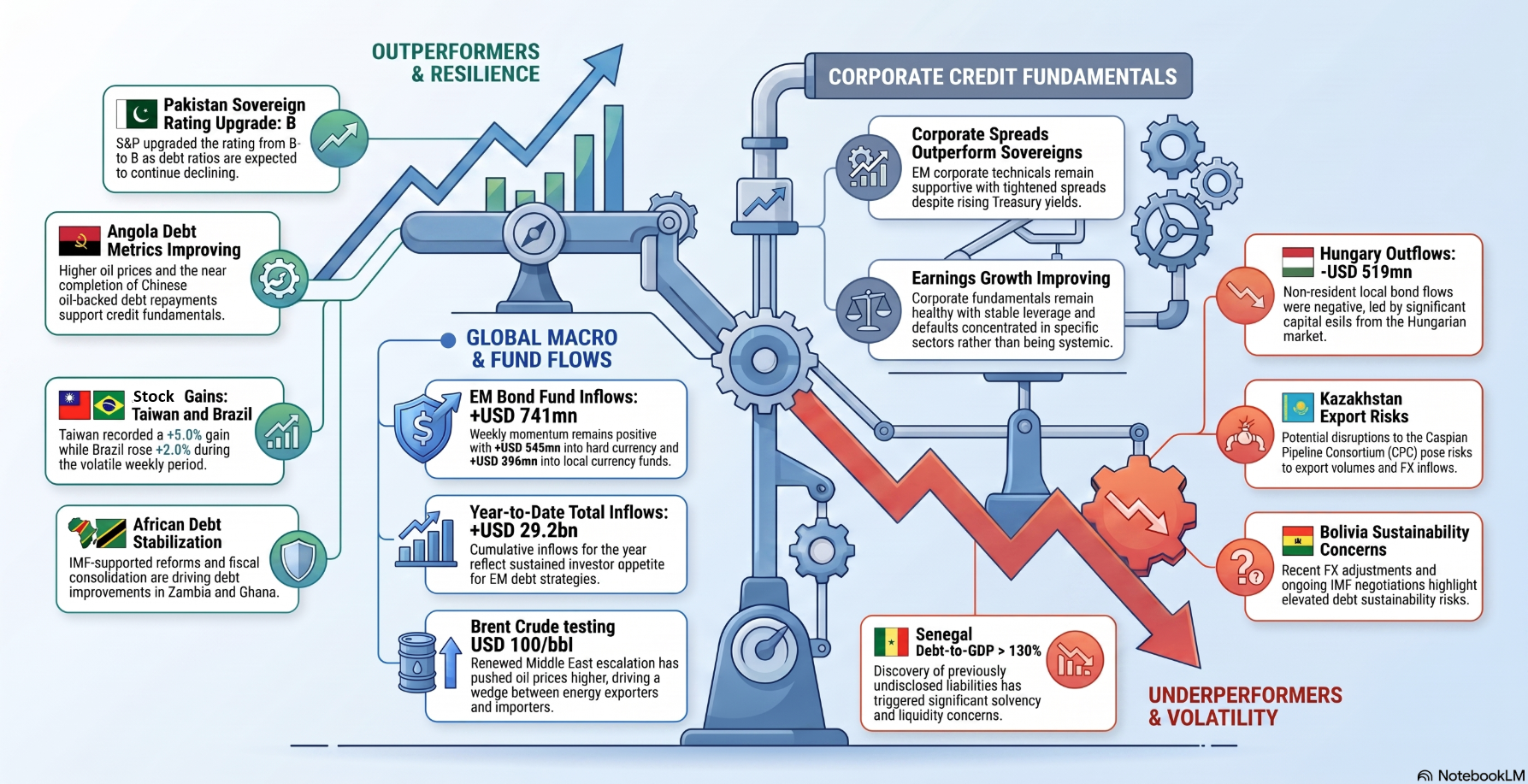
Weekly Snapshot: Key Drivers & Regional Flows
Regional Credit Developments
Global EM Themes
Flows & Technicals
- EM bond funds attracted +US$741mn during the week, split between hard-currency inflows of +US$345mn and local-currency inflows of +US$396mn.
- Year-to-date EM bond flows reached US$29.2bn, with ex-China local currency strategies continuing to attract allocations while China-focused funds saw modest outflows.
- Corporate technicals remained supportive despite higher Treasury yields and rising oil prices, allowing EM corporate spreads to tighten and outperform sovereign benchmarks.
- Non-resident local bond flows were negative overall, led by outflows from Hungary totaling US$519mn.
Macro & Economics
- Renewed Middle East tensions pushed Brent crude toward US$100/bbl and increased volatility across global credit markets.
- Oil-exporting sovereigns generally benefited from stronger commodity prices, while oil importers remained vulnerable to further energy cost shocks.
- Market performance continued to be driven by country-specific catalysts rather than broad EM macro trends, supporting a selective investment approach.
Regional Developments
Middle East & Africa
- Escalating regional tensions, including threats to energy infrastructure and shipping routes, remained the key catalyst driving oil markets and credit sentiment.
- Debt stabilization trends across frontier Africa continued to improve as fiscal consolidation and IMF-supported reforms gained traction.
- Senegal remained under close scrutiny after previously undisclosed liabilities pushed debt levels above 130% of GDP, raising ongoing solvency and restructuring concerns.
- Nigeria and Angola benefited from higher oil prices, with stronger external balances and improving debt metrics supporting credit fundamentals.
Eastern Europe (CEE)
- Debt dynamics across the region remained relatively stable, supported by generally stronger fiscal profiles than many other EM peers.
- Hungary remained a relative bright spot and saw an additional central bank rate cut during the week.
- Kazakhstan faced risks to export volumes and foreign-exchange inflows from potential disruptions to the Caspian Pipeline Consortium route.
- Ukraine’s debt metrics remained elevated due to ongoing war-related financing needs despite continued international support.
Latin America
- Lower-rated Latin American high-yield sovereigns continued to offer attractive relative value versus higher-quality alternatives.
- Bolivia remained a prominent debt-risk story as sustainability concerns persisted alongside ongoing IMF discussions and FX adjustments.
- Venezuela continued to face funding constraints and limited access to multilateral financing following recent economic disruptions.
- Oil-exporting markets including Brazil and Colombia remained comparatively resilient during the latest commodity rally.
Asia
- Asian market performance diverged, with Taiwan and China posting gains while Korea, Indonesia, India and the Philippines underperformed.
- Debt ratios in Pakistan and Sri Lanka are expected to continue declining as reforms and external financing programs progress.
- Pakistan continued accessing international funding channels and received a sovereign rating upgrade during the week.
- Vietnam remained among the economies most exposed to evolving US tariff policy risks.
Primary Markets
- Primary issuance conditions remained constructive as persistent inflows and supportive technicals continued to underpin investor demand.
- Market participants remained focused on carry opportunities and selective high-yield issuance rather than broad sovereign beta exposure.
- Corporate credit fundamentals continued to screen favorably, with stable leverage, improving earnings growth and relatively contained default activity.
- Investor positioning remained constructive toward the BBB/BB segment of EM corporate credit while showing greater caution toward broad oil-linked high-yield trades.
GEMBRIDGE CAPITAL
www.gembridgecapital.com
www.gembridgecapital.com
DISCLAIMER
This document is strictly confidential and is being provided to you for informational purposes only. It does not constitute an offer to sell or a solicitation of an offer to buy any securities or financial instruments. The information contained herein has been obtained from sources believed to be reliable but is not guaranteed as to accuracy or completeness. Opinions and estimates constitute our judgment as of the date of this material and are subject to change without notice.
AI Generation Notice: Portions of this content may have been generated or assisted by Artificial Intelligence (AI) technologies. Users should independently verify critical data points. Past performance is not indicative of future results.
© 2026 Gembridge Capital. All rights reserved.