


GEMBRIDGE CAPITAL
Global Emerging Markets Credit Strategy
Week Ending: 31 October 2026
Key Takeaways
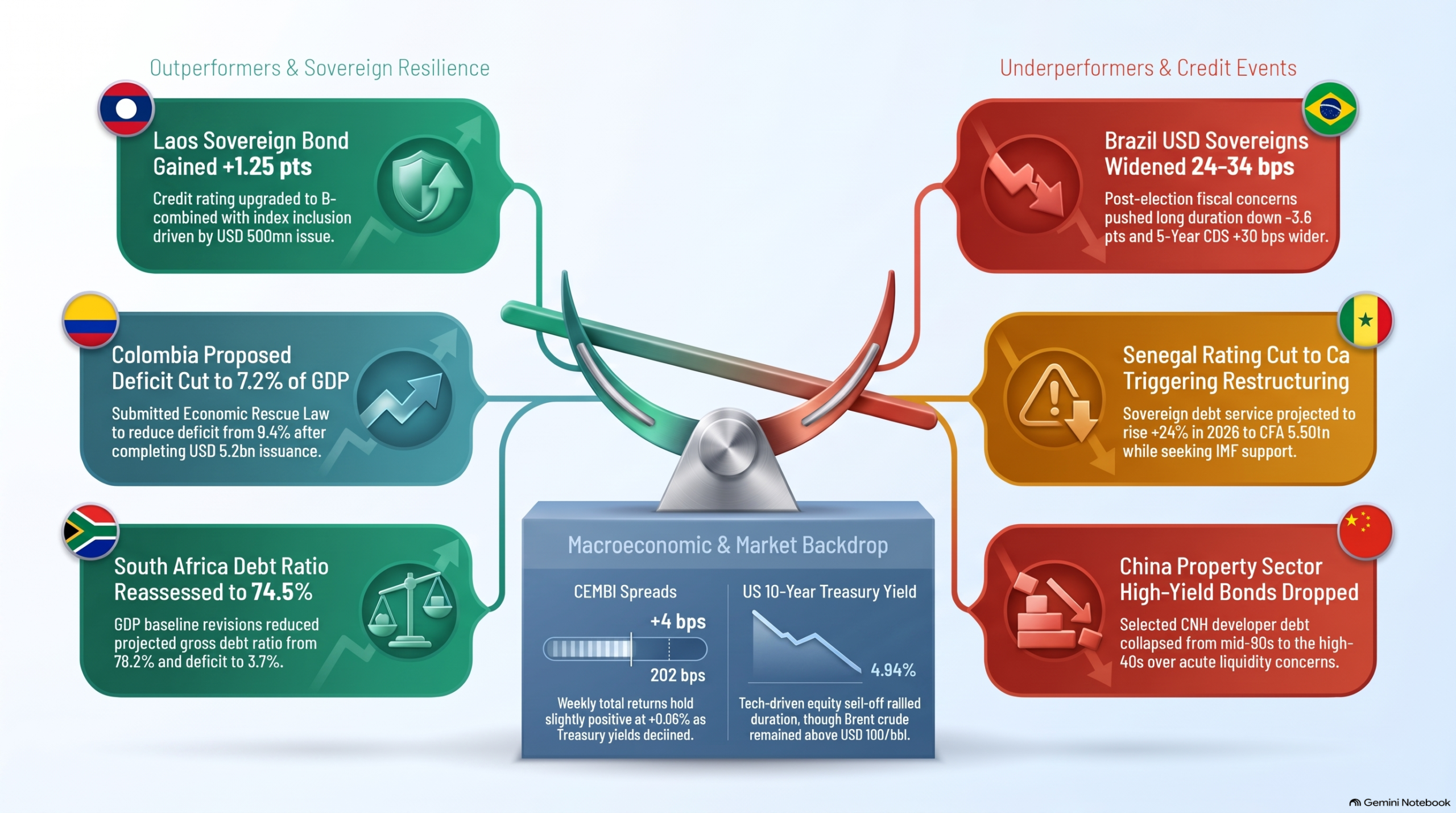
- EM credit delivered marginally positive carry despite benchmark spreads widening 4bp to 202bp, as lower Treasury yields offset modest spread decompression.
- Hard-currency fund flows remained negative but improved WoW, with ETF demand cushioning continued redemptions from active vehicles rather than reversing the broader outflow trend.
- Technology-led risk reduction weakened the usual relationship between lower Treasury yields and tighter EM spreads, increasing the importance of spread beta, liquidity and refinancing needs.
- Brazil, Senegal, Bahrain, Egypt and China-property-linked risk showed the greatest event sensitivity, while liquid Asian IG and selected commodity exporters retained stronger sponsorship.
- Medium-duration high-quality credit captured the rates rally more effectively than long-end bonds, which remained exposed to supply, term premium and event convexity.
Market Visualizer
Weekly Snapshot: Key Drivers & Regional Flows
Global EM Themes
Flows & Technicals
- Total EM bond funds recorded US$508mn of outflows, improving from US$731mn previously, as hard-currency funds lost US$515mn and local-currency vehicles received US$6mn.
- ETFs attracted US$426mn while non-ETF vehicles lost US$934mn, indicating that passive demand was cushioning rather than reversing active-fund redemptions.
- Global-mandated EM debt funds lost US$498mn, although sovereign allocations received US$220mn and hard-currency ETFs attracted US$395mn.
- China fixed-income funds received US$4.4bn within US$15.3bn of global bond-fund inflows, explaining why strong aggregate demand did not translate evenly into EM hard-currency credit.
- Ten privately placed corporate bonds totalling US$5.65bn were scheduled to enter the corporate benchmark at month-end, representing approximately 60bp of the diversified index.
Macro & Economics
- The US 10-year Treasury yield fell 8.1bp to 4.9% on 29 October, while the 2-year yield declined 10bp and the dollar index fell 0.3% amid a technology-led risk-off rotation.
- US 3Q GDP expanded at a 3.4% annualised rate while core PCE remained at 3.1% y/y, leaving the rates rally driven more by risk reduction than by a clean disinflation signal.
- The Fed held rates at 3.8–4.0% in a 10–2 vote, while major developed-market central banks paused without abandoning their tightening biases.
- Brent remained above US$100/bbl, while delivered oil costs reached US$131/bbl in China and US$120/bbl in Europe because of freight and refined-product dislocations.
- US equities fell sharply on 30 October, with the S&P 500 down 1.8%, Nasdaq down 2.9% and technology shares down 4.2%, while Treasury duration rallied and credit indices widened.
Regional Developments
Middle East & Africa
- Senegal’s foreign-currency issuer and senior unsecured ratings were cut to Ca from Caa2 as the sovereign pursued a US$2.2bn IMF facility alongside external debt restructuring, its debt service was projected to rise 24% to CFA5.50tn, increasing the importance of restructuring terms and creditor burden-sharing.
- Egypt’s central bank raised its benchmark rate by 100bp to 20% after the EGP weakened beyond 55, while an IMF mission began the final review of the US$8bn EFF.
- South Africa’s revised GDP level made the 2025 economy 5.3% larger, potentially reducing the current-year gross debt ratio to 75% from 78% and the deficit to 3.7% from 3.9%.
- Mozambique identified a further US$528mn external funding need, while Nigeria defended a five-year US$21.7bn external borrowing plan that included approximately US$7.9bn from multilateral and bilateral sources.
- Saudi official reserves fell 4.4% m/m in September despite elevated oil prices, while conflict-related disruption continued to weigh on non-oil activity and regional infrastructure risk.
- Bahrain faced projections of a 7.7% economic contraction, a fiscal deficit of 19% of GDP, debt at 180% of GDP and reserves of US$1.6bn in August.
- Two Qatari LNG trains were expected to remain offline for about three years, removing approximately 17% of production capacity.
Eastern Europe (CEE)
- Ukraine’s central bank cut its 2026 GDP forecast to a 0.4% contraction from 1.8% growth as IMF discussions resumed around fiscal policy and external financing needs.
- Serbia’s opposition-led Student List secured an outright parliamentary majority, ending 14 years of incumbent-party dominance and shifting attention to cabinet formation and policy continuity.
- Romania retained a 6.2%-of-GDP full-year cash-deficit target while raising October domestic issuance to RON7.1bn from RON5.8bn.
- Poland began pre-financing its 2027 requirements, while Hungary received US$156mn of non-resident local-bond inflows.
Latin America
- Brazilian USD sovereign spreads widened 24–34bp after the presidential runoff, with intermediate bonds falling approximately 1.15 pts and long-duration bonds declining as much as 3.8 pts. Its five-year CDS widened 30bp to 148/152, while domestic debentures fell approximately 6% as high real rates and fiscal uncertainty tightened local funding conditions. Brazilian exporters and USD earners were relatively insulated compared with leveraged businesses dependent on domestic demand, BRL funding or regulated pricing.
- Colombia completed US$5.2bn of sovereign issuance across 2032, 2037 and 2056 maturities, removing its remaining 2026 Eurobond requirement. Colombia also submitted an Economic Rescue Law targeting a reduction in the fiscal deficit from 9.4% to 7.2% of GDP, with execution dependent on legislative approval and multilateral engagement.
- Peru faced reports of a potential international sovereign issue of PEN10bn or more, making prospective supply the main near-term technical consideration.
Asia
- Indonesian USD sovereign cash tightened 5–15bp late in the week even as local bonds widened 15bp on the day and 50bp month-to-date.
- A major China property issuer’s (HUAFA) 2027 and 2028 CNH bonds fell to the high-50s and high-40s from the mid-to-high-90s, while its perpetual securities dropped to the mid-30s from near par.
- The China property shock spread into performing property names and higher-beta China IG, although policy-supported SOEs and liquid technology credits remained more resilient.
- Laos was upgraded to B- from CCC and benefited from sovereign-index inclusion, with its new bond rising 1.25 pts during the 29 October session.
- Real-money demand supported selected Indian banks and non-bank financial companies, but low-beta IG paper continued to clear slowly.
Primary Markets
- EM credit issuance totalled US$12.1bn during the week, including US$5.7bn of sovereign supply.
- Colombia issued US$2.2bn of 2032 bonds, US$2.0bn of 2037 bonds and US$1.0bn of 2056 bonds, concentrating supply across intermediate and long maturities.
- Laos entered the sovereign benchmark through a US$500mn 2032 issue, creating passive demand alongside the sovereign’s rating upgrade.
- High-quality Asian financial, consumer and gaming borrower (Meituan) completed subordinated, CNH senior and USD senior transactions, confirming continued access for liquid or strategically supported issuers.
- A lower-quality Indonesian bank (Bank KB) withdrew a proposed three-year USD senior transaction despite initial guidance at T+275bp, highlighting weak demand below the stronger end of the Asian primary market.
GEMBRIDGE CAPITAL
www.gembridgecapital.com
www.gembridgecapital.com
DISCLAIMER
This document is strictly confidential and is being provided to you for informational purposes only. It does not constitute an offer to sell or a solicitation of an offer to buy any securities or financial instruments. The information contained herein has been obtained from sources believed to be reliable but is not guaranteed as to accuracy or completeness. Opinions and estimates constitute our judgment as of the date of this material and are subject to change without notice.
AI Generation Notice: Portions of this content may have been generated or assisted by Artificial Intelligence (AI) technologies. Users should independently verify critical data points. Past performance is not indicative of future results.
© 2026 Gembridge Capital. All rights reserved.