


Executive Summary: EM credit delivered a broadly resilient performance with risk recovering into week-end following a US–Iran agreement that eased oil and geopolitical concerns, though hawkish Fed signals capped upside. LatAm sovereigns tightened while selective CEEMEA and Africa names outperformed, with Ukraine and Bolivia standing out on catalysts. Asia lagged amid weak China macro and supply concerns, while frontier sovereigns benefited from lower oil prices. Primary markets remained open but subdued, with flows and positioning continuing to drive dispersion across credits.
Market Visualizer
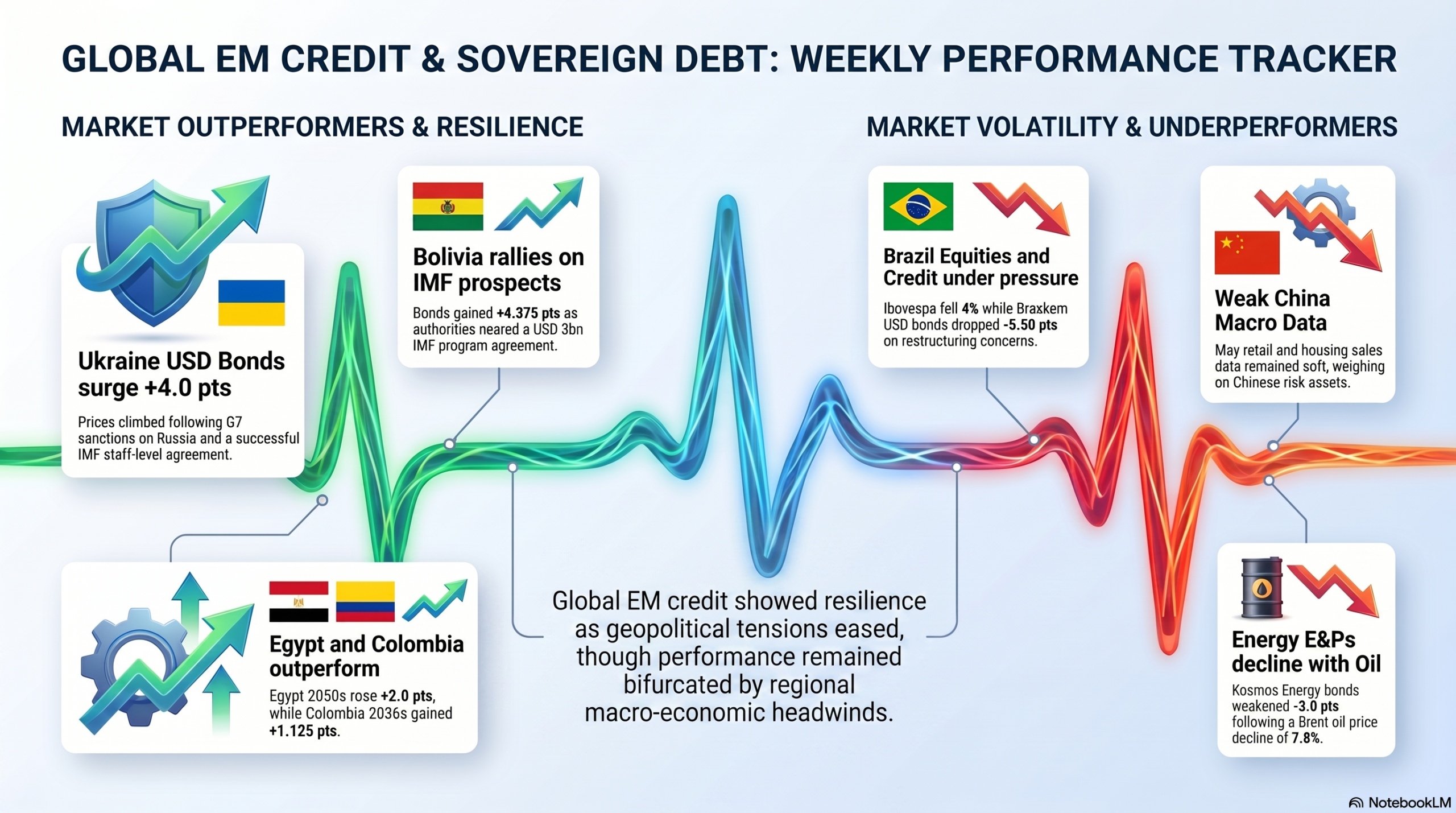
Regional Credit Developments
🌍 EM Ex-Asia Credit
- Global EM ex-Asia: Credit was mixed but resilient as risk recovered late WoW on easing geopolitics, though higher UST yields and hawkish Fed tone limited gains.
- Egypt / Turkey: Egypt 2033s/2050s rose +1.125pts/+2.0pts while Turkey 2036s/2047s gained +0.625pts/+0.75pts on lighter positioning and lower oil.
- MENA IG / CEE: MENA IG was mixed with selling in oil-linked curves; CEE choppy on Romania headlines, though Hungary supported ahead of expected 25bp cut.
- LatAm Sovereigns: Broad tightening with Argentina 2035s +0.25pts (‑7bp), Brazil 2035s +0.75pts (‑11bp), Colombia 2036s +1.125pts (‑11bp), DR 2035s +0.625pts (‑8bp).
- Brazil Flows: Local risk weak with Ibovespa -4% and Petrobras -10%, alongside largest equity fund outflows in 15 weeks; credit focus on Braskem and Raízen.
- Primary Market: Issuance remained open but light at ~USD 7bn, including Banorte, Southern Copper, Volcan, OTP and PKO.
- Africa E&Ps: Kosmos upgraded to Caa2 (Positive) but bonds fell -3.0pts to -1.0pts; Tullow and Gran Tierra also down -2.0pts to -1.25pts on lower oil.
- Kenya / Ghana: Kenya passed KES 18.2bn mini-budget with supportive secondary demand; Ghana secured USD 300m World Bank financing.
- Lebanon: Bonds down ~-1.0pts amid ongoing regional tensions, with IMF reform clarification deadline set for 25 June and ceasefire renewed late Friday.
- Ukraine: Strong performance with A bonds +1.125pts to +2.0pts and B bonds +1.875pts to +4.0pts on IMF SLA and USD 4bn pledged military aid.
- Argentina / Bolivia: Argentina +0.125pts to +0.25pts on USD 2bn WB guarantee and USD 2bn trade surplus; Bolivia +1.125pts to +4.375pts on IMF program progress.
- Colombia: 2036s and 2054s gained +1.125pts/+1.50pts into run-off vote, with spreads -11bp/-4bp and improving polling momentum.
- LatAm HY: Digicel upgraded to B1 (+0.50pts), CSN +1.0pts to +4.0pts on asset sale process, while Braskem fell -5.50pts to -3.0pts on restructuring concerns.
🇨🇳 Asia Credit: China Property & HY
- China Macro: Weak May data with soft retail and housing sales drove underperformance in Chinese risk assets versus global equities.
- Genting: Perpetuals fell ~-0.5pts following withdrawal of SGD deal, raising supply overhang for USD perpetuals.
🌏 Asia Credit: Frontier & Sovereign
- Global Macro: Brent fell -7.8% on US–Iran agreement while hawkish Fed drove UST flattening, tempering late-week risk-on sentiment.
- Pakistan / Sri Lanka: Long-end bonds rallied ~+2pts supported by lower oil prices.
- Indonesia Sovereign: Stabilisation after BI hiked rates by 25bp, extending tightening cycle.
- Garuda Indonesia: 2031 bonds outperformed, rising ~+3pts WoW.
- Woodside: Curve tightened ~5bp on M&A speculation before being denied.
- Laisun: Bonds rose ~+2pts into low 90s following exchange offer launch with terms broadly as expected.
www.gembridgecapital.com
DISCLAIMER
This document is strictly confidential and is being provided to you for informational purposes only. It does not constitute an offer to sell or a solicitation of an offer to buy any securities or financial instruments. The information contained herein has been obtained from sources believed to be reliable but is not guaranteed as to accuracy or completeness. Opinions and estimates constitute our judgment as of the date of this material and are subject to change without notice.
AI Generation Notice: Portions of this content may have been generated or assisted by Artificial Intelligence (AI) technologies. Users should independently verify critical data points. Past performance is not indicative of future results.
Executive Summary: Emerging market credit traded with a constructive tone, supported by ongoing multilateral funding and improving sovereign credit momentum, particularly in Argentina and Ukraine. Price action was led by restructuring-driven gains in select LatAm corporates, while weaker credits underperformed on refinancing risks. Asia HY remained broadly stable with pockets of idiosyncratic volatility, and profit taking emerging after recent rallies. Frontier sovereigns benefited from softer oil prices and improved sentiment, with Indonesia supported by policy actions and renewed primary issuance.
Market Visualizer
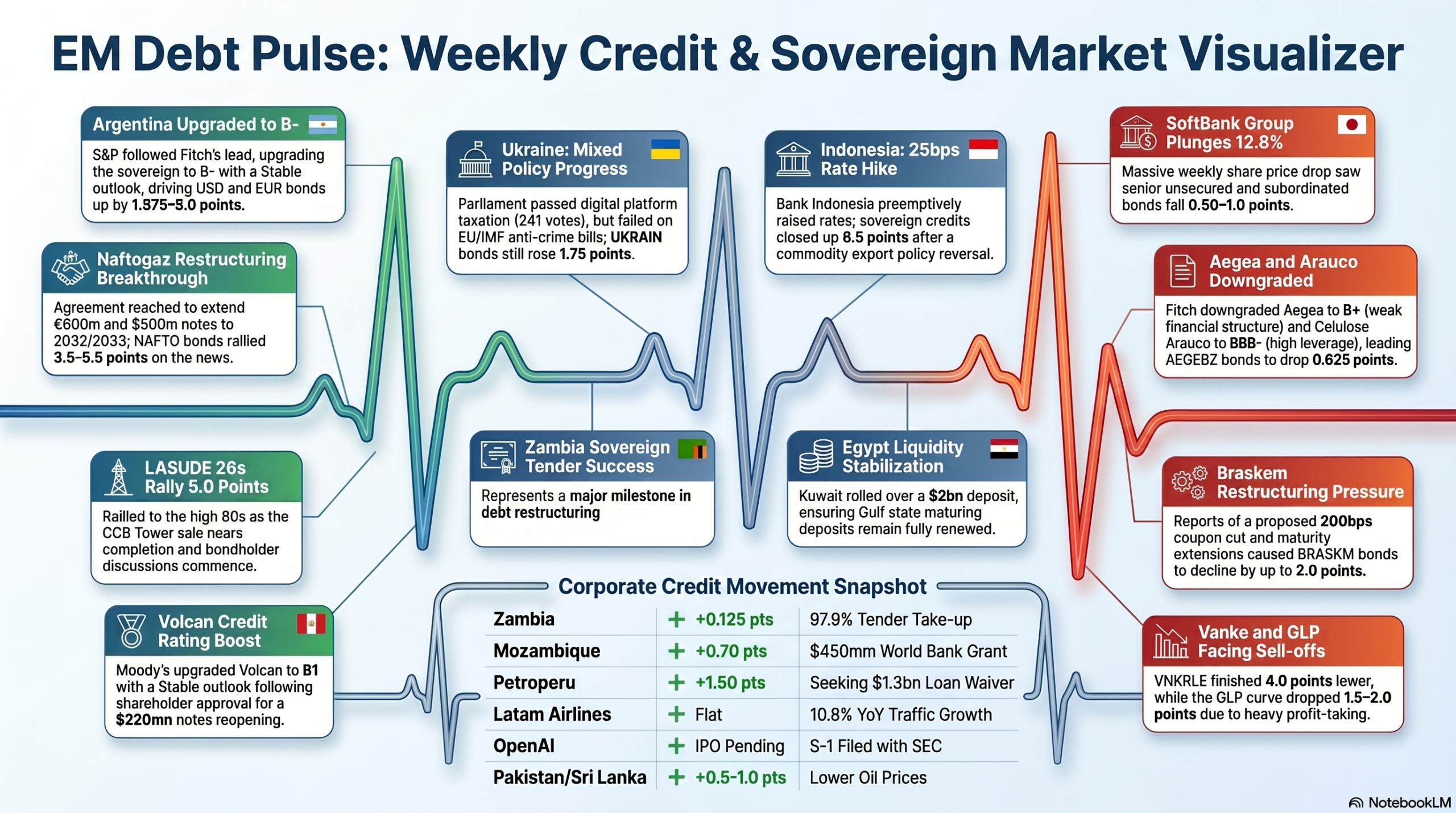
Regional Credit Developments
🌍 EM Ex-Asia Credit
- Argentina: S&P upgraded sovereign to B- (Stable); USD bonds +1.375–3.0 pts, EUR bonds +1.875–3.0 pts, GDP warrants +0.375–0.75 pts WoW.
- Ukraine: Partial reform progress with IMF tranche approved; EUR 8.35bn EU support expected; bonds +1.0–1.75 pts.
- Zambia: 97.9% participation in eurobond tender; 2033 bonds +0.125 pts.
- Mozambique: $450mm World Bank grant secured; 2031 bonds +0.70 pts.
- Egypt: Gulf deposits fully rolled including USD2bn Kuwait rollover; bonds flat to +0.875 pts (2033s +0.375, 2050s +1.875).
- Naftogaz: Restructuring agreed with maturity extensions and 8.95% coupons; bonds +3.5–5.5 pts.
- CSN: Advancing restructuring and BRL12–13bn asset sale discussions; bonds +1.375–2.125 pts.
- Brazil Airlines: Applying for BRL5.5bn BNDES program; AZULBZ/GOLLBZ unchanged, Latam flat.
- Aegea: Downgraded to B+ on weaker financial profile; bonds -0.375–0.625 pts.
- Braskem: Exploring restructuring terms including maturity extension and coupon cuts; bonds -1.0–2.0 pts.
- Celulosa Arauco: Downgraded to BBB- on higher leverage; bonds flat.
- Volcan: Upgraded to B1 with new issuance plans; bonds unchanged.
- SoftBank: Equity -12.8%; bonds -0.50 to -1.0 pts.
- Petroperu: Seeking CESCE waiver ahead of payment deadlines; bonds +1.50 pts (2032s) and +0.25 pts (2047s).
🇨🇳 Asia Credit: China Property & HY
- China/HK HY: Mixed week; China HY +0–0.25 pts with HK credits outperforming.
- Lasu De / HK Credits: LASUDE 26s +4–5 pts on asset sale progress; demand in NWD perps and LIFUNG.
- Vanke: Bonds -4 pts WoW.
- GLP: Curve -1.5–2.0 pts on profit taking.
- Vedanta: Tender and new issuance roadshow; bonds +0.25 pts.
🌏 Asia Credit: Frontier & Sovereign
- Pakistan & Sri Lanka: Bonds +0.5–1.0 pts on lower oil prices.
- Indonesia (Macro): BI hiked rates 25bps; JCI +7.4% on improved sentiment.
- Indonesia (Primary): Danantara issued $1.5bn; sovereigns +0.25–0.5 pts, quasis mixed.
- Indonesia HY: HY -0.25–0.5 pts with INDYIJ and JAPSP outperforming.
www.gembridgecapital.com
DISCLAIMER
This document is strictly confidential and is being provided to you for informational purposes only. It does not constitute an offer to sell or a solicitation of an offer to buy any securities or financial instruments. The information contained herein has been obtained from sources believed to be reliable but is not guaranteed as to accuracy or completeness. Opinions and estimates constitute our judgment as of the date of this material and are subject to change without notice.
AI Generation Notice: Portions of this content may have been generated or assisted by Artificial Intelligence (AI) technologies. Users should independently verify critical data points. Past performance is not indicative of future results.
Executive Summary: Global equity markets sold off sharply Friday on stronger US jobs data, raising Fed hike concerns, while EM aggregate spreads tightened modestly by 2bp with $15.3bn in hard-currency issuance and $0.9bn in fund inflows. Indonesia’s risk assets experienced heavy selling with JCI down 8.7% and IDR above 18,000, while China HY credit closed firmer with most benchmark names modestly higher. CEEMEA dominated by Iran-related headlines as talks halted mid-week following Israeli airstrikes, though Lebanon ceasefire announced and later disputed.
Market Visualizer
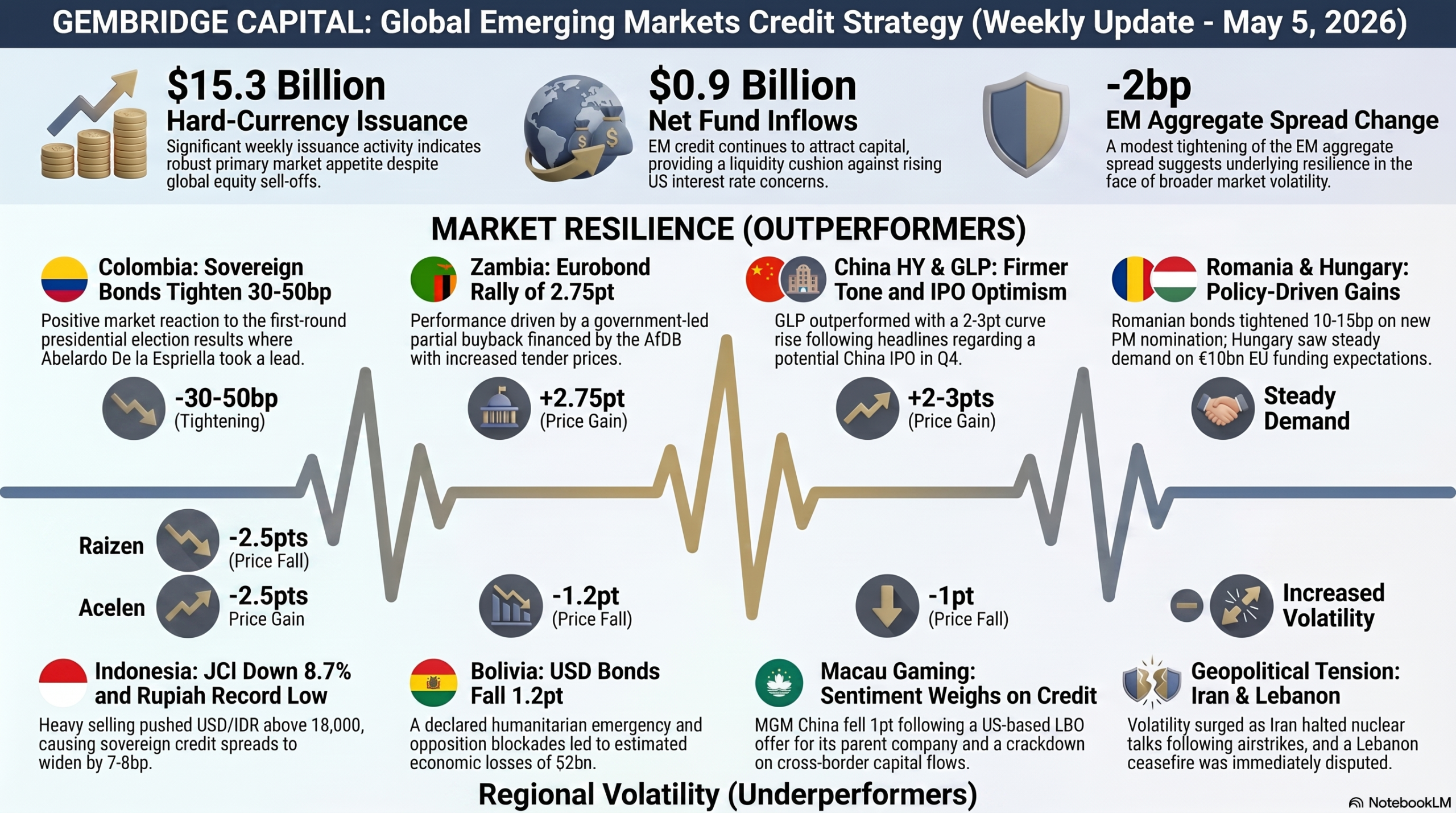
Regional Credit Developments
🌍 EM Ex-Asia Credit
- Indonesia: JCI fell 8.7% on the week with USD/IDR moving above 18,000 (all-time low for rupiah). Indonesia IG sovereign and quasi-sovereign USD credit widened 7-8bp, while Indonesia HY USD bonds fell 0.5-1.0pt. Sovereign wealth fund Danantara conducted roadshow for debut USD bonds.
- Colombia: Sovereign USD bonds tightened 30-50bp and ECOPET compressed 50-66bp following first-round presidential election where Abelardo De la Espriella received 43.7% versus Cepeda’s 40.9%. Subsequent poll showed Espriella ahead by nearly 8 percentage points ahead of 21 June runoff.
- Bolivia: 2031 USD bonds fell approximately 1.2pt on week after government declared humanitarian emergency amid opposition blockades estimated at US$2bn economic losses. Multiple cabinet ministers resigned amid demands for President Paz’s departure.
- Zambia: 2053 Eurobonds rallied approximately 2.75pt after government launched partial buyback financed by AfDB and raised tender price to 82.3-84.4pt. Ad hoc bondholder group stated intention to participate.
- Iran: Tehran halted nuclear talks with Washington mid-week following Israeli airstrikes in Beirut. US intercepted Iranian ballistic missiles and drones targeting Kuwait and Bahrain on 3 June. Late in week Iran signaled negotiations could resume under US pressure for weekend deadline.
- Lebanon: Hezbollah and Amal Movement moderated stance on ceasefire with Israel. Israel-Lebanon ceasefire announced Thursday, followed by renewed fire within hours after Hezbollah’s leader criticized deal.
- Romania: President Dan nominated advisor Eugen Tomac as prime minister. Romanian EUR bonds tightened 10-15bp on the day.
- Hungary: Steady real-money and hedge-fund demand in bonds over week following headlines that government expects up to EUR10bn in EU recovery funding by year-end.
- Ukraine: Bonds volatile, selling off mid-week after Rubio signaled poor prospects for Russia-Ukraine deal. Bonds recovered Friday after President Zelensky published open letter to President Putin proposing direct peace talks and full ceasefire during negotiations.
- Senegal: President Faye dismissed Prime Minister Ousmane Sonko and retained Finance Minister Cheikh Diba in cabinet reshuffle. Authorities announced Friday payment arranged for following week’s coupon on FC-denominated bonds. Senegal USD bonds ended week +0.5 to +1.0pt.
- Ethiopia: IMF and authorities reached staff-level agreement on Extended Credit Facility review, making approximately US$468m available upon approval. Ethiopia sovereign bonds unchanged on week.
- Braskem: Reported considering maturity extensions, coupon reductions, and coupon grace periods for FC-denominated bonds. Bonds traded flat to +2pts on week.
- Raizen: Obtained sufficient creditor support for out-of-court restructuring plan. Bonds fell approximately 2.5pts over week.
- Grupo Televisa: Issued MXN-denominated convertible bonds equivalent to US$400m following shareholder approval in April, with stated use for potential M&A in sector. Televisa bonds roughly flat to +1.5pts on week.
- Acelen: Reported 1Q26 EBITDA of US$240m with 2Q EBITDA guidance over US$400m. Management indicated potential buybacks of USD notes toward year-end if cash levels more than sufficient. Bonds up approximately 1.25pts WoW.
- Aeromexico: Published May traffic data with 85.8% load factor. Airline bonds ended week broadly unchanged.
- Volcan: Fitch upgraded from B (Positive) to B+ (Stable) citing strong free cash flow generation. Bonds gained approximately 0.25pt on week.
🇨🇳 Asia Credit: China Property & HY
- China HY: Closed week on firmer tone with most benchmark names modestly higher despite global equity volatility. EM hard-currency spreads tightened modestly over week with EM Agg approximately 2bp tighter and CDXEM44 about 5ct firmer, supported by real-money inflows and local sponsorship with hedge-fund profit-taking and new-issue supply capping rallies.
- GLP: Notable outperformer with curve up around 2-3pts on week following renewed headlines regarding potential GLP China IPO in 4Q.
- VNKRLE: Outperformed with curve up roughly 1.5pts over week.
- Macau Gaming: Underperformed on week. MGM China down approximately 1pt and other Macau names around 0.5pt lower following Barry Diller’s US$12.4bn LBO offer for US-based MGM Resorts. China’s crackdown on illegal cross-border capital flows weighed on broader financial-sector sentiment.
🌏 Asia Credit: Frontier & Sovereign
- Japan Credit: Started week firm but ended mixed as selling interest increased toward latter part of week.
- SoftBank Group: Priced JPY260bn onshore subordinated bonds at JGB +316bp, broadly in line with previous JPY418bn subordinated deal in April. Senior USD bonds finished roughly unchanged to +0.5pt while USD hybrids gained around 1.5pts over week prior to US tech-led sell-off Friday.
- NWD: Bonds unchanged to modestly higher following announcement of advanced talks with Aravest on sale of 50% stake in three Hong Kong hotels for US$1.8bn and ongoing discussions with Hong Kong Airport Authority on cash settlement to terminate obligations related to 11 Skies mall project.
www.gembridgecapital.com
DISCLAIMER
This document is strictly confidential and is being provided to you for informational purposes only. It does not constitute an offer to sell or a solicitation of an offer to buy any securities or financial instruments. The information contained herein has been obtained from sources believed to be reliable but is not guaranteed as to accuracy or completeness. Opinions and estimates constitute our judgment as of the date of this material and are subject to change without notice.
AI Generation Notice: Portions of this content may have been generated or assisted by Artificial Intelligence (AI) technologies. Users should independently verify critical data points. Past performance is not indicative of future results.
Gembridge Capital
Emerging Markets Credit Strategy
Ex-Asia EM credit traded in a defensive but functional market backdrop during the week, with primary issuance remaining open while secondary flow turned more selective. Geopolitical headlines dominated price action: President Donald Trump said a planned US strike on Iran was put on hold after requests from Gulf leaders, and mediated talks continued through the week around draft proposals, with no formal agreement announced.
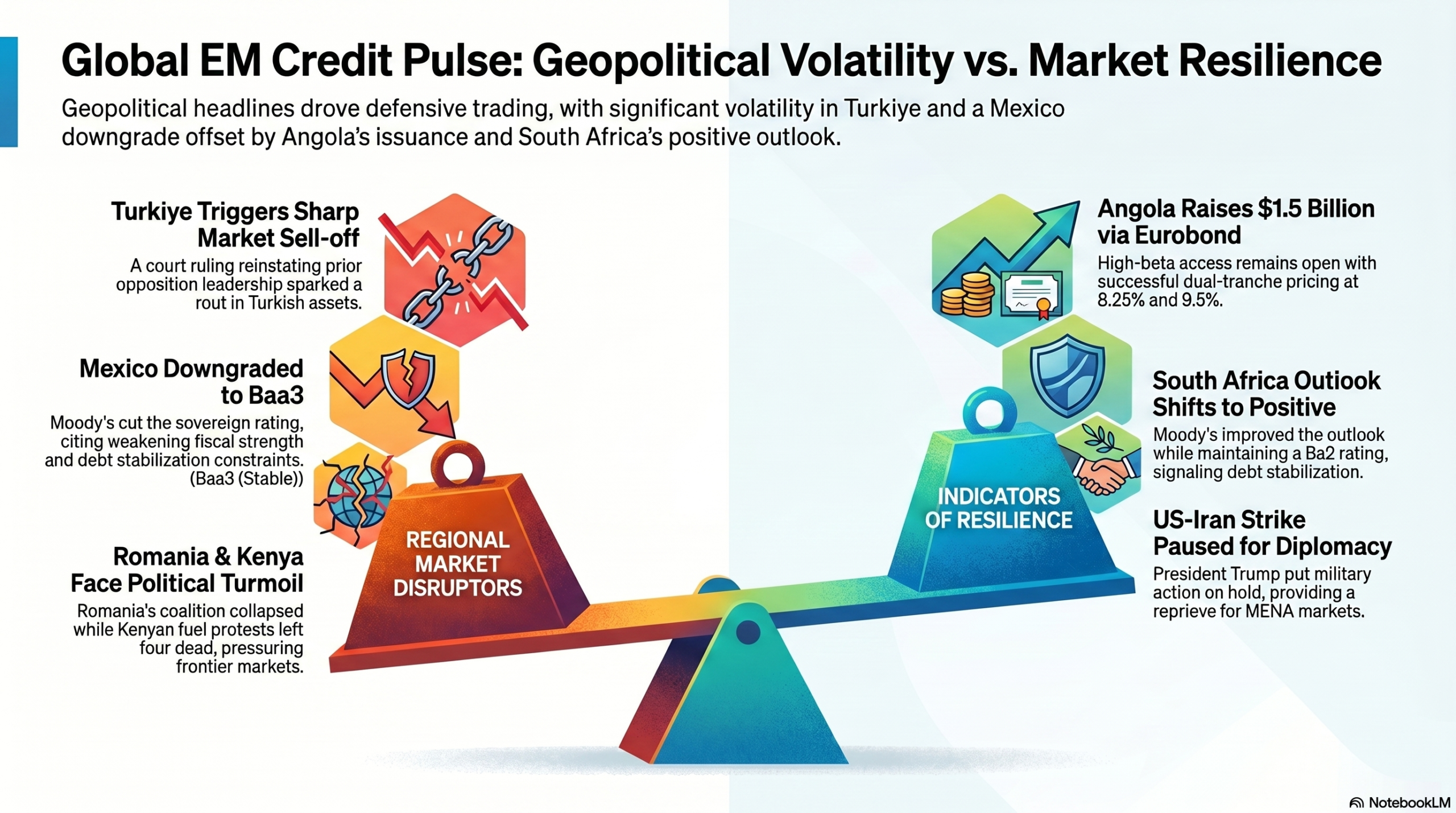
Ex-Asia EM credit
Activity in ex-Asia EM credit was shaped by geopolitical headlines rather than a broad deterioration in market access. The primary market remained open, while secondary trading was more defensive, with investors focused on domestic political risk and idiosyncratic credit events.
CEEMEA
Turkiye was the clear underperformer. A Turkish court annulled the CHP’s 2023 congress, effectively removing Ozgur Ozel and reinstating the prior party leadership. Turkish assets sold off following the ruling, and the central bank was reported to have sold billions of dollars in FX reserves to steady markets.
Romania’s pro-European coalition collapsed following a no-confidence vote, extending a period of political instability. In frontier CEEMEA, Kenya came under pressure early in the week after protests over fuel price increases left four people dead; the government subsequently moved to cut diesel prices and secured a suspension of the public transport strike.
Ukraine traded firmer on the back of military and policy headlines. The US Defense Intelligence Agency said Ukraine had retaken approximately 400 square kilometres this year after Russian-operated Starlink terminals were deactivated, and the US State Department approved a possible US$108 million foreign military sale for Hawk missile system sustainment and related equipment.
MENA
MENA investment-grade tone was relatively constructive. Egypt’s central bank held its overnight deposit rate at 19% and lending rate at 20%, leaving policy unchanged this week. Saudi sovereign cash bonds were comparatively resilient amid rotation within the Gulf complex, and Lebanon cash trading saw firmer tone over the week.
Sub-Saharan Africa
Angola raised US$1.5 billion through a dual-tranche Eurobond deal, with notes maturing in 2031 and 2037 priced at 8.25% and 9.5% respectively. Secondary flow across Sub-Saharan Africa was generally skewed to selling, particularly in higher-beta names.
After Friday’s close, Moody’s changed South Africa’s outlook to positive while maintaining the Ba2 rating.
Latin America
Latin American sovereign credit traded broadly range-bound during the week. Mexico was the main ratings event: Moody’s downgraded the sovereign to Baa3 from Baa2 and changed the outlook to stable from negative, citing weakening fiscal strength and constraints related to debt stabilisation.
Brazilian political headlines remained in focus, while sovereign spread moves were relatively contained compared with the sharper moves in corporates and quasi-sovereigns. In Peru, polling for the presidential runoff showed a modest lead for Keiko Fujimori over Pedro Sanchez.
At the corporate level, Moody’s downgraded Brazil’s CSN to Caa1 from B2 with a negative outlook maintained, citing expectations of weak credit metrics and elevated distressed-exchange risk. Moody’s and Fitch each took negative rating actions on Amaggi following the company’s announcement of the acquisition of a 40% stake in FS Industria de Biocombustiveis; bond price reaction was limited by week-end.
Mexican financials were volatile after market chatter around possible US sanctions on a large Mexican financial institution prompted selling across parts of the bank capital structure, with some stabilisation later in the week. Regional airline credits traded firmer after April traffic data from Abra Group carriers Avianca and Gol showed capacity and demand growth, in line with figures already reported by Latam Airlines and Aeromexico.
Other market developments
Outside EM sovereign credit, AI-linked equities and select credit moved higher during the week. Bloomberg reported that OpenAI is preparing to file for an IPO in the coming weeks and is targeting a fall listing. ARM Holdings rallied sharply following Nvidia-related news, and SoftBank shares and long-dated hybrid bonds also moved higher.
Ratings monitor
| Sovereign / Issuer | Agency | Action |
|---|---|---|
| Mexico | Moody’s | Downgrade to Baa3 from Baa2; outlook changed to stable from negative |
| South Africa | Moody’s | Outlook changed to positive; rating affirmed at Ba2 |
| Brazil — CSN | Moody’s | Downgrade to Caa1 from B2; negative outlook maintained |
| Brazil — Amaggi | Moody’s / Fitch | Negative rating actions following announced 40% stake acquisition in FS Industria de Biocombustiveis |
Core sovereign rating profiles across major Gulf and Central European names were unchanged on the week outside the actions above.
Executive Summary: EM sovereign hard currency spreads tightened by around 5bp on the week, and CDX EM indices closed tighter. Primary supply totalled approximately USD 22 billion across the week, with most new issues trading above reoffer. Hard currency funds recorded outflows while local currency funds recorded inflows. Outperformers on the week included Egypt, Kenya, Turkey, Argentina and Venezuela; underperformers included Senegal, Angola, Colombia and Romania, with Romania still finishing somewhat tighter on spread despite relative underperformance.
Market Visualizer

Sovereign Movers
🇺🇦 Ukraine
- Q1 2026 GDP: –0.5% YoY, versus Bloomberg consensus of +0.5% YoY.
- UKRAIN bonds: Line A +1.2 pts, line B +0.75 pts, line C +0.875 pts on the week. [source]
🇷🇴 Romania
- Politics: Parliament passed a motion of no-confidence on Tuesday, ousting the prime minister.
- ROMANI bonds: Underperformed regional peers but finished approximately 5–10bp tighter on spread, with cash prices +0.375 to +0.75 pts on the week.
🇵🇪 Peru
- Election count: With 97.9% of votes counted on the ONPE platform, Roberto Sánchez held a lead of close to 26,000 votes over Rafael López Aliaga for second place and a runoff spot against Keiko Fujimori.
- 10y PERU bonds: Broadly unchanged on the week.
🇻🇪 Venezuela
- OFAC action: US Treasury issued a general license authorizing certain legal, financial advisory and consulting services to the Venezuelan government and PDVSA in connection with potential debt restructuring preparations. The license does not authorize any actual restructuring or settlement of debt, nor direct negotiations with creditors.
- VENZ / PDVSA complex: Approximately +1.5 pts on the week. [source]
🇦🇷 Argentina
- Ratings: Fitch upgraded long-term foreign-currency and local-currency IDRs to B− from CCC+, stable outlook (May 5, 2026), citing improved fiscal and external metrics and progress on reforms.
- ARGENT complex: +0.5 to +1.375 pts across the curve on the week. [source]
Regional Highlights
🌍 MENA & GCC
- Egypt: CDS tighter by approximately 60bp on the week, with reported flows from regional investors including Kuwait.
- Turkey: Approximately 15–20bp tighter on the week.
- GCC: Sovereign and quasi-sovereign spreads tighter; Saudi PIF placed a USD 7 billion multi-tranche deal, absorbed without visible secondary dislocation.
🌍 CEEMEA ex-MENA
- Hungary & Poland: Stable to slightly tighter on the week, with no major macro or political surprises.
- Pakistan: External financing and reserve dynamics remained part of market commentary; IMF support continues to be referenced.
🌍 Africa
- Kenya: Outperformed; oil-importer status referenced alongside the lower-than-peak oil price backdrop.
- Senegal: Bonds weaker amid renewed political instability.
- Angola: Bonds weaker, with market focus on oil-price sensitivity and fiscal metrics.
- Nigeria: External curve broadly stable; ongoing reform efforts, including the absence of fuel subsidies, remain part of market commentary.
🌎 Latin America
- Colombia: Bonds wider on the week amid heightened political headlines.
- Mexico & Brazil: Steady, incremental spread tightening over the week.
Corporate & Sector Developments
- DTEK Oil & Gas (DTEKOG): Announced sufficient bondholder consents to amend the terms of its 2026 bonds and proceed with an exchange. Bonds broadly unchanged on the week.
- Acelen (MCBRAC): Held Q4 2025 results call on Monday with Q1 2026 guidance characterised as strong. Bonds +0.5 pts on the week.
- Movida (MOVIBZ): Q1 2026 EBITDA BRL 1.57 bn, +17% YoY, slightly above Bloomberg consensus of BRL 1.55 bn. Bonds +0.75 pts on the week.
- Latam Airlines (LTMCI) & Azul (AZUBBZ): Both released Q1 2026 results, noting higher oil prices as a Q2 factor. LTMCI +0.625 pts; AZUBBZ +2.625 pts on the week.
- Aeromexico (AEROMX): April traffic — consolidated ASM flat YoY (domestic −1%, international +1%); RPM flat YoY; load factor 86.1%, +0.2 pts YoY. Bonds +2.25 pts on the week.
www.gembridgecapital.com
DISCLAIMER
This document is strictly confidential and is being provided to you for informational purposes only. It does not constitute an offer to sell or a solicitation of an offer to buy any securities or financial instruments. The information contained herein has been obtained from sources believed to be reliable but is not guaranteed as to accuracy or completeness. Opinions and estimates constitute our judgment as of the date of this material and are subject to change without notice.
AI Generation Notice: Portions of this content may have been generated or assisted by Artificial Intelligence (AI) technologies. Users should independently verify critical data points. Past performance is not indicative of future results.